Cancer has a lot of side effects. The nausea, the fatigue, the hair loss - you know the usual suspects. But there's another one that doesn't show up on prescription warning labels: financial ruin. Oncologists have started calling it "financial toxicity," and yes, that's the actual medical term now. Apparently, when researchers at Duke coined it back in 2013, they wanted to emphasize that draining your bank account can be just as devastating as the chemo draining your white blood cells.
So here's a question that sounds simple but absolutely isn't: What if we just... gave cancer patients money?
The Problem Nobody Wants to Talk About
Here's the uncomfortable math. About 56% of American adults experience some form of financial toxicity from healthcare costs. For cancer patients specifically, somewhere between 40-50% deal with material or psychological stressors tied to treatment expenses. And we're not just talking about hospital bills - we're talking about the gas to get to appointments, the parking that costs $40 a pop, the meals, the lost wages from missed work.
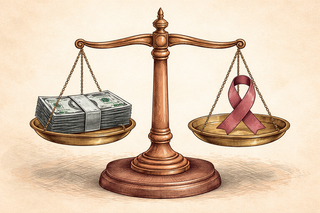
This creates a nasty feedback loop. Research shows that financial hardship connects to anxiety, depression, greater pain, skipped treatments, and - here's the kicker - actual mortality. Being broke can literally kill you faster than cancer.
Enter the Cash Transfer Conundrum
Some researchers are now testing what happens when you hand cancer patients actual money. The GIFTT trial (Guaranteed Income and Financial Treatment Trial) at Penn is giving low-income cancer patients $1,000 per month for a year, no strings attached. Dr. Kira Bona at Dana-Farber developed Pediatric RISE, which provides direct cash transfers to low-income families during their child's chemotherapy.
The early logic is compelling. If poverty independently predicts worse outcomes even when treatment is identical, then maybe we should treat poverty like we treat any other risk factor - with an intervention.
But this is where ethics gets deliciously complicated.
The "Undue Inducement" Handwringing
For decades, ethicists and IRBs have worried about something called "undue inducement." The concern goes like this: if you pay research participants too much, desperate people might ignore risks just to get the cash. It sounds reasonable until you actually talk to cancer patients.
One lung cancer patient advocate put it bluntly: "The inducement piece, the 'undue influence' factor, is just crap, because I'm only induced by my impending mortality."
There's also a delicious irony here. The rules meant to protect low-income people from being exploited have actually created the opposite effect - clinical trials skew wealthy and white because only people who can absorb extra costs participate. When participating costs you $40 each visit, you've essentially hung a "rich people only" sign on your groundbreaking research.
Designing Money Transfers That Don't Backfire
This is precisely what the new Journal of Clinical Oncology paper from Hantel and colleagues tackles. How do you give cancer patients money without creating new ethical problems?
The considerations are genuinely tricky. Give too little and you're just performative. Give too much and regulators panic about inducement. Make it conditional and you've added bureaucratic hoops for people already exhausted by treatment. Make it unconditional and someone will complain about "handouts."
Then there's the question of who gets the money. Studies show that existing interventions disproportionately reach non-Hispanic white patients - the demographic that often needs financial support least. Any well-designed program has to actively counter this tendency.
The Bigger Picture
What makes this conversation fascinating is that it forces oncology to grapple with something medicine often ignores: context matters. You can have the most brilliant cancer treatment ever developed, but if patients can't afford to show up for infusions, it's worthless.
Dr. Bona's approach at Dana-Farber treats poverty as something "druggable" - a condition you can target with specific interventions. It sounds radical until you realize that nearly 30% of pediatric cancer families experience food, energy, or housing insecurity during treatment. At that point, a gift card for groceries isn't charity - it's medicine.
The ethical frameworks are still being built. But the underlying question has shifted from "should we give cancer patients money?" to "how do we do it right?" That's progress, even if the answers remain complicated.
References
-
Hantel A, Williams CP, Nipp RD, et al. Ethical Design and Implementation of Monetary Transfer Interventions in Clinical Cancer Research. J Clin Oncol. 2026. DOI: 10.1200/JCO-25-02606
-
Doherty M, et al. Guaranteed Income and Financial Treatment Trial (GIFTT). Front Psychol. 2023. PMCID: PMC10234289
-
Kelly MJ, et al. Pediatric RISE: Development of a Poverty-Targeted Cash Support Intervention for Pediatric Cancer. Pediatr Blood Cancer. 2024. DOI: 10.1002/pbc.32103
-
Nipp RD, et al. Addressing the Financial Burden of Cancer Clinical Trial Participation: Longitudinal Effects of an Equity Intervention. The Oncologist. 2019. PMCID: PMC6693715
-
Bona K, et al. Household material hardship in families of children post-chemotherapy. Pediatr Blood Cancer. 2018. PMCID: PMC6042835
-
National Cancer Institute. Financial Toxicity and Cancer Treatment (PDQ). 2024. https://www.cancer.gov/about-cancer/managing-care/track-care-costs/financial-toxicity-pdq
Disclaimer: The image accompanying this article is for illustrative purposes only and does not depict actual experimental results, data, or biological mechanisms.
Get cancer research delivered to your inbox
The best new studies, explained without the jargon. One email per week.