Pancreatic cancer has been running circles around modern medicine for decades. With a five-year survival rate stubbornly parked at 13% and checkpoint immunotherapy benefiting fewer than 1% of patients, PDAC (pancreatic ductal adenocarcinoma, for those who like their acronyms painful) has earned its reputation as the oncology world's final boss. But a team of Danish researchers just published something that reads less like a standard cancer paper and more like a heist movie script - they figured out how to turn the tumor's own shield into a target.
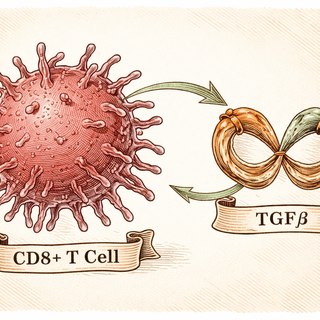
Meet TGFβ: The Ultimate Double Agent
TGFβ (transforming growth factor beta) starts its career as a legitimate good guy. In healthy tissue, it keeps cell growth in check and even triggers self-destruct sequences in cells that start misbehaving. Solid credentials for a tumor suppressor.
But here's where the plot thickens. Once cancer gets established, TGFβ switches teams. It starts cranking up fibrosis around the tumor - building what amounts to a biological panic room - while simultaneously telling your immune cells to stand down. Your T cells show up ready to fight, and TGFβ essentially hands them a cup of chamomile tea and a blanket. The killer instinct? Gone. The proliferation signals? Muted. Worse still, TGFβ actively recruits regulatory T cells, the immune system's internal affairs division, to shut down any remaining resistance.
In pancreatic cancer specifically, this betrayal is devastating. PDAC tumors are notoriously "cold" - meaning they create an environment so immunosuppressive that even our best checkpoint inhibitors can't get a foothold (Christenson et al., 2025).
The Judo Move: Vaccinating Against the Bodyguard
Rather than trying to block TGFβ with drugs (which has a mixed track record because, remember, TGFβ also does useful things elsewhere in your body), the team led by Ruders, Ahmad, and colleagues at Copenhagen's Herlev Hospital tried something cleverer. They designed a vaccine that trains the immune system to recognize and kill cells producing TGFβ.
Think of it this way: instead of trying to intercept every shady message TGFβ sends, you just take out the corrupt mailroom.
The team identified three TGFβ-derived epitopes - little protein fragments the immune system can learn to recognize - designated TGFβ-15, TGFβ-33, and TGFβ-38. Testing blood from both healthy volunteers and PDAC patients, they found T cell responses against all three, with TGFβ-33 triggering especially strong reactions in cancer patients. These weren't just any T cells, either. The responders were primarily CD4+ helper T cells that showed both pro-inflammatory signaling AND direct cell-killing ability - the immunological equivalent of a diplomat who also happens to be a black belt (Ruders et al., 2026).
More Targets, Better Outcomes
The real headline-grabber: patients who already had natural T cell responses against multiple TGFβ epitopes at baseline lived significantly longer - both in overall survival and progression-free survival - compared to those responding to just one or none. This wasn't after vaccination; this was their immune system already doing the work before treatment even started. The correlation held up in patients receiving combined checkpoint inhibitors and radiotherapy.
This builds on earlier work from the same group showing that TGFβ-specific T cell immunity predicted survival outcomes after checkpoint-plus-radiotherapy combos (Holmström et al., 2023; PMID: 36948507), and mouse model studies where TGFβ vaccination reshaped the entire tumor microenvironment from a fibrotic fortress into something the immune system could actually infiltrate (Ahmad et al., 2022; PMID: 36600556).
One mRNA Shot, Multiple Targets
Perhaps the most forward-looking piece of this study: the team built a single mRNA construct encoding all the key TGFβ epitopes and showed it could activate T cells against each one simultaneously. One shot, multiple immune responses activated. If that sounds familiar, it's the same platform logic behind mRNA COVID vaccines - except here the target isn't a spike protein, it's the tumor's favorite bodyguard.
The mRNA approach also opens the door to combination strategies. Pair a TGFβ vaccine with checkpoint inhibitors (to remove the brakes on T cells) and radiotherapy (to expose more tumor antigens), and you start building what immunologists would call a "hot" tumor microenvironment - one where immune cells can actually show up, get in, and do their job (Ahmad et al., 2024; PMID: 38417917).
What This Means (and What It Doesn't - Yet)
Let's keep our feet on the ground. This is still preclinical and correlative data, not a Phase III trial readout. Nobody is curing pancreatic cancer with a TGFβ vaccine tomorrow. But the logic is elegant and the evidence is stacking up: TGFβ is a linchpin of PDAC's immune evasion strategy, patients whose immune systems naturally target it do better, and we now have a way to synthetically induce that response with a single mRNA vaccine.
For a cancer that has resisted nearly every immunotherapy thrown at it, that's not a small thing. The tumor microenvironment in PDAC has been described as a fortress, a swamp, and a bureaucratic nightmare all at once. This research suggests we might finally have the right set of keys - not to storm the gates, but to dismantle them from the inside.
References
-
Ruders JH, Ahmad SM, Mortensen REJ, et al. Rationale for multi-epitope TGFβ vaccination in pancreatic cancer: evidence from immunologic and clinical correlates. Signal Transduct Target Ther. 2026. DOI: 10.1038/s41392-026-02626-3
-
Ahmad SM, Martinenaite E, Holmström MO, et al. TGFβ-derived immune modulatory vaccine: targeting the immunosuppressive and fibrotic tumor microenvironment in a murine model of pancreatic cancer. J Immunother Cancer. 2022;10(12):e005491. PMID: 36600556. PMCID: PMC9730419
-
Holmström MO, Mortensen REJ, Ahmad SM, et al. Pre-existing TGF-β-specific T-cell immunity in patients with pancreatic cancer predicts survival after checkpoint inhibitors combined with radiotherapy. J Immunother Cancer. 2023;11(3):e006432. PMID: 36948507. PMCID: PMC10040073
-
Ahmad SM, Ruders JH, Holmström MO, et al. TGFβ-specific T cells induced by a TGFβ-derived immune modulatory vaccine both directly and indirectly modulate the phenotype of tumor-associated macrophages and fibroblasts. Cell Mol Immunol. 2024. PMID: 38417917
-
Ahmad SM, Holmström MO, Martinenaite E, et al. Novel immune modulatory vaccines targeting TGFβ. Cell Mol Immunol. 2023;20(7):834-836. PMCID: PMC10040921
Disclaimer: The image accompanying this article is for illustrative purposes only and does not depict actual experimental results, data, or biological mechanisms.
Get cancer research delivered to your inbox
The best new studies, explained without the jargon. One email per week.