Hold on to your lab goggles, folks, because we're diving into the cellular underworld of pancreatic cancer—a place where the good, the bad, and the fibroblasts play a high-stakes game of hide and seek. Spoiler alert: the fibroblasts aren't exactly team players.
The Plot Thickens: Tertiary Lymphoid Structures
Picture a tumor as a sketchy neighborhood, full of cellular rebels trying to outsmart your immune system, the 24/7 security team. Now, what if I told you that some tumors have their own mini-police stations called tertiary lymphoid structures (TLSs)? These TLSs are like pop-up fortresses for immune cells, and they're associated with better survival rates in pancreatic cancer. But here's the twist—these immune fortresses don't just pop up anywhere. Some tumors are like gated communities, keeping the TLSs out. So, what's the deal?
Fibroblasts: The Unlikely Suspects
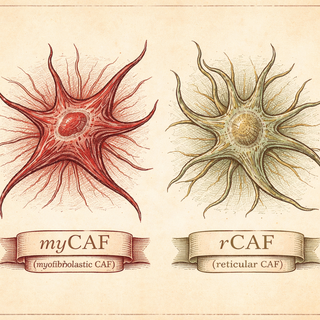
Enter the fibroblasts, the unsung interior decorators of the tumor microenvironment. In this story, we have two main types: myofibroblastic CAFs (myCAF), the bouncers that keep the TLSs at bay, and reticular CAFs (rCAF), the welcoming party that rolls out the red carpet for TLSs. Research is now shining a spotlight on how these fibroblasts influence the formation of TLSs, and believe it or not, it's all about whether they’re feeling more ‘myCAF’ or ‘rCAF’ today.
The Fibroblast Face-Off: MyCAF vs. rCAF
In this cellular showdown, myCAFs are like overzealous security guards, blocking the signals that would otherwise call in the TLS cavalry. They have this annoying habit of hogging the spotlight and preventing chemokines and lymphocytes from following the scent trail to the tumor. Meanwhile, rCAFs are the chill party planners, creating an inviting scene for TLSs to gather and help fend off the cancer.
The Science Behind the Drama
Research published in Cancer Cell (cue the dramatic music) used a lymphotoxin beta receptor (LTBR) agonist to induce TLS-aggregates in certain pancreatic cancer models. Turns out, the models showing resistance to TLS formation were infested with myCAFs. However, when researchers combined LTBR agonism with a TGFβ receptor inhibitor, the script flipped—myCAFs were temporarily sidelined, allowing TLSs to roll in and bolster the immune response.
Real-World Implications: The Pancreatic Plot Twist
If you’re thinking this sounds like a science fiction plot, remember it’s all happening in the microscopic reality of pancreatic cancer. By understanding how to coax those myCAFs into a more rCAF-like behavior, we could potentially open up a new front in the war against cancer, especially for a notoriously tough customer like pancreatic ductal adenocarcinoma (PDAC).
The Takeaway: Rewriting the Cellular Script
So, the next time you hear about fibroblasts, remember: they're not just supporting actors. With the right push, they might just play a leading role in reprogramming the tumor microenvironment. Could this be the key to unlocking more effective cancer therapies?
Stay tuned, because in the world of cancer biology, the only thing that’s predictable is the plot twist.
Disclaimer: The image accompanying this article is for illustrative purposes only and does not depict actual experimental results, data, or biological mechanisms.
References
- DOI: 10.1016/j.ccell.2026.03.004
- Additional references from recent related studies will enhance your understanding of this complex topic. Check out PubMed for more!
```
Get cancer research delivered to your inbox
The best new studies, explained without the jargon. One email per week.