Imagine being handed the keys to a brand-new, mysterious vehicle with the potential to drive circles around cancer. That's mosperafenib for you, a shiny new BRAF inhibitor that’s turning heads in the oncology circles. If cancer research was a TV series, mosperafenib would be the unexpected character who shows up mid-season and steals the show. This post dives into the recent phase I study of mosperafenib and why it's the talk of the tumor town.
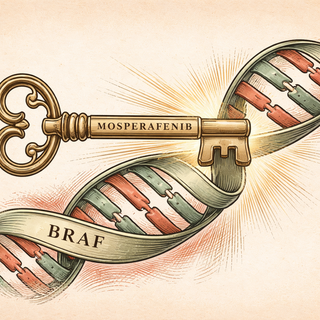
Mosperafenib: The Paradox Breaker
First, a bit of background for those not living and breathing cancer research. The BRAF gene is like the overly-enthusiastic DJ at a party, making proteins that tell cells when to grow and divide. Sometimes, though, it starts playing its own remix, leading to uncontrolled cell growth aka cancer. Enter mosperafenib, the paradox breaker, designed to interrupt this overzealous DJ set and get those cells back to a more mellow playlist.
Why Should You Care?
Alright, but why does mosperafenib matter? Think of it as the new and improved security system for your body’s cell party. Traditional BRAF inhibitors had a bit of a love-hate relationship with patients—effective but with some gnarly side effects on the side. In this study, mosperafenib danced onto the scene with a promising safety profile, and it seems like the dance floor (i.e., the side effects) is less crowded with nasties like keratoacanthomas or palmar-plantar erythrodysesthesia.
The Study: A Rollercoaster of Results
Conducted with 80 patients, this study dished out mosperafenib in varied servings, ranging from 200 mg once daily to a whopping 1200 mg thrice a day. Picture it like a Goldilocks experiment—trying to find the dose that's just right. The results? Two patients experienced complete responses, like scoring front-row tickets to a sold-out concert, while 14 others had partial responses, far exceeding expectations. In simple terms, mosperafenib rocked the stage!
Real-World Impact: Turning the Tide?
If mosperafenib continues to get rave reviews, it could change the narrative for patients with BRAF-mutant cancers. Currently, progression-free survival hit 6.4 months for colorectal cancer patients and 3.5 months for those with melanoma. These numbers might not be the blockbuster stats just yet, but they’re promising opening acts with the potential for a chart-topping future.
Challenges: The Elephant in the Lab
Of course, no new drug journey is without its hurdles. The challenge remains to fine-tune mosperafenib’s application and ensure its long-term efficacy and safety. It’s like making sure this promising new DJ doesn’t start playing the same track on repeat. Ongoing studies and trials will hopefully continue to optimize its performance and iron out any kinks.
In a world where cancer research often feels like a maze with shifting walls, mosperafenib offers a promising new path. It's not just a phase (I study) but potentially a phase of things to come. So, keep an eye on this space—it might just change the face of cancer treatment as we know it.
References
- Vieito, M., et al. (2023). Phase I Study of Mosperafenib, a Novel Paradox Breaker B-Raf Proto-Oncogene Serine/Threonine Kinase (BRAF) Inhibitor, in Patients With Advanced Solid Tumors. Journal of Clinical Oncology. DOI: 10.1200/JCO-25-02444
Disclaimer: The image accompanying this article is for illustrative purposes only and does not depict actual experimental results, data, or biological mechanisms.
```
Get cancer research delivered to your inbox
The best new studies, explained without the jargon. One email per week.