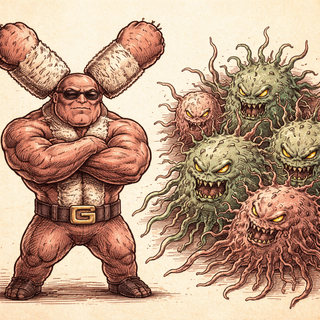
Imagine you throw a party, but the only guests to show up are the friends you didn’t invite—let's call them cancer cells. They take over your house, order pizza on your tab, and refuse to leave. Wouldn't you want a bouncer to chuck them out? That’s where Gotistobart, our new bouncer, comes in. And it's not just any bouncer; it's like the Dwayne "The Rock" Johnson of the antibody world, designed to kick out those unruly cancer cells and restore order.
The New Sheriff in Town: Gotistobart
In the colorful world of cancer treatment, Gotistobart is the new sheriff. It’s an antibody that targets a specific protein called CTLA-4. Sounds technical, right? But stick with me here. CTLA-4 is like a crafty lawyer that defends our mischievous regulatory T cells—those little guys that sometimes help cancer cells throw their wild parties in your body. Gotistobart is designed to boot those freeloaders out, specifically going after the tumor microenvironment, which, let's be honest, is like the sketchiest neighborhood in town.
Why Should You Care?
You might be wondering, "Why is this important to me?" Well, if you or someone you love is dealing with metastatic squamous non-small cell lung cancer (sqNSCLC), you're in for a fight. This type of lung cancer is like the boss level in a video game—tough, unforgiving, and with a particularly poor prognosis. Gotistobart, however, offers hope by selectively targeting and depleting those sneaky regulatory T cells that help cancer thrive.
The PRESERVE-003 Trial: A New Hope
In a galaxy not so far away (a.k.a., Nature Medicine), scientists conducted the PRESERVE-003 trial, a two-stage, phase 3 showdown between Gotistobart and the well-known chemotherapy drug, docetaxel. This trial focused on patients who had already tried and not responded to other treatments. Think of it as the ultimate dance-off, with Gotistobart trying to outmaneuver docetaxel in a bid to improve overall survival rates and shrink those stubborn tumors.
The Results Are In
In this first stage of the trial, the researchers wanted to find the right dose and see if Gotistobart could indeed be the party crasher they hoped. Spoiler alert: it showed promise. Not only was it safe, but it also offered preliminary improvements in overall survival, progression-free survival, and response rates compared to docetaxel. That’s scientific jargon for saying Gotistobart might just be the life of the cancer-fighting party.
Challenges on the Horizon
But, like any good superhero story, it’s not all sunshine and rainbows. There are challenges—like figuring out how Gotistobart will perform in the real world outside of controlled clinical trials. Plus, there's the small matter of scaling this treatment up and ensuring it’s affordable and accessible for all the people who need it. After all, a party-crashing hero is only as good as the number of parties they can crash.
Final Thoughts
So, there you have it. Gotistobart is stepping into the ring as a new contender in the fight against a particularly pesky form of lung cancer. While it’s not the definitive cure, it’s a promising step forward, offering hope and a potential new lifeline for those battling sqNSCLC. And who knows? Maybe one day, Gotistobart will be the household name that turns the tide in the war against cancer.
Disclaimer: The image accompanying this article is for illustrative purposes only and does not depict actual experimental results, data, or biological mechanisms.
References
- "Gotistobart or Docetaxel in Metastatic Squamous Non-Small Cell Lung Cancer: Stage 1 of the Randomized Phase 3 PRESERVE-003 Trial." DOI: 10.1038/s41591-026-04323-8
```
Get cancer research delivered to your inbox
The best new studies, explained without the jargon. One email per week.