Somewhere inside a breast tumor, millions of cells are staging the world's worst block party. They're packed in tight, shoulder-to-shoulder, locked in place like commuters on a rush-hour subway car. For a while, this is actually good news - a solid, jammed tumor isn't going anywhere. But then something shifts. The crowd loosens up. Cells start sliding past each other. The whole mass begins to flow, creeping outward like honey spreading across a countertop. And just like that, a contained problem becomes an invasive one.
A new study published in Nature Materials has identified one of the bouncers keeping that cellular crowd in check - and what happens when it goes missing (Marchesi et al., 2026).
Your Tissues Have a Thermostat (Sort Of)
The idea that tissues can switch between solid-like and fluid-like states isn't new. Physicists have been describing this "jamming transition" for years - the same physics that explains why your bag of rice flows freely until you squeeze it applies, weirdly enough, to how tumor cells behave (Cai et al., 2025). When cells are jammed, the tissue is rigid and stays put. When they unjam, everything gets slippery.
What researchers have been hunting is the molecular thermostat - the specific proteins that dial tissue fluidity up or down. Giorgio Scita's team at IFOM in Milan just found a big one: IRSp53.
Meet IRSp53, the Cellular Velcro
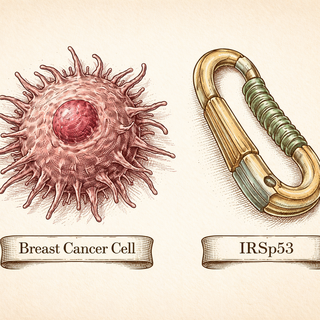
IRSp53 is a scaffolding protein, which is a fancy way of saying it's the thing connecting your cell's outer membrane to its internal skeleton. Think of it as Velcro between a tent's fabric and its poles - it holds the structure taut and keeps everything in its place (Scita et al., Trends in Cell Biology, 2008).
When the research team removed IRSp53 from breast cancer cells, things got interesting. In flat, two-dimensional layers, cells that normally moved in polite, coordinated waves turned into a mosh pit of local rearrangements. Neighbors that once slid past each other with predictable friction suddenly moved like they'd been greased. In three-dimensional spheroids - little tumor balls grown in the lab - the effect was even more dramatic. Without IRSp53, these spheroids spread across surfaces the way a drop of water wets a glass slide. The technical term is "active wetting," and it's exactly as alarming as it sounds when we're talking about cancer.
The Buddy System Gone Wrong
IRSp53 doesn't work alone. The team discovered it partners with another protein called Afadin, a well-known organizer of cell-cell junctions. Afadin is the office manager of the adherens junction - the riveted seam that holds neighboring epithelial cells together (Ikeda et al., 1999). When IRSp53 grabs onto Afadin, the pair maintains tension across the tissue, keeping cells locked in a solid-like state. Remove either one, and that collective grip loosens. Intercellular friction drops, local cell rearrangements spike, and the whole tissue transitions from "frozen crowd" to "flowing river."
Biophysical modeling confirmed what the experiments showed: IRSp53 depletion reduces bulk viscosity and contractility in spheroids. In plain English, the tumor gets runnier.
Why This Actually Matters for Patients
Here's where it stops being a cool physics experiment and starts being clinically relevant. The researchers examined actual breast cancer patient samples and found that low IRSp53 expression and abnormal localization correlated with worse outcomes. Patients whose tumors had lost this protein fared worse, suggesting that the solid-to-fluid transition isn't just a lab curiosity - it may be a real driver of tumor progression and metastasis.
This dovetails with other recent work showing that active wetting, driven by proteins like RAB5A, represents a fundamental mechanism of solid tumor invasion (Lemahieu et al., Advanced Science, 2025). The emerging picture is that cancer doesn't always need to dismantle its epithelial identity through the classic epithelial-to-mesenchymal transition. Sometimes, tumors just need to get a little more liquid.
The Bottom Line
Cancer cells don't have to transform into lone-wolf invaders to spread. Sometimes, the whole gang just needs to loosen up and flow together. IRSp53 and Afadin act as molecular brakes on that process, maintaining the friction and tension that keep epithelial tissues solid. Lose those brakes, and the tumor starts wetting its surroundings like a spilled drink nobody's wiping up.
Understanding the mechanics behind this transition opens the door to a completely different way of thinking about stopping metastasis - not by killing cells, but by keeping them stuck.
References
-
Marchesi, S., Guidolin, C., Massey, A.E., et al. Mechanisms of active wetting and fluidification in epithelial cell collectives. Nature Materials (2026). DOI: 10.1038/s41563-026-02553-2
-
Lemahieu, G., et al. RAB5A Promotes Active Fluid Wetting by Reprogramming Breast Cancer Spheroid Mechanics. Advanced Science, 12(34) (2025). DOI: 10.1002/advs.202503569
-
Cai, D., et al. Unjamming Transition as a Paradigm for Biomechanical Control of Cancer Metastasis. Cytoskeleton (2025). PMID: 39633605
-
Scita, G., et al. IRSp53: crossing the road of membrane and actin dynamics in the formation of membrane protrusions. Trends in Cell Biology, 18(2), 52-60 (2008). PMID: 18215522
-
Pépy, G., et al. Stiffness-dependent active wetting enables optimal collective cell durotaxis. Nature Physics, 18, 1–9 (2022). DOI: 10.1038/s41567-022-01835-1
Disclaimer: The image accompanying this article is for illustrative purposes only and does not depict actual experimental results, data, or biological mechanisms.
Get cancer research delivered to your inbox
The best new studies, explained without the jargon. One email per week.