Tomorrow morning, a woman with metastatic ER-positive breast cancer will learn her tumors have stopped responding to chemotherapy. Her oncologist will flip through the limited options remaining, searching for something - anything - that might buy more time. What if the answer has been sitting in the addiction medicine cabinet all along?
The Villain's Fatal Flaw
Here's the setup for our story: Cancer cells are survivors. Not the inspirational kind - the conniving, adapt-or-die kind. When you hit ER-positive breast cancer with chemotherapy, most cells die. But a handful of rebels figure out how to resist, and they multiply. Soon, the tumor is populated entirely by these resistant cells, giving your oncologist the medical equivalent of a shrug emoji.
For decades, this has been the depressing third act in far too many cancer stories. Nearly 80% of breast cancers are ER-positive, and while early-stage survival rates are excellent, metastatic disease remains stubbornly incurable with average survival hovering around 2-5 years.
But what if the very adaptations that make cancer cells resistant to chemotherapy also make them vulnerable to something else entirely?
Enter the Double-Bind (And a Very Old Drug)
Researchers from Moffitt Cancer Center and their collaborators just published work in Molecular Systems Biology that reads like a heist movie plot. They've identified what evolutionary biologists call a "double-bind" - a scenario where the tumor can't win no matter which direction it evolves.
The unlikely hero? Disulfiram - a drug your grandfather might recognize as Antabuse, the pill that makes drinking alcohol profoundly unpleasant. Turns out this 70-year-old anti-alcoholism medication has a secret talent for killing cancer cells, particularly through generating reactive oxygen species and targeting cancer stem cells.
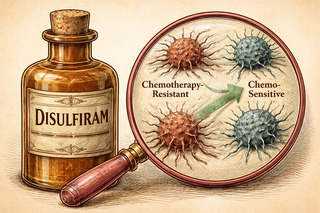
Here's where it gets clever. The research team grew ER-positive breast cancer spheroids (tiny 3D tumor models) with varying ratios of chemo-sensitive and chemo-resistant cells. They discovered that cells resistant to chemotherapy become more sensitive to disulfiram. Meanwhile, disulfiram treatment shifts the population back toward chemo-sensitive cells.
It's like the tumor is playing chess against an opponent who keeps changing the rules. Adapt to chemotherapy? Now disulfiram works better. Adapt to disulfiram? Congratulations, you're sensitive to chemo again.
The Math Behind the Mayhem
The team didn't just stumble onto this in the lab - they predicted it using evolutionary game theory, a mathematical framework borrowed from ecology and economics. By modeling cancer cells as players competing for resources, they could simulate how populations would shift under different treatment schedules.
Their game-theoretic model correctly predicted that disulfiram monotherapy would favor sensitive cells, effectively "re-sensitizing" tumors to subsequent chemotherapy. The model even predicted dose-dependent effects that matched what they observed in experiments.
This isn't the first evolutionary double-bind discovered in cancer. Just this year, researchers at Trinity College Dublin and Moffitt demonstrated a similar phenomenon in prostate cancer, where radiation-resistant cells became twice as vulnerable to natural killer cell attack. The approach appears to work across multiple cancer types - any treatment that forces predictable adaptations could potentially be paired with a therapy that exploits those exact changes.
Why This Matters Beyond the Petri Dish
The elegance of this approach lies in its simplicity. Disulfiram is cheap, FDA-approved, and has a well-understood safety profile from decades of use. It doesn't require developing a new drug from scratch - just thinking differently about the ones we already have.
More importantly, it represents a philosophical shift in how we fight cancer. Instead of simply trying to kill as many cancer cells as possible with maximum tolerated doses, evolutionary approaches ask: "How will the tumor adapt, and how can we trap it?"
The study still needs validation in animal models and eventually human trials. Disulfiram faces challenges including stability issues and rapid clearance that researchers are working to solve with nanoparticle delivery systems.
But for the woman learning about her resistance diagnosis tomorrow? This research suggests a future where resistance isn't the end of the story - it's just the setup for the next chapter.
References:
-
Emond R, West J, Grolmusz VK, et al. A novel combination therapy for ER+ breast cancer suppresses drug resistance via an evolutionary double-bind. Mol Syst Biol. 2026. DOI: 10.1038/s44320-026-00191-z
-
Li Y, Chen F, Chen J, et al. Disulfiram: A novel repurposed drug for cancer therapy. Chin Med J. 2024;137(12):1389-1398. PMCID: PMC11188872
-
West J, Ma Y, Newton PK. Capitalizing on competition: An evolutionary model of competitive release in metastatic castration resistant prostate cancer treatment. J Theor Biol. 2018;455:249-260. PMCID: PMC6947530
-
O'Farrelly C, Luddy K, et al. Evolutionary double-bind treatment using radiation therapy and NK cell-based immunotherapy in prostate cancer. Int J Radiat Oncol Biol Phys. 2026. Available at: Medical Xpress
-
Cioce M, Centonze G, et al. Metastatic ER+ Breast Cancer: Mechanisms of Resistance and Future Therapeutic Approaches. Int J Mol Sci. 2023;24(22):16198. PMCID: PMC10671474
Disclaimer: The image accompanying this article is for illustrative purposes only and does not depict actual experimental results, data, or biological mechanisms.