For years, there was this awkward silence in photodynamic therapy research - the kind of silence that happens when everyone's pretending not to notice the elephant in the room. The elephant? Tumors are often hypoxic, meaning they're low on oxygen. And the main weapon we had against them - a treatment that literally needs oxygen to work - was basically showing up to a gunfight with a water pistol.
Wait, What's Photodynamic Therapy Again?
Okay, quick crash course. Photodynamic therapy (PDT) is this genuinely cool cancer treatment where you inject a light-sensitive compound (called a photosensitizer), wait for it to accumulate in tumor tissue, then hit it with specific wavelengths of light. The photosensitizer gets excited - not in an emotional way, in a quantum physics way - and transfers that energy to nearby oxygen molecules. The oxygen becomes "singlet oxygen," which is basically oxygen in an angry mood, and it wreaks havoc on cancer cells.
Pretty elegant, right? One problem: tumors are notorious oxygen hoarders. They grow so fast and so chaotically that their blood supply can't keep up, creating pockets of hypoxia. And traditional PDT (called Type II) relies on having oxygen around to do its dirty work. It's like trying to start a campfire in a vacuum.
Enter the Rebel Approach: Type I PDT
So researchers have been trying to crack Type I PDT for a while now. Instead of transferring energy to oxygen, Type I photosensitizers transfer electrons. This creates radical reactive oxygen species like superoxide through a different pathway - one that's way more tolerant of low-oxygen conditions [1].
The catch? Designing molecules that actually do this efficiently has been... let's call it "character building" for the scientists involved.
A Framework That Actually Works
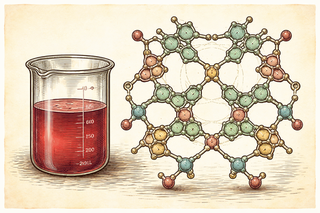
A team led by researchers at the University of Chicago just published something genuinely clever in Nature Communications [2]. They created what they call an "iminium-linked hyperporphyrin covalent organic framework" - which is a mouthful, so let's call it IH-COF.
Here's the cool part: they made it in a one-pot synthesis (chemists love one-pot reactions the way home cooks love sheet pan dinners). By adding a compound called trimethyloxonium tetrafluoroborate, they accomplished two things simultaneously:
- They converted imine bonds into iminium ions (which act as electron acceptors)
- They protonated the porphyrin units, creating "hyperporphyrins"
That second bit is important because it shifts the absorption of light to 725 nanometers - deep into the near-infrared range that penetrates tissue better. So you're not just getting better chemistry, you're getting better physics too.
The Photocatalytic Cycle (A.K.A. The Part That Actually Kills Cancer)
When light hits IH-COF, electrons jump from the hyperporphyrin units to the iminium ions. This generates α-amino radicals, which then reduce oxygen to superoxide - even when oxygen is scarce. The iminium ions get regenerated in the process.
But wait, there's more! The oxidized hyperporphyrins get reduced by NADH (that's 1,4-dihydronicotinamide adenine dinucleotide if you're feeling fancy), which is naturally present in cells. This keeps the whole cycle going. It's essentially a tiny, self-sustaining cancer-killing factory powered by light [3].
Does It Actually Work in Living Things?
The researchers tested IH-COF in mouse models of colorectal cancer and triple-negative breast cancer - two notoriously difficult cancer types. Under both normal oxygen conditions and hypoxic conditions, it performed well. The framework showed "potent antitumor efficacy," which in science-speak means the tumors got substantially smaller.
This matters because triple-negative breast cancer in particular has limited treatment options and tends to have hypoxic tumor microenvironments [4]. Having a therapy that doesn't care about oxygen levels could be a genuine game-changer.
Why Covalent Organic Frameworks Are Having a Moment
COFs have been getting a lot of attention lately for biomedical applications. They're highly tunable, meaning you can adjust their properties by changing their building blocks. They're porous, so they can carry drug payloads. And they're relatively biocompatible [5].
This study suggests they might also be excellent platforms for photomedicine - not just as passive drug carriers but as active therapeutic agents. The ability to engineer specific photophysical and electrochemical properties into a framework opens up possibilities that individual molecules simply can't match.
The Bottom Line
We've been trying to use light to kill cancer for decades, but we kept running into the same wall: tumors that had evolved to survive in low-oxygen environments were essentially immune to our best photodynamic approaches. This new framework sidesteps that problem entirely by using a completely different mechanism.
Is it a cure for cancer? No. But it's a genuinely elegant solution to a long-standing problem, and it works in some of the most challenging tumor models we have. Sometimes that's how progress happens - not with a single breakthrough, but by systematically knocking down the obstacles that were in the way all along.
References
-
Li, M., et al. (2022). Type I photosensitizers for photodynamic therapy: recent advances and future prospects. Chemical Society Reviews, 51(21), 9149-9178. DOI: 10.1039/D2CS00467D
-
Zhou, Z., Xiong, Y., Wang, Z., et al. (2025). Iminium-linked hyperporphyrin covalent organic framework mediates type I photodynamic therapy via a photoredox process. Nature Communications. DOI: 10.1038/s41467-026-71240-2 | PMID: 41904180
-
Guan, Q., et al. (2023). Covalent organic frameworks for cancer phototherapy. Chemical Society Reviews, 52(11), 3735-3764. DOI: 10.1039/D2CS00903J
-
Vaupel, P., & Multhoff, G. (2021). Hypoxia-/HIF-1α-driven factors of the tumor microenvironment impeding antitumor immune responses and promoting malignant progression. Advances in Experimental Medicine and Biology, 1232, 171-175. DOI: 10.1007/978-3-030-34461-0_21
-
Geng, K., et al. (2020). Covalent organic frameworks: design, synthesis, and functions. Chemical Reviews, 120(16), 8814-8933. DOI: 10.1021/acs.chemrev.9b00550
Disclaimer: The image accompanying this article is for illustrative purposes only and does not depict actual experimental results, data, or biological mechanisms.