Like the mystery of why socks vanish in the dryer or how Amelia Earhart disappeared over the Pacific, there's been a baffling puzzle haunting American healthcare: we have a screening test that can catch lung cancer early and cut deaths by 20%, yet barely anyone actually gets it. We're talking about 4-6% of eligible people. That's like having a fire extinguisher and just... not using it when things get smoky.
The Screening Paradox Nobody Talks About
Here's the situation: low-dose CT scans can detect lung cancer early about 85% of the time, and when caught early, survival rates exceed 90%. Pretty good odds, right? Yet lung cancer remains the leading cause of cancer death in the U.S., claiming an estimated 124,730 lives in 2025 alone.
So why the disconnect?
In other words, it's complicated. Unlike mammograms or colonoscopies where you basically just need to hit a certain birthday, lung cancer screening eligibility is tied to smoking history. And that introduces something healthcare folks call "stigma" but the rest of us might call "feeling judged." Research shows that many patients experience discomfort discussing their smoking history with doctors, and some patients literally describe screening programs as feeling like a "scam."
Add in confusion about who actually qualifies, concerns about cost, and a dash of fatalism - "well, if I have it, I have it" - and you've got a recipe for people skipping a test that could save their lives.
Enter: Your Inbox
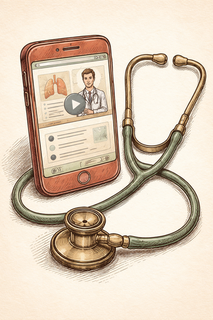
Researchers at Wake Forest and UNC decided to try something different. Instead of waiting for patients to navigate the awkward doctor's office conversation, they built mPATH-Lung - basically a digital program that reaches out to potentially eligible patients directly through patient portals or text messages.
The pitch? A brief educational video, a decision aid to help you figure out if screening makes sense for you, and - here's the clever part - an option to schedule a screening appointment right there. No awkward conversations required.
The results from their randomized trial of 1,333 participants, published in JAMA, were pretty telling: 24.5% of people who got the digital intervention completed their CT scan within 16 weeks, compared to just 17% in the control group who were told to talk to their doctor.
Why "Just Talk to Your Doctor" Doesn't Always Cut It
The control group essentially got the advice we've been giving people forever: "You might qualify for lung cancer screening. Discuss with your primary care provider."
The problem? Those conversations are short - one study found they averaged less than a minute - and often don't include the kind of information people need to make an informed decision. Doctors are busy, patients are uncomfortable, and somehow the topic never quite gets the attention it deserves.
What the digital approach does is remove some friction. You can learn about screening in your own time, on your own terms, without sitting in a paper gown wondering if you're being judged. The decision aid walks through the benefits and risks (yes, there are some false positives to consider), and if you decide to move forward, you can book the appointment before you change your mind.
The Equity Angle
One particularly encouraging finding: the screening improvements showed up across all demographic and socioeconomic groups. Given that lung cancer screening has historically had significant disparities in uptake, with underserved populations often left behind, that's a meaningful result.
Not a Silver Bullet, But a Pretty Good Start
Let's be clear - going from 17% to 24.5% still means three-quarters of eligible people didn't get screened. And the digital program works best as a complement to, not replacement for, good primary care relationships.
But in a world where we've struggled for over a decade to get people to use a test that genuinely saves lives, a tool that can move the needle by 44% without requiring additional clinic visits is worth paying attention to.
The larger point? Sometimes the barrier isn't that people don't care about their health. It's that we've made caring about their health unnecessarily complicated. A thoughtfully designed app can't solve stigma or healthcare distrust overnight, but it can give people one more way to access care that doesn't require them to feel judged first.
Your phone already tracks your steps, reminds you to drink water, and knows more about your sleep habits than your spouse does. Maybe helping you decide about cancer screening isn't such a weird addition to the list.
References
-
Miller DP, Snavely AC, Dharod A, et al. A Direct-to-Patient Digital Health Program for Lung Cancer Screening: A Randomized Clinical Trial. JAMA. 2025;334(20):1807-1815. doi:10.1001/jama.2025.17281
-
Vijay S. Digital Health Intervention for Lung Cancer Screening. JAMA. 2026;335(12):1090. doi:10.1001/jama.2025.26342
-
Fedewa SA, Kazerooni EA, Enguidanos SM, et al. Prevalence of Lung Cancer Screening in the US, 2022. JAMA Netw Open. 2024. Link
-
Lung Cancer Screening. Cancer Trends Progress Report. National Cancer Institute. Link
-
American Thoracic Society. Addressing Disparities in Lung Cancer Screening Eligibility and Healthcare Access. Am J Respir Crit Care Med. 2020. doi:10.1164/rccm.202008-3053ST
Disclaimer: The image accompanying this article is for illustrative purposes only and does not depict actual experimental results, data, or biological mechanisms.