HER2-low breast cancer is defined by not having quite enough HER2 to be a big deal, and yet here we are, finding out it may hide some very big deals. Oncology does love a contradiction. It keeps the lights on.
A new 2026 paper in Biomarker Research looked across the full HER2 expression spectrum in breast cancer and asked a question pathologists and oncologists have been quietly side-eyeing for a while: is HER2-low actually one thing, or did we just dump a bunch of biologically different tumors into the same mildly annoying bucket? The answer, in the most cancer-biology way possible, is: of course it’s messy [1].
The HER2 Story Gets More Annoying
Quick refresher. HER2 is a growth-signaling receptor encoded by the ERBB2 gene on chromosome 17. When breast cancers crank HER2 way up, that matters a lot. We have drugs for that. When tumors have no meaningful HER2, that matters too. Then came HER2-low, the middle child category that used to be mostly a pathology footnote and is now clinically relevant because antibody-drug conjugates like trastuzumab deruxtecan can work in some of these patients [2-4].
So yes, a tiny bit of HER2 that once got shrugged at now suddenly affects treatment decisions. Somewhere, a pathology resident just sighed into a microscope.
The problem is that HER2-low has never looked like a clean biological species. Prior work suggested it behaves more like a therapeutic label than a neat, tidy subtype with its own matching sweater [3,5]. This new study leans into that uncertainty and says, basically, let’s stop pretending all HER2-low tumors are cousins who show up to the same barbecue.
They Sequenced the Whole Neighborhood
The authors analyzed 157 breast cancers using shallow whole-genome sequencing to map copy number alterations, which is a technical phrase meaning they looked for gains and losses of chunks of DNA across the genome. The cohort included HER2-null, HER2-ultralow, HER2-low, and HER2-positive cases [1].
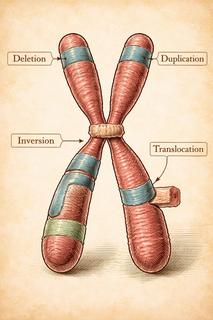
What they found was not subtle. HER2-null and HER2-ultralow tumors tended to have relatively quiet chromosome 17 patterns. HER2-low tumors did not. Those split into three distinct genomic clusters, and about 40% carried a chromosome 17 imbalance: loss of the short arm, called 17p, and gain of the long arm, called 17q [1].
That matters because chromosome 17 is prime breast cancer real estate. HER2 itself lives on 17q12. TP53, one of cancer biology’s least amusing but most important tumor suppressor genes, lives on 17p. So when a tumor loses one side of chromosome 17 and bulks up the other, this is not interior decorating. This is structural sabotage.
Even more interesting, the group used single-cell DNA sequencing in a few HER2-low tumors and found that this chromosome 17 imbalance looked clonal, meaning it likely happened early and then got copied into a large share of the tumor’s descendants [1]. In plain English: this may be part of the tumor’s founding personality, not a late random tantrum.
Why You Should Care Even If You Hate Genomics
Because this may explain why some HER2-low cancers act worse than others.
In this study, that chromosome 17 imbalance was linked to poorer prognosis [1]. That does not mean every HER2-low tumor is bad news. It means the label “HER2-low” may be hiding very different diseases under one bland sticker, which is classic oncology. We invent a category, celebrate it for six months, then spend the next five years discovering it contains three smaller categories and one existential crisis.
That broader idea matches other recent work. Prior genomic studies found that HER2-low tumors are heterogeneous and often do not differ dramatically from HER2-zero tumors once you account for hormone receptor status [5,6]. At the same time, several groups have pointed toward chromosome 17 abnormalities and ERBB2 copy number shifts as biologically meaningful, especially when they travel with other genomic damage [1,7,8].
So the real action may not be “does this stain score 0 or 1+?” but “what is this tumor actually doing under the hood?” Which is a more useful question, albeit much ruder to your workflow.
The Real-World Angle
This does not change standard care tomorrow morning. It is not a new bedside test. It does not prove that patients with this chromosome 17 pattern respond differently to antibody-drug conjugates. Not yet.
What it does do is sharpen the next question. If HER2-low includes a subgroup with a clonal chromosome 17 imbalance and worse outcomes, that subgroup might eventually deserve separate risk assessment, separate trial stratification, or even separate treatment logic [1,8]. That would be useful. Clinicians enjoy having fewer mystery boxes.
And this lands at a moment when the HER2-low world is moving fast. Since trastuzumab deruxtecan cracked open this category clinically, the field has been racing to sort out who truly benefits, how to score these tumors more reliably, and whether “HER2-low” is biology, billing, or both [3,4,6].
Turns out the answer may be: both, plus a very cranky chromosome 17.
References
[1] Bellomo SE, Berrino E, Arcella P, et al. Genome-wide biomarker analysis across the full spectrum of HER2-expressing breast cancers to reveal a clonal chromosome 17 imbalance defining unfavourable HER2-low disease. Biomarker Research. 2026. DOI: https://doi.org/10.1186/s40364-026-00922-2
[2] Marchiò C, Annaratone L, Marques A, Casorzo L, Berrino E, Sapino A. Evolving concepts in HER2 evaluation in breast cancer: Heterogeneity, HER2-low carcinomas and beyond. Seminars in Cancer Biology. 2021;72:123-135. DOI: https://doi.org/10.1016/j.semcancer.2020.02.016
[3] Modi S, Jacot W, Yamashita T, et al. Trastuzumab Deruxtecan in Previously Treated HER2-Low Advanced Breast Cancer. New England Journal of Medicine. 2022;387:9-20. DOI: https://doi.org/10.1056/NEJMoa2203690. PMCID: https://pmc.ncbi.nlm.nih.gov/articles/PMC10561652/
[4] Bardia A, Hu X, Dent R, et al. Trastuzumab Deruxtecan after Endocrine Therapy in Metastatic Breast Cancer. New England Journal of Medicine. 2024. DOI: https://doi.org/10.1056/NEJMoa2407086
[5] Berrino E, Annaratone L, Bellomo SE, et al. Integrative genomic and transcriptomic analyses illuminate the ontology of HER2-low breast carcinomas. Genome Medicine. 2022;14:98. DOI: https://doi.org/10.1186/s13073-022-01104-z
[6] Tarantino P, Gupta H, Hughes ME, et al. Comprehensive genomic characterization of HER2-low and HER2-0 breast cancer. Nature Communications. 2023;14:7496. DOI: https://doi.org/10.1038/s41467-023-43324-w. PMCID: https://pmc.ncbi.nlm.nih.gov/articles/PMC10657399/
[7] Loh JW, Lim AH, Chan JY, Yap YS. Classification of HER2-negative breast cancers by ERBB2 copy number alteration status reveals molecular differences associated with chromosome 17 gene aberrations. Therapeutic Advances in Medical Oncology. 2023;15. PMCID: https://pmc.ncbi.nlm.nih.gov/articles/PMC10619358/
[8] Qiu X, Tarantino P, Li R, et al. Molecular characterization of HER2-negative breast cancers reveals a distinct patient subgroup with 17q12 deletion and heterozygous loss of ERBB2. ESMO Open. 2025;10:104111. DOI: https://doi.org/10.1016/j.esmoop.2024.104111
Disclaimer: The image accompanying this article is for illustrative purposes only and does not depict actual experimental results, data, or biological mechanisms.