Pancreatic cancer has a reputation problem—and honestly, it's earned. It's aggressive, it's sneaky, and it loves to spread to lymph nodes before anyone realizes what's happening. But researchers just caught one of its accomplices red-handed, and the culprit is wonderfully weird: zombie-like "senescent" cells that should be retired but are instead running a metabolic smuggling operation.
The Cellular Undead Have Entered the Chat
Let's talk about senescent cells. These are cells that have hit their biological retirement age—they've stopped dividing, they're damaged, and in a perfect world, your immune system would escort them out. But sometimes they stick around, refusing to leave the party and, worse, causing trouble for everyone else.
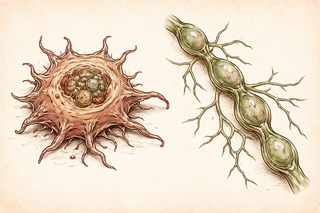
In pancreatic ductal adenocarcinoma (PDAC), researchers from Tianjin Medical University discovered that a specific type of these cellular zombies—senescent cancer-associated fibroblasts, or senCAFs—are actively helping tumors spread to lymph nodes [1]. And they're doing it through an elaborate scheme involving lactate, metabolism, and some creative molecular rewiring.
Lactate: Not Just for Leg Day Anymore
Here's where it gets interesting. SenCAFs have cranked up their glucose metabolism, producing excess lactate like they're training for a molecular marathon. But instead of just sitting there being acidic and annoying, this lactate is doing something clever: it's protecting lymphatic endothelial cells (the cells lining your lymph vessels) from oxidative stress.
The mechanism involves something called "lactylation"—a process where lactate modifies proteins in ways that change how genes are expressed. In this case, lactylation activates serine metabolism in lymphatic cells, essentially giving them a shield against damage [1]. It's like the senCAFs are running a protection racket, and the lymphatic vessels are paying up by becoming highways for cancer cells.
Regulatory T Cells: The Corrupt Security Guards
But wait, there's more scheming happening. The research team found that CCR4+ regulatory T cells (Tregs)—immune cells that normally keep inflammation in check—were clustering around lymphatic vessels in draining lymph nodes. Instead of protecting against cancer, these Tregs were creating an "immunosuppressive peri-lymphatic niche" [1].
Translation: the area around the lymphatic vessels becomes a safe zone where cancer cells can travel without getting attacked by the immune system. It's as if the tumor hired its own private security to clear a path through your body's defenses.
The Drug That Crashes the Party
The silver lining in this cellular conspiracy? The researchers found a way to disrupt it. Through high-throughput drug screening, they identified chidamide—an HDAC inhibitor already approved for treating certain lymphomas—as a selective senCAF assassin [1].
When they cleared out the senCAFs with chidamide, tumor progression slowed down and responses to chemo-immunotherapy improved. This makes biological sense: remove the corrupt contractors, and the whole smuggling operation falls apart.
The team was confident enough in their findings to launch a clinical trial combining chidamide with standard chemotherapy (nab-paclitaxel and gemcitabine) plus immune checkpoint inhibitors (anti-PD-1 and anti-CTLA-4) in patients with metastatic PDAC. Early results are described as "promising" [1], which in the measured language of oncology research is practically doing a victory lap.
Why This Actually Matters
Pancreatic cancer has a five-year survival rate that hovers around 12%, and lymph node metastasis is one of the key reasons outcomes are so grim [2]. When cancer reaches the lymph nodes, it's often a sign that systemic spread has begun or is imminent.
Understanding how this spread happens—not just that it happens—opens doors for intervention. Previous research has explored the tumor microenvironment's role in PDAC progression, with cancer-associated fibroblasts emerging as key players in creating conditions favorable for tumor growth and metastasis [3]. This new work adds a critical layer: it's not just fibroblasts in general, but specifically the senescent ones that are driving early lymphatic spread.
The connection between cellular senescence and cancer has been a hot topic in oncology. Senescent cells accumulate with age and in response to various stresses, and while they can sometimes suppress tumor growth, they can also promote it through their secretions—collectively called the senescence-associated secretory phenotype (SASP) [4]. This study provides concrete mechanistic evidence for how senescent stromal cells contribute to metastasis.
The Bottom Line
Cancer cells don't work alone. They recruit help, manipulate their environment, and exploit cellular processes that normally keep us healthy. In pancreatic cancer, senescent fibroblasts have been caught moonlighting as metastasis facilitators, using lactate metabolism to remodel lymphatic vessels and immune suppression to clear the path for spreading tumor cells.
The good news? Once you identify the accomplices, you can target them. Chidamide's ability to selectively eliminate senCAFs while improving responses to existing therapies suggests that senolytic strategies—drugs that kill senescent cells—might become an important addition to pancreatic cancer treatment.
For a cancer that desperately needs new approaches, catching these cellular zombies in the act might be exactly the break researchers have been looking for.
References
-
Zhou T, Yan J, Mao G, et al. Senescent cancer-associated fibroblasts drive early-stage lymph node metastasis in pancreatic cancer through lactate-mediated metabolic-epigenetic rewiring. Cancer Discovery. 2025. DOI: 10.1158/2159-8290.CD-25-1627. PMID: 41891402.
-
Siegel RL, Giaquinto AN, Jemal A. Cancer statistics, 2024. CA Cancer J Clin. 2024;74(1):12-49. DOI: 10.3322/caac.21820.
-
Hosein AN, Brekken RA, Maitra A. Pancreatic cancer stroma: an update on therapeutic targeting strategies. Nat Rev Gastroenterol Hepatol. 2020;17(8):487-505. DOI: 10.1038/s41575-020-0300-1. PMCID: PMC7367709.
-
Faget DV, Ren Q, Stewart SA. Unmasking senescence: context-dependent effects of SASP in cancer. Nat Rev Cancer. 2019;19(8):439-453. DOI: 10.1038/s41568-019-0156-2.
Disclaimer: The image accompanying this article is for illustrative purposes only and does not depict actual experimental results, data, or biological mechanisms.