A middle-aged woman walks into a colonoscopy, and the gastroenterologist spots something weird in her rectum. Sounds like the setup to a bad joke, but for the doctors at Showa University Northern Yokohama Hospital, it was the beginning of a diagnostic head-scratcher that landed in the pages of Gut journal.
When Your Bowel Plays Dress-Up
Here's the thing about rectal lesions that look like submucosal tumors: they're basically the catfish of the gastrointestinal world. On the surface, everything looks normal - smooth mucosa, polite little bump, nothing to see here. But underneath? Could be anything from a harmless lipoma to something far more sinister pretending to be chill.
Submucosal tumors (SMTs) get their name because they arise from the deeper layers of the gut wall - beneath the mucosa that lines the surface. When you peer through a colonoscope, you see a smooth bulge covered by normal-looking tissue. It's like seeing a lump under a carpet and trying to guess what's underneath without lifting it up.
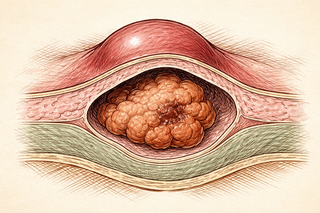
The differential diagnosis list reads like a gastroenterology greatest hits album: gastrointestinal stromal tumors (GISTs), neuroendocrine tumors (formerly known as carcinoids), lipomas, and occasionally something completely unexpected like endometriosis or metastatic cancer from somewhere else entirely [1].
The Plot Thickens
What makes cases like this particularly tricky is that standard biopsies often come back unhelpful. You're essentially trying to sample something buried under a layer of normal tissue - like trying to identify what's in a wrapped present by licking the wrapping paper. Not super effective.
Colorectal cancer masquerading as a submucosal tumor is especially sneaky. It's rare - most colorectal cancers announce themselves by disrupting the mucosal surface - but when cancer decides to grow inward rather than outward, diagnosis becomes exponentially harder [2]. A 2017 case report described a similar situation where EUS-guided fine needle aspiration biopsy finally unmasked what standard endoscopy couldn't: adenocarcinoma playing dress-up [2].
The Technology Arms Race
Enter the cavalry: endoscopic ultrasound (EUS), MRI, and increasingly, artificial intelligence. Dr. Shin-Ei Kudo and colleagues at the same institution where this case originated have spent years developing AI systems that can assist endoscopists in characterizing colorectal lesions [3]. Their computer-aided diagnosis systems have achieved detection rates approaching 98% sensitivity for colorectal lesions - numbers that would make most screening programs weep with joy.
MRI has become particularly valuable for rectal lesions, offering soft tissue contrast that helps differentiate between tumor types. Lipomas show up as obvious fat on imaging. GISTs enhance with contrast. Carcinoids tend to be small and superficial. But when something doesn't fit the expected pattern, that's when clinicians start getting nervous - and rightfully so [4].
Why This Matters to Your Gut (Literally)
The incidence of submucosal lesions being detected has skyrocketed, largely because we're doing more colonoscopies and getting better at looking. With screening programs expanding globally, gastroenterologists are encountering these diagnostic puzzles more frequently.
The stakes aren't trivial. Miss a cancer hiding behind a benign appearance, and you've potentially delayed life-saving treatment. Cut out something harmless, and you've put a patient through unnecessary surgery. The push toward accurate "optical biopsy" - diagnosing tissue without cutting it out - represents medicine's attempt to thread this needle.
Current guidelines suggest that lesions meeting certain low-risk criteria can be left alone or removed endoscopically, while anything suspicious warrants more aggressive investigation [5]. But defining "suspicious" when the lesion is actively trying to look innocent? That's where clinical judgment meets technological assistance.
The Bottom Line
Cases like this remind us that the gut doesn't read textbooks. It doesn't know it's supposed to present classic findings. Sometimes a bump is just a bump, and sometimes it's a wolf in sheep's clothing that requires the full diagnostic arsenal - EUS, MRI, biopsy, and a healthy dose of clinical suspicion - to unmask.
The publication of this case in Gut suggests there's a teaching point worth sharing with the broader medical community. Because when it comes to rectal lesions pretending to be something they're not, the only thing worse than being fooled is being fooled twice.
References:
-
Kim SY, Kim KM, Kim K-N. MRI Findings of Rectal Submucosal Tumors. Korean J Radiol. 2011;12(4):487-498. PMCID: PMC3150677
-
Sato K, Tanaka T, Takakuwa Y, et al. Resection of rectal cancer resembling submucosal tumor that was preoperatively diagnosed with endoscopic ultrasound-guided biopsy. Surg Case Rep. 2017;3:72. DOI: 10.1186/s40792-017-0362-7
-
Kudo S-E, Misawa M, Mori Y, et al. Artificial intelligence and computer-aided diagnosis for colonoscopy: where do we stand now?. Transl Gastroenterol Hepatol. 2021;6:64. PMCID: PMC8573374
-
Levy AD, Remotti HE, Thompson WM, et al. Colorectal Subepithelial Lesions. Gastrointest Endosc Clin N Am. 2015;25(3):577-594. PMCID: PMC4522421
-
Wang J, Li Y, Liu L, et al. The Chinese Society of Clinical Oncology (CSCO): Clinical guidelines for the diagnosis and treatment of colorectal cancer, 2024 update. Cancer Commun. 2025;45:201-234. DOI: 10.1002/cac2.12639
Original Article: Otani S, Kudo S-E, Maeda Y, Ichimasa K, Misawa M, Okumura T. Rectal lesion with a submucosal tumour-like appearance in a middle-aged woman. Gut. 2026. DOI: 10.1136/gutjnl-2026-338551
Disclaimer: The image accompanying this article is for illustrative purposes only and does not depict actual experimental results, data, or biological mechanisms.