So there's a bacterium living in your gut right now that might be secretly undermining cancer immunotherapy. Not in a dramatic, villain-twirling-mustache way, but in the quiet, bureaucratic way that makes it almost more annoying. Researchers just caught Ligilactobacillus salivarius red-handed, and honestly, the betrayal stings a little.
The Setup: Immunotherapy's Uneven Track Record
Here's what we know about anti-PD-1 immunotherapy for esophageal squamous cell carcinoma (ESCC): it works brilliantly for some patients and barely registers for others. ESCC is nasty - one of the most aggressive cancers out there, with survival rates that make oncologists wince. Immunotherapy promised to change the game by essentially taking the brakes off your immune system so it could attack tumors properly.
But why does it work for Patient A and not Patient B? Scientists have been chasing this question like it owes them money. And increasingly, the answer keeps pointing toward an unexpected location: your gut.
The Culprit in Your Intestines
A research team led by scientists from Sichuan University analyzed stool samples from 122 ESCC patients receiving neoadjuvant immunotherapy [1]. What they found was genuinely surprising - patients who didn't respond well to treatment had significantly higher levels of L. salivarius hanging out in their intestines.
Now, L. salivarius isn't some obscure pathogen. It's actually considered a probiotic in many contexts. You might even be taking it in supplement form right now. Which makes this finding feel a bit like discovering your trusted accountant has been skimming from the books.
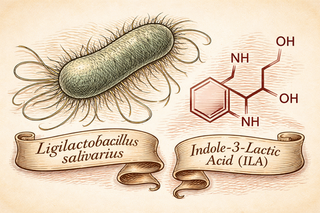
The mechanism? This bacterium produces a compound called indole-3-lactic acid, or ILA. And ILA, it turns out, has a very specific and very inconvenient talent.
How a Tiny Molecule Disarms Your Immune System
Your immune system has these specialized cells called NKG7⁺CD8⁺ Tpex cells - think of them as the special forces unit that infiltrates tumors and coordinates the broader immune attack. They're precursors to the exhausted T cells that typically populate tumors, and keeping them functional is crucial for immunotherapy to work.
ILA basically walks into these cells and flips the off switch on a key signaling pathway called NF-κB. Without NF-κB signaling, these Tpex cells can't do their job properly. The tumor gets to keep operating its sketchy neighborhood watch program undisturbed.
The researchers confirmed this wasn't just correlation by engineering L. salivarius strains that couldn't produce ILA. When they gave these modified bacteria to mice with ESCC tumors, the immunotherapy resistance disappeared [1]. The immune cells started working again. The tumors started shrinking.
The Aryl Hydrocarbon Receptor: An Unexpected Villain's Sidekick
ILA doesn't just randomly suppress immune function - it works through a specific receptor called the aryl hydrocarbon receptor (AhR). This receptor normally helps cells respond to environmental signals, including various metabolites from gut bacteria. But when ILA activates AhR in Tpex cells, it triggers a cascade that ultimately silences NF-κB [1].
This finding actually connects to broader research showing that tryptophan metabolites - the chemical family ILA belongs to - can profoundly influence immune function. A 2023 review in Nature Reviews Immunology documented how gut-derived metabolites shape everything from T cell differentiation to tumor immunity [2]. The gut-immune-tumor axis is becoming one of the hottest areas in cancer research, and for good reason.
What This Means for Patients (Eventually)
The exciting part? The researchers found that pharmacologically activating NF-κB could restore Tpex function even in the presence of ILA. This suggests potential therapeutic strategies: either target the bacteria, block ILA production, or find ways to keep NF-κB signaling active despite the metabolite's interference.
Two separate validation cohorts confirmed the L. salivarius-ILA-Tpex axis as a resistance mechanism in ESCC patients, which is the kind of replication that makes scientists actually start believing their results [1].
We're not at the point of prescribing specific microbiome interventions alongside immunotherapy yet. But we're getting closer to understanding why some patients respond and others don't - and that understanding is the first step toward fixing it.
The Bigger Picture
Your gut microbiome isn't just about digestion or even general immune health. It's actively participating in whether your cancer treatments work. The same bacteria that might help with one condition could potentially undermine treatment for another.
This research adds to growing evidence that personalized cancer therapy might eventually include personalized microbiome management. Imagine getting a stool test alongside your tumor biopsy to predict immunotherapy response. That future is looking increasingly plausible.
For now, ESCC patients and their oncologists have another piece of the puzzle - and researchers have a clear target for developing strategies to overcome resistance. Sometimes the enemy isn't just the cancer. Sometimes it's the bacteria that were supposed to be on your side.
References
-
Zhou J, Zeng X, Sun J, et al. Gut microbiota-derived indole-3-lactic acid suppresses anti-PD-1 efficacy in esophageal squamous cell carcinoma. Cell Host & Microbe. 2026. DOI: 10.1016/j.chom.2026.02.019
-
Agus A, Clément K, Sokol H. Gut microbiota-derived metabolites as central regulators in metabolic disorders. Nature Reviews Immunology. 2023;23(4):217-235. DOI: 10.1038/s41577-022-00834-0
-
Routy B, Le Chatelier E, Derosa L, et al. Gut microbiome influences efficacy of PD-1-based immunotherapy against epithelial tumors. Science. 2018;359(6371):91-97. DOI: 10.1126/science.aan3706
-
Spencer CN, McQuade JL, Gopalakrishnan V, et al. Dietary fiber and probiotics influence the gut microbiome and melanoma immunotherapy response. Science. 2021;374(6575):1632-1640. DOI: 10.1126/science.aaz7015
Disclaimer: The image accompanying this article is for illustrative purposes only and does not depict actual experimental results, data, or biological mechanisms.