Some tumors do not grow like a lone trumpet blaring off-key. They conduct a whole unruly orchestra - rewriting the score, bribing the percussion section, and somehow convincing the security staff to nap in the lobby.
That is the basic plot of a review published on April 16, 2026 in Biomarker Research by Spitschak, Casalegno Garduño, and Pützer. The paper argues that cancer biomarkers should stop acting like they are auditioning one instrument at a time. A single mutation, one protein stain, one fancy molecular blip - useful, yes. Sufficient? Not really. Tumors are messier than that. Ruder, too. They change identity, adapt under pressure, and reshape the neighborhood around them, especially the immune cells and support cells nearby.[1]
The Tumor Is Not Just the Tumor
If you hear "tumor biomarker," you might picture a tidy lab result that says yes, no, bad, worse, maybe bring snacks. But tumors do not behave like tidy paperwork. They behave like improvisers.
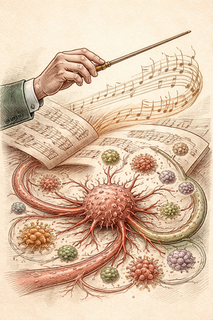
This review focuses on tumor-intrinsic transcriptional programs. Translation: the internal gene-control circuits that tell cancer cells what kind of cell to be, what genes to switch on, how sneaky to act, and whether to invite the immune system in or lock the door. Those programs do not operate in isolation. They interact with epigenetics, noncoding RNAs, fibroblasts, blood vessels, and immune cells in the tumor microenvironment - basically the cellular neighborhood around the cancer, which can be either helpful, hostile, or wildly codependent.
That matters because a tumor can look one way on Tuesday and behave another way by Friday. Cancer cells can slide into more mobile, stem-like, treatment-resistant states through processes tied to plasticity and epithelial-mesenchymal transition. Biology really did decide that one of its most important concepts should sound like a Scandinavian prog-rock album.[2-4]
Why Single Biomarkers Keep Getting Ambushed
Doctors already use biomarkers like PD-L1, microsatellite instability, and tumor mutational burden to help guide treatment, especially immunotherapy. These markers are genuinely useful. But they can also miss the bigger story.
A tumor may carry a marker that suggests immunotherapy could work, while its surrounding microenvironment is busy building a bureaucratic nightmare of suppressive macrophages, exhausted T cells, and fibroblasts acting like overzealous bouncers. Result: the therapy arrives, the biology shrugs, everyone is disappointed.
The review's argument is that we need systems-level biomarkers instead. Not just "does this gene look odd?" but "what program is this tumor running, what state is it in, who are its cellular accomplices, and how is that changing over time?" That is a much more annoying question to answer, which is usually how you know it is the right one.
Cancer Plasticity: The World's Worst Rebrand
One of the most important ideas here is plasticity. Cancer cells are not always locked into one identity. Under therapy, low oxygen, immune pressure, or other stress, they can shift states. They may become more stem-like, more invasive, less visible to immune attack, or simply more difficult than before. Which, to be fair, is a classic villain move.
Recent reviews back this up. Epigenetic changes can widen the range of cell states a tumor can explore.[2] Lineage plasticity can drive metastasis, therapy resistance, and immune escape.[3] Broader work on cancer cell plasticity shows that both internal gene programs and outside environmental signals help tumors keep changing costumes mid-scene.[4]
This is why the paper is interesting. It is not saying, "Here is one magic biomarker." It is saying, "Maybe the magic is gone, and what we need instead is a moving map."
AI, Multi-Omics, and Other Beautifully Complicated Headaches
To build that moving map, the authors point toward multi-omics, spatial profiling, and AI. Multi-omics means combining layers of data - DNA, RNA, epigenetics, proteins, maybe spatial context too - rather than pretending one layer tells the whole story. Spatial methods help show where immune cells and cancer cells are standing relative to each other, which matters because location in tumors is not decoration. It is plot.
AI enters because humans are bad at holding nineteen dimensions of cancer weirdness in their heads at once. Machine learning can help integrate pathology images, molecular data, and spatial features into more predictive biomarker models.[5,6] The catch, and it is a meaningful catch, is that AI in oncology still faces real-world barriers involving validation, reproducibility, infrastructure, and regulation. Cancer biology was not content to be difficult on its own. It had to acquire paperwork.
What This Could Mean in Real Life
If this framework holds up, it could help doctors do a better job matching patients to treatments, spotting resistance earlier, and identifying tumors that look similar under a microscope but are running very different survival strategies underneath.
For patients, that could mean fewer blunt-force guesses and more genuinely tailored care. Not perfect care. Not movie-montage care. But smarter care that recognizes tumors as evolving ecosystems rather than static lumps with a barcode.
That is the real charm of this paper. It treats cancer less like a frozen mugshot and more like a shifting performance. Messy. Dynamic. Occasionally infuriating. Still readable, if you know where to listen.
References
-
Spitschak A, Casalegno Garduño R, Pützer BM. Cancer in transition: discovery of tumor-intrinsic transcriptional programs shaping the immune and microenvironmental landscape. Biomarker Research. 2026;14(1):45. doi: 10.1186/s40364-026-00925-z. PMCID: PMC13094380
-
Feinberg AP, Levchenko A. Epigenetics as a mediator of plasticity in cancer. Science. 2023;379(6632):eaaw3835. doi: 10.1126/science.aaw3835. PMCID: PMC10249049
-
Davies A, Zoubeidi A, Beltran H, Selth LA. The Transcriptional and Epigenetic Landscape of Cancer Cell Lineage Plasticity. Cancer Discovery. 2023;13(8):1771-1788. doi: 10.1158/2159-8290.CD-23-0225. PMCID: PMC10527883
-
Pérez-González A, Bévant K, Blanpain C. Cancer cell plasticity during tumor progression, metastasis and response to therapy. Nature Cancer. 2023;4:1063-1082. doi: 10.1038/s43018-023-00595-y. PMCID: PMC7615147
-
Prelaj A, Miskovic V, Zanitti M, et al. Artificial intelligence for predictive biomarker discovery in immuno-oncology: a systematic review. Annals of Oncology. 2024;35(1):29-65. doi: 10.1016/j.annonc.2023.10.125
-
Hai L, Jiang Z, Zhang H, Sun Y. From multi-omics to predictive biomarker: AI in tumor microenvironment. Frontiers in Immunology. 2024;15:1514977. doi: 10.3389/fimmu.2024.1514977. PMCID: PMC11701166
Disclaimer: The image accompanying this article is for illustrative purposes only and does not depict actual experimental results, data, or biological mechanisms.