Two armies occupy the same territory, but only one of them is fighting for you.
That's the situation unfolding inside lung tumors, according to a new study in Nature Immunology that just redrew the tactical map of cancer immunity. Researchers at Dartmouth led by Claudia Jakubzick used single-cell and spatial transcriptomics to expose a covert operation: tissue-resident macrophages - your body's embedded special forces - are running two completely opposite playbooks depending on which chemical signals they broadcast.
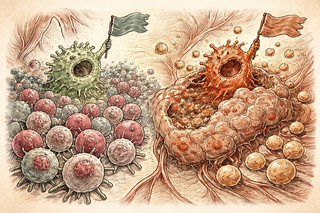
Picking Sides on the Cellular Chessboard
Here's the setup. Lung tissue hosts resident immune cells called interstitial macrophages (IMs), and they come in subtypes marked by a surface protein called CD206. Think of CD206-high IMs as the veteran operatives who've been stationed in lung territory since before trouble started.
Ghosh, Jakubzick, and colleagues discovered that these veterans split into factions with radically different allegiances. Some CD206-high IMs pump out chemokines called CXCL9, CXCL10, and CXCL13 - essentially broadcasting "all friendlies, rally here" from positions along the lung's bronchovascular corridors. These signals recruit T cells and B cells, and - this is the big move - they build tertiary lymphoid structures (TLS), which are basically pop-up military bases your immune system assembles right next to the tumor (Ghosh et al., 2026).
TLS have been one of immunology's hottest topics because patients whose tumors contain them tend to respond better to immunotherapy and have improved survival outcomes (Li et al., 2025). Having macrophages that actively construct these structures? That's like discovering your defensive line has been secretly building forward operating bases.
The Double Agent Problem
But not all resident macrophages got the anti-tumor memo. Another subset - the CCL2-expressing IMs - positioned themselves inside the tumor and started recruiting reinforcements for the wrong team. Their CCL2 signal acts as a homing beacon for Ly6c2+Fn1+Vcan+ monocyte-derived macrophages, which roll in and proceed to suppress immune responses and support tumor growth.
So the same class of cell, sitting in different locations, sending different chemical signals, playing for opposite sides. If this were a chess match, it's as if your own bishops started protecting the opponent's king.
The CCL2-monocyte recruitment axis has long been suspected of aiding tumors. Previous research showed that CCL2 blockade slows primary tumor growth and inhibits metastasis across multiple cancer models (Fridlender et al., 2010). What Jakubzick's team adds is the spatial intelligence - where these traitorous signals originate and how they create distinct immunosuppressive zones within the tumor.
A Third Player Enters the Match
The study uncovered another tactical wrinkle. Monocyte-derived dendritic cells (moDCs) - cells you'd normally count on to present enemy intelligence to the immune system - were migrating to tumor-draining lymph nodes and acting as immunosuppressive antigen-presenting cells. Instead of rallying the troops, they were essentially telling T cells to stand down.
The countermove? Blocking the CCR5 receptor that these rogue dendritic cells use to travel. When the researchers combined CCR5 blockade with dendritic cell-based vaccination, anti-tumor immunity improved. That's a potential real-world maneuver: maraviroc, an existing CCR5 inhibitor already FDA-approved for HIV, could theoretically be repurposed to enhance cancer vaccines.
Why the Map Matters More Than the Army
This study builds on the Jakubzick lab's earlier discovery that lung macrophages organize into at least ten chemokine-defined subsets with conserved roles across tissues and species (Li et al., 2024). Combined with evidence that macrophage-derived CXCL9 and CXCL10 are essential for checkpoint immunotherapy to work (House et al., 2020), the emerging picture is clear: it's not just about having macrophages present in tumors. It's about which macrophages, where they're positioned, and what signals they're broadcasting.
Cancer immunology has spent years asking "how many immune cells infiltrate the tumor?" This research suggests the better question is "who controls the territory?" The tumor microenvironment isn't a random crowd - it's a mapped battlefield with defined zones of attack and sabotage, and macrophages are the ones drawing the lines.
For patients, this means future therapies might not just boost the immune system broadly but target specific chemokine pathways to flip the spatial balance - reinforcing the anti-tumor outposts while cutting supply lines to the tumor's allies. Checkmate isn't about having more pieces. It's about controlling the right squares.
References
-
Ghosh, S., Li, X., Rawat, K., Dighal, A., Kalinowski, S., Hosseini, R., Kolling, F.W., Ringelberg, C.S. & Jakubzick, C.V. Chemokine-defined macrophage niches establish spatial organization of tumor immunity. Nature Immunology (2026). DOI: 10.1038/s41590-026-02445-2 | PMID: 41872505
-
Li, X., Mara, A.B., Musial, S.C., Kolling, F.W., Gibbings, S.L., Gerebtsov, N. & Jakubzick, C.V. Coordinated chemokine expression defines macrophage subsets across tissues. Nature Immunology 25, 1110-1122 (2024). DOI: 10.1038/s41590-024-01826-9 | PMCID: PMC11565582
-
House, I.G., Savas, P., Lai, J. et al. Macrophage-derived CXCL9 and CXCL10 are required for antitumor immune responses following immune checkpoint blockade. Clinical Cancer Research 26(2), 487-504 (2020). DOI: 10.1158/1078-0432.CCR-19-1868 | PMID: 31636098
-
Li, J., Huang, L., Zhao, H. et al. Tertiary lymphoid structures and cancer immunotherapy: From bench to bedside. Med (2025). DOI: 10.1016/j.medj.2024.12.005 | PMID: 39798544
-
Fridlender, Z.G. et al. Monocyte chemoattractant protein-1 blockade inhibits lung cancer tumor growth by altering macrophage phenotype and activating CD8+ cells. Cancer Research 70(9), 3857-3866 (2010). DOI: 10.1158/0008-5472.CAN-09-3903 | PMID: 20395632
Disclaimer: The image accompanying this article is for illustrative purposes only and does not depict actual experimental results, data, or biological mechanisms.