[Stage direction: A single B-cell stands center stage under a flickering spotlight. It clutches a chromosome 11 fragment that clearly belongs somewhere else. The cell cycle clock on the wall spins too fast. Enter, stage left, an increasingly sophisticated lineup of molecular inhibitors, engineered T-cells, and bispecific antibodies, each carrying blueprints.]
Somewhere in the design phase of your immune system, there's a component called the mantle zone - a thin ring of B-cells surrounding the germinal centers of your lymph nodes. Think of it as a buffer zone, the biological equivalent of that DMZ between your network's trusted and untrusted segments. Most of the time, these cells do their job quietly. But in about 6% of non-Hodgkin lymphoma cases, something goes catastrophically wrong in this zone, and the result is mantle cell lymphoma (MCL) - a cancer that, until recently, ran circles around every treatment thrown at it.
The Root Cause: A Wiring Error
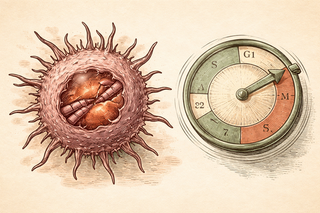
MCL's origin story reads like a classic engineering fault report. A chromosomal translocation - specifically t(11;14) - swaps genetic material between chromosomes 11 and 14, jamming the cyclin D1 gene next to the immunoglobulin heavy chain promoter. The result? Cyclin D1, a protein that normally helps regulate your cell's G1/S phase checkpoint, gets overexpressed like a stuck accelerator pedal. The cell cycle's built-in braking system fails, and these B-cells start replicating without authorization. Median age at diagnosis: 68. Male-to-female ratio: 4:1. Percentage presenting with advanced disease: about 80%. The system has been compromised for a while before anyone notices the alerts.
BTK Inhibitors: Installing a Circuit Breaker
For years, the standard approach was chemotherapy plus rituximab - essentially hitting the problem with a very large hammer. It worked, sort of, but MCL kept rebooting. The real shift came with Bruton's tyrosine kinase (BTK) inhibitors, drugs that block a critical signaling node in the B-cell survival pathway.
Think of BTK as a relay switch that keeps malignant B-cells powered on. First-generation inhibitors like ibrutinib flipped that switch off, and outcomes improved dramatically. But ibrutinib was a bit like using a breaker panel that also trips the circuits in your kitchen and bathroom - off-target effects meant cardiac arrhythmias and bleeding weren't uncommon.
Second-generation options got more selective. In January 2025, the FDA approved acalabrutinib combined with bendamustine and rituximab for untreated MCL patients ineligible for transplant, based on the ECHO trial's impressive data: median progression-free survival of 66.4 months versus 49.6 months with chemo alone (Dreyling et al., Blood, 2025). That's a meaningful upgrade to the system's uptime.
Then came pirtobrutinib, a third-generation, non-covalent BTKi that works even after the earlier models fail. In the BRUIN trial, patients who'd already progressed through prior BTK inhibitors still saw a 57% response rate - not bad for a population where the previous firmware was completely bricked (Wang et al., J Clin Oncol, 2024; DOI: 10.1200/JCO.23.00562).
CAR-T Cells: Deploying Custom-Built Security
When BTK inhibitors aren't enough, the engineering gets more ambitious. Brexucabtagene autoleucel (brexu-cel) is a CAR-T cell therapy - essentially a process where engineers extract a patient's T-cells, retrofit them with a chimeric antigen receptor that targets CD19 on lymphoma cells, expand the fleet, and redeploy. It's bespoke security firmware for your immune system.
The ZUMA-2 trial's five-year data showed a 91% overall response rate and a median overall survival of 46.4 months in heavily pretreated patients, with 44% still alive at last follow-up (Wang et al., N Engl J Med, 2020; DOI: 10.1056/NEJMoa1914347). The FDA granted brexu-cel full approval, including for BTK inhibitor-naive patients. The catch? Cytokine release syndrome hits 93% of recipients, and neurological events affect 80%. The system reboots hard before it stabilizes.
The Expanding Toolkit: Bispecifics, Degraders, and Beyond
As Tavarozzi and colleagues lay out in their comprehensive new review in Leukemia, the MCL treatment architecture is getting genuinely modular (Tavarozzi et al., Leukemia, 2026; DOI: 10.1038/s41375-026-02942-1). Bispecific antibodies - molecules engineered with two binding arms, one grabbing the tumor cell and the other grabbing a T-cell - are essentially matchmaking services that introduce your immune system's enforcers directly to their targets. BTK degraders like NX-2127 don't just inhibit the protein; they tag it for destruction, the molecular equivalent of not just flipping the breaker but ripping the faulty wiring out entirely.
The Remaining Failure Modes
The honest engineering assessment: MCL is still not curable for most patients. High-risk subtypes carrying TP53 mutations or blastoid morphology remain the hardest failure modes to patch. Sequencing these therapies optimally - which circuit breaker first, when to deploy the custom T-cells, where bispecifics fit - is the open design problem (Dreyling et al., Blood, 2025; DOI: 10.1182/blood.2024024038). And not every patient qualifies for CAR-T manufacturing timelines or tolerates the reboot.
But the trajectory is clear. A disease that once had a median survival of three to five years now has patients crossing the five-year mark on therapies that didn't exist a decade ago. The system isn't fully debugged, but the engineering team has never had more tools on the bench.
References:
-
Tavarozzi R, Maher N, Catania G, et al. Evolving therapeutic strategies in mantle cell lymphoma: advancements and future directions. Leukemia. 2026. DOI: 10.1038/s41375-026-02942-1
-
Wang ML, Munoz J, Goy A, et al. KTE-X19 CAR T-cell therapy in relapsed or refractory mantle-cell lymphoma. N Engl J Med. 2020;382(14):1331-1342. DOI: 10.1056/NEJMoa1914347
-
Wang M, Shah NN, Alencar AJ, et al. Pirtobrutinib in covalent Bruton tyrosine kinase inhibitor pretreated mantle-cell lymphoma. J Clin Oncol. 2024;42(5):533-543. DOI: 10.1200/JCO.23.00562
-
Dreyling M, Doorduijn JK, Giné E, et al. Frontline management of mantle cell lymphoma. Blood. 2025;145(7):663-682. DOI: 10.1182/blood.2024024030
-
Dreyling M, Cheah CY, von Bergwelt-Baildon M, et al. High-risk MCL: recognition and treatment. Blood. 2025;145(7):683-698. DOI: 10.1182/blood.2024024038
Disclaimer: The image accompanying this article is for illustrative purposes only and does not depict actual experimental results, data, or biological mechanisms.