UCSF Research Team Discovers New Villain Hiding in Pancreatic Tumors After Knocking Out Fibroblast's Primary Communication Channel
Alright, hold up. Before your eyes glaze over at "cancer-associated fibroblasts," let me tell you what these things actually are: the tumor's personal construction crew, interior decorators, and security team rolled into one. They build the scaffolding around tumors, decide who gets in and out, and generally make life easier for cancer cells that should really be evicted from the premises.
A team at UCSF just figured out how to edit these fibroblasts' genes inside living tumors - not in a dish, not in isolation, but right there in the belly of the beast. And when they started cutting their communication lines, specifically one called TGFBR2, they stumbled onto something nobody expected.
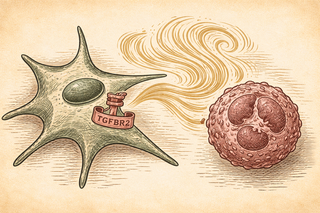
When You Cut a Signal, Something Else Picks Up the Phone
Here's the setup: fibroblasts in tumors receive signals through various receptors, kind of like having multiple email accounts for different purposes. TGFBR2 is one of these - it's how cells receive TGF-beta signals, which normally tell fibroblasts to stay calm and maintain order.
The researchers snipped out this receptor in fibroblasts inside mouse tumors. Reasonable hypothesis: maybe the tumor's support network would fall apart without these signals. What actually happened was considerably weirder.
Instead of collapsing, these edited fibroblasts morphed into something new - a cell state marked by high levels of a protein called Col18a1. Think of it as fibroblasts putting on a different uniform and starting a completely different job. And this new job? Not great news.
The Col18a1hi Problem
When the team looked at human pancreatic cancer data, patients whose tumors had this Col18a1-high fibroblast signature had worse survival outcomes. That's the kind of finding that makes researchers sit up straight and start asking harder questions.
What are these transformed fibroblasts doing? They're recruiting a particular flavor of immune cells called Siglec-F-high neutrophils through a chemical messenger called CXCL5. If neutrophils were employees, these particular ones would be the type who show up, punch in, and then spend all day making everyone else's job harder. Research has previously shown that CXCL5-mediated neutrophil recruitment into tumors correlates with reduced survival in multiple cancer types.
The Circuit Diagram
The researchers didn't stop at identifying the problem. They mapped out the whole circuit:
- Lose TGFBR2 signaling in fibroblasts
- Col18a1-high fibroblasts emerge
- These fibroblasts start pumping out CXCL5
- Siglec-F-high neutrophils come running
- Tumor microenvironment gets remodeled in tumor-friendly ways
But wait - what's making the Col18a1-high state happen? Through more gene knockouts, they found it depends on two things: TNFR1 (a receptor for tumor necrosis factor) and canonical Wnt signaling. Recent work has shown that Wnt signaling in cancer-associated fibroblasts can flip cells between subtypes with completely different effects on tumors.
Why This Matters Beyond the Lab
Pancreatic cancer remains brutally difficult to treat, with 5-year survival rates around 13%. A big part of the problem is the dense, fibroblast-rich stroma that shields tumor cells from both the immune system and chemotherapy.
Previous attempts to just eliminate fibroblasts backfired spectacularly - survival actually got worse in some studies. The issue was that we were treating fibroblasts like a single enemy when they're actually a diverse ecosystem. Some fibroblast types restrain tumors; others enable them. Current research identifies at least eight distinct CAF subtypes with different molecular signatures and functions.
This study's contribution isn't just finding another bad actor - it's showing a method to precisely edit fibroblasts in situ and map out how changes ripple through the tumor ecosystem. The technique is described as fast, affordable, and modular, which in scientific terms means "other labs can actually do this."
The Takeaway
Sometimes you have to break something to see how it works. By cutting one communication line in tumor fibroblasts, researchers uncovered an entirely new cell state that appears to actively worsen outcomes in pancreatic cancer patients. More importantly, they traced the whole pathway - from trigger to consequence - giving future researchers actual targets to aim at.
The tumor microenvironment keeps revealing itself to be less like a simple battlefield and more like a dysfunctional office where everyone's job depends on everyone else's, and occasionally someone switches departments without telling HR.
References:
-
Kuhn NF, et al. Local gene editing of fibroblasts in tumors reveals a new cancer-associated fibroblast state. J Exp Med. 2025. DOI: 10.1084/jem.20251228 | PubMed
-
Biffi G, Tuveson DA. Cancer-associated fibroblasts in pancreatic ductal adenocarcinoma. Cell Death Dis. 2022. https://www.nature.com/articles/s41419-022-05351-1
-
Czekay RP, et al. Cancer‐Associated Fibroblasts: Heterogeneity, Cancer Pathogenesis, and Therapeutic Targets. Mol Oncol. 2025. PMC12246558
-
Karstens KF, et al. A Wnt-Induced Phenotypic Switch in Cancer-Associated Fibroblasts Inhibits EMT in Colorectal Cancer. Cancer Res. 2020. https://aacrjournals.org/cancerres/article/80/24/5569/647612/
-
Haider C, et al. Transforming Growth Factor-β and Axl Induce CXCL5 and Neutrophil Recruitment in Hepatocellular Carcinoma. Hepatology. 2019. PMC6590451
Disclaimer: The image accompanying this article is for illustrative purposes only and does not depict actual experimental results, data, or biological mechanisms.