There's a villain living rent-free in the human brain, and it's been getting away with murder for decades. Glioblastoma - GBM to those unfortunate enough to know it well - is the sort of antagonist that laughs at our best weapons. Surgery? It infiltrates like smoke through cracks. Radiation? It adapts. Chemotherapy? Please. The median survival after diagnosis is a brutal 14 months, and that number hasn't budged much in twenty years.
But here's where our story takes an unexpected turn.
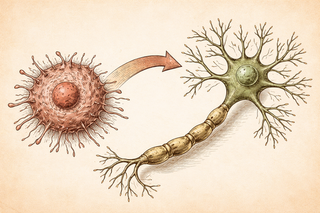
Enter the Shapeshifter
At the heart of every GBM lurks a particularly troublesome cast of characters: glioma stem cells (GSCs). Think of them as the mob bosses of the tumor world - they don't just divide endlessly, they recruit, they resist, they hide, and when you think you've taken them out, they respawn the whole operation. These cells have the infuriating ability to self-renew and differentiate, which is exactly what normal stem cells do, except GSCs use these powers for evil.
Scientists have long wondered: what if we could convince these cellular criminals to retire? Not kill them (they're annoyingly good at surviving that), but reform them. Turn them into something harmless. Say, neurons - those post-mitotic couch potatoes of the brain that have completely forgotten how to divide.
The Plot Thickens: A Protein Called PTBP1
A team of researchers led by Shuang Hao and Anhua Wu at Harbin Medical University decided to play detective. They started by examining tumor samples from 65 glioma patients using deep learning to classify cell shapes, and discovered something cinema-worthy: tumors with rounder, stem-like cells spelled worse outcomes. Tumors with more elongated, neuron-like cells? Better survival.
The culprit keeping cells in their aggressive, rounded state? A protein called PTBP1, an RNA-binding protein that acts like a molecular puppeteer controlling which genes get expressed. PTBP1 is the bouncer at the differentiation nightclub, turning away any cellular intentions of growing up and settling down.
When the researchers knocked down PTBP1 in glioma stem cells, something remarkable happened. The cells stretched out, sprouted neuron-like extensions, and - critically - stopped dividing. The former troublemakers had been reprogrammed into law-abiding neuronal citizens.
The Signaling Pathway: Three Characters, One Drama
Here's where the molecular plot gets juicy. PTBP1, it turns out, suppresses something called DUSP5 - a phosphatase that normally puts the brakes on ERK1/2 signaling. ERK signaling is one of those pathways that cells use to decide whether to proliferate or differentiate. Too much ERK activity? The cells keep dividing like they're trying to win a reproduction contest.
By knocking down PTBP1, the researchers unleashed DUSP5, which then slammed the brakes on ERK1/2. With the proliferation signal dampened, the glioma stem cells had no choice but to mature. It's like cutting off a teenager's credit cards - suddenly, growing up becomes the only option.
The Twist: An Old Drug Learns New Tricks
Now, discovering a mechanism is one thing. Finding a drug that can exploit it is the sequel everyone wants. The team screened existing compounds and landed on an unexpected candidate: venetoclax, a drug already FDA-approved for treating leukemia.
But venetoclax has a problem - it barely crosses the blood-brain barrier, that frustrating biological bouncer that keeps most drugs out of the brain. Solution? Wrap it in nanoparticles. The team created A2-PLGA/venetoclax, essentially giving the drug a VIP pass to the brain.
In mouse models, these nanoparticles infiltrated glioblastoma tumors, blocked PTBP1, triggered the differentiation cascade, and suppressed tumor growth. The mice lived longer. The tumors shrank. The mechanism held.
The Bigger Picture
This research represents a philosophical shift in how we might approach GBM. Instead of trying to kill cancer cells (which have evolved spectacular survival mechanisms), what if we could force them to differentiate into harmless cells? It's rehabilitation over execution, and it might just outmaneuver the tumor's defense strategies.
Of course, we're still in the early chapters. Mouse models aren't humans. Nanoparticle delivery systems need optimization. Clinical trials are years away. But the PTBP1/DUSP5/ERK1/2 axis represents a promising new target, and the repurposing of venetoclax shows how existing drugs might find unexpected second careers - much like the glioma cells they're designed to reform.
For the roughly 300,000 people diagnosed with GBM globally each year, any new chapter in this story is worth reading.
References
-
Li C, Chen M, Guo S, et al. PTBP1 knockdown reprograms glioma stem cells into neuronal-like cells and suppresses tumorigenesis via the DUSP5-ERK1/2 signaling pathway. Neuro-Oncology. 2025. DOI: 10.1093/neuonc/noag068
-
Sahoo S, et al. The hidden architects of glioblastoma multiforme: Glioma stem cells. MedComm – Oncology. 2024. DOI: 10.1002/mog2.66
-
Caunt CJ, et al. Dual-specificity phosphatase 5 controls the localized inhibition, propagation, and transforming potential of ERK signaling. PNAS. 2017;114(3):E317-E326. DOI: 10.1073/pnas.1614684114 PMCID: PMC5255582
-
Shen X, et al. Molecular Mechanisms and Strategies for Inducing Neuronal Differentiation in Glioblastoma Cells. Cellular Reprogramming. 2025. DOI: 10.1089/cell.2024.0087
-
Niessen M, et al. A Novel Approach for Glioblastoma Treatment by Combining Apoptosis Inducers (TMZ, MTX, and Cytarabine) with E.V.A. Cancers. 2024;16(7):1404. PMCID: PMC11011525
-
Broekman ML, et al. Glioblastoma: Clinical Presentation, Multidisciplinary Management, and Long-Term Outcomes. J Clin Med. 2025. PMCID: PMC11719842
Disclaimer: The image accompanying this article is for illustrative purposes only and does not depict actual experimental results, data, or biological mechanisms.