Recipe for a cancer cell disaster:
Take one perfectly normal cell. Add a heaping tablespoon of whole-genome duplication - that's when a cell accidentally copies ALL its DNA and keeps both sets. Fold in some genomic instability, let it simmer under therapeutic stress, and watch what emerges from the oven. But here's where the recipe gets controversial: are we baking up trouble with tetraploid cells (4 copies of everything), or are those massive polyploid giant cancer cells (8+ copies) the real menace? A new opinion piece in Trends in Cell Biology just threw down the gauntlet.
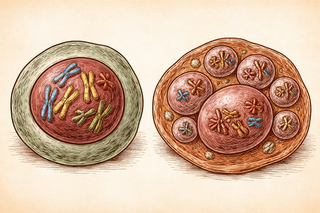
The Tetraploid: Cancer's Reliable Troublemaker
Let's start with what we actually know. Tetraploid cells - cells that have doubled their genome exactly once - are like that friend who's "just chaotic enough" to be interesting at parties but occasionally sets something on fire. About 30-40% of human cancers show evidence of whole-genome doubling (WGD), and this isn't coincidental [1].
When a cell goes tetraploid, it gains what scientists call "evolvability." Extra chromosomes mean extra genetic material to shuffle around, mutate, and generally cause problems. These cells become genomically unstable, throwing off chromosomes left and right, creating the kind of cellular diversity that lets tumors adapt and survive. Studies in mice, cell lines, and actual human tumor sequencing data all point to the same conclusion: tetraploidy is a legitimate stepping stone to cancer progression [2].
The evidence here is solid. We can track these cells. We can sequence tumors and see the WGD signature. We can create tetraploid cells in the lab and watch them misbehave. The receipts exist.
Enter the Giants: Big Cells, Bigger Questions
Now for the plot twist that's been generating considerable buzz in oncology circles. Polyploid giant cancer cells - or PGCCs, because everything needs an acronym - are absolutely massive cells that emerge when tumors get stressed, particularly by chemotherapy. We're talking cells with 8, 16, sometimes 32 copies of the genome. These things are the cellular equivalent of a monster truck parked in a compact car space.
The exciting hypothesis goes like this: PGCCs hunker down during treatment, survive the chemical onslaught, and then somehow spawn smaller, nimbler daughter cells that repopulate the tumor. It's like a phoenix rising from therapeutic ashes, and it would explain a lot about cancer recurrence and drug resistance [3].
There's just one small problem, according to Bloomfield and colleagues: the evidence that this actually happens in human patients is... well, let's call it "aspirational."
Show Me the Data (Please?)
Here's where things get spicy. The research team argues that while PGCC behavior has been documented extensively in laboratory settings, the critical leap - proving that viable progeny from these giant cells actually drive cancer progression in real human tumors - hasn't been convincingly made [4].
Much of the PGCC literature relies on cell culture experiments, where conditions are controlled but artificial. Cells do weird things in dishes that they might never do inside an actual human body. The tumor microenvironment is complicated, resources are limited, and the immune system has opinions about large, abnormal cells wandering around.
This isn't to say PGCCs are irrelevant. They clearly exist. They clearly do something. But whether that something is "secretly orchestrating cancer's comeback tour" or "just being big and dying awkwardly" remains genuinely unclear.
Why This Argument Matters
You might be thinking: why does this scientific squabble matter to anyone outside a laboratory? Because treatment strategies depend on understanding what actually drives cancer progression.
If tetraploid cells are the main concern, therapeutic approaches might focus on preventing that initial genome doubling event or targeting the specific vulnerabilities of cells with doubled chromosomes. If PGCCs are the real culprit behind treatment resistance, we need entirely different strategies - ones that either prevent giant cell formation or somehow neutralize them while they're dormant.
Getting this wrong means potentially chasing the wrong targets while the actual problem keeps multiplying.
The Bottom Line
The authors aren't saying PGCCs don't matter - they're saying the enthusiasm has outpaced the evidence. Tetraploidy's role in cancer has decades of multi-level support. The PGCC hypothesis, while genuinely intriguing, needs more rigorous demonstration that these cells actually produce viable, cancer-driving offspring in human tumors rather than just laboratory conditions.
Science at its best involves exactly this kind of productive disagreement. Someone needs to be the voice asking "but can we prove that?" even when the story is compelling. Consider this your invitation to watch this space - because whoever's right, the answer matters.
References
-
Bielski CM, Zehir A, Penson AV, et al. Genome doubling shapes the evolution and prognosis of advanced cancers. Nat Genet. 2018;50(8):1189-1195. doi:10.1038/s41588-018-0165-1
-
Fujiwara T, Bandi M, Nitta M, et al. Cytokinesis failure generating tetraploids promotes tumorigenesis in p53-null cells. Nature. 2005;437(7061):1043-1047. doi:10.1038/nature04217
-
Mirzayans R, Murray D. Intratumor heterogeneity and therapy resistance: contributions of dormancy, apoptosis reversal (anastasis) and cell fusion to disease recurrence. Int J Mol Sci. 2020;21(4):1308. doi:10.3390/ijms21041308 PMCID: PMC7072907
-
Bloomfield M, Vora S, Epa D, Gabrielli B, Cimini D. Tetraploids or polyploid giants: who is truly dangerous? Trends Cell Biol. 2026. doi:10.1016/j.tcb.2026.03.003
Disclaimer: The image accompanying this article is for illustrative purposes only and does not depict actual experimental results, data, or biological mechanisms.