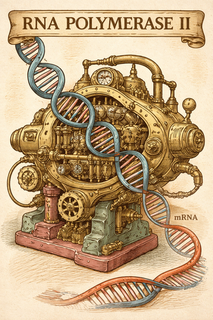
RNA polymerase II is the enzyme that reads DNA and makes messenger RNA. That sounds tidy until you remember it is doing this on crowded chromatin, while DNA replication and repair are happening nearby, all inside a nucleus that has the traffic design of a medieval alleyway. When Pol II stalls, slows, or loses coordination, bad things can pile up fast: RNA-DNA hybrids, replication-transcription collisions, messed-up splicing, and lower expression of genes that are supposed to fix damage in the first place. It is less "one broken cog" and more "the office printer jammed and now accounting is on fire."
That link between transcription and repair is not new. Recent work has shown in increasing detail how stalled RNA polymerase II talks to DNA repair machinery and how failures in that handoff can threaten genome stability and contribute to disease Kokic et al., 2021; van der Meer and Luijsterburg, 2025. What this new paper adds is a specific stress-response axis - HSF2 plus HSP110 - that seems to keep Pol II functional after ionizing radiation rather than merely showing up after the damage is already done.
The genome’s night shift
The authors report that x-irradiation activates this HSF2-HSP110 axis. When they removed either HSF2 or HSP110, cells accumulated more DNA damage and became more sensitive to radiation. Mechanistically, the story centers on RNA polymerase II processivity and phosphorylation of its C-terminal domain at serine 7. Translation: the transcription machine did not keep moving properly, and one of its important regulatory tags went missing.
Once that happened, the downstream consequences looked like a small disaster with excellent documentation. Transcription became dysregulated. Replication-transcription conflicts increased. Pre-mRNA splicing changed. Levels of DNA repair genes dropped. Damage lingered. If you enjoy causal chains, this paper is basically a catered event.
The in vivo result is the part that should make cancer researchers sit up a little straighter. In mice, loss of HSF2 sped up the development of ionizing-radiation-induced T cell lymphoma. That does not mean HSF2 loss causes human lymphoma in some tidy one-line way. Biology rarely grants us that kind of emotional closure. But it does suggest that this axis helps restrain the consequences of genotoxic stress in a whole organism, not just in cultured cells Jin et al., 2026.
Why this could matter outside the lab freezer
If these findings hold up, the clinical angle is straightforward and tricky at the same time. Straightforward, because tumors often depend on stress-response and DNA-damage-response pathways to survive radiation and certain chemotherapies. Tricky, because normal cells also enjoy not having their genomes shredded. The epidemiologist in me is obligated to ruin the party with denominators: a useful target is not just one that sensitizes tumors, but one that widens the gap between harm to cancer cells and harm to healthy tissue.
Still, the idea is compelling. Instead of targeting DNA repair enzymes directly, maybe you can sabotage the transcription support system that keeps repair genes expressed during stress. That is a little like cutting the phone lines to the repair crew instead of fighting every mechanic individually. Modern work on transcription-coupled repair, RNAPII organization, and transcription-linked genome stability makes that idea feel increasingly plausible, not like a grant abstract written at 2 a.m. after bad coffee Duan et al., 2021; Rippe and Papantonis, 2025; Wagner et al., 2024.
The bigger takeaway is simple: cancer is not only a story about mutations. It is also a story about whether stressed cells can keep the genome readable, repairable, and statistically less chaotic than it wants to be. This paper suggests HSF2 and HSP110 are part of that anti-chaos coalition. Not the flashiest coalition, perhaps, but then neither is flossing, and you miss it when it is gone.
References
- Jin X, Xi C, Pandya B, et al. HSF2-HSP110 axis supports genome stability via RNA polymerase II transcription and DNA repair. J Cell Biol. 2026;225(6):e202508059. DOI: 10.1083/jcb.202508059
- Kokic G, Wagner FR, Chernev A, et al. Structural basis of human transcription-DNA repair coupling. Nature. 2021;598:368-372. DOI: 10.1038/s41586-021-03906-4. PMCID: PMC8514338
- Duan M, Speer RM, Ulibarri J, Liu KJ, Mao P. Transcription-coupled nucleotide excision repair: New insights revealed by genomic approaches. DNA Repair (Amst). 2021;103:103126. DOI: 10.1016/j.dnarep.2021.103126. PMCID: PMC8205993
- van der Meer PJ, Luijsterburg MS. The molecular basis of human transcription-coupled DNA repair. Nat Cell Biol. 2025;27:1230-1239. DOI: 10.1038/s41556-025-01715-9
- Rippe K, Papantonis A. RNA polymerase II transcription compartments - from factories to condensates. Nat Rev Genet. 2025;26:775-788. DOI: 10.1038/s41576-025-00859-6
- Wagner RE, Arnetzl L, Britto-Borges T, et al. SRSF2 safeguards efficient transcription of DNA damage and repair genes. Cell Rep. 2024;43(11):114869. DOI: 10.1016/j.celrep.2024.114869
Disclaimer: The image accompanying this article is for illustrative purposes only and does not depict actual experimental results, data, or biological mechanisms.