Mycosis fungoides, or MF, is the most common type of cutaneous T-cell lymphoma - a cancer of immune cells that prefers to loiter in the skin like it pays rent there [6,7]. It often behaves slowly, which sounds comforting until you remember that “slow” in cancer biology can also mean “sneaky enough to waste everybody’s time.” MF can masquerade as eczema or psoriasis for years, and that diagnostic hide-and-seek is a known problem [5,6].
That is why this new registry study matters. Filippatos and colleagues looked at 25,467 patients with MF using the TriNetX network, making this the largest real-world MF analysis reported so far [1]. Big datasets are not automatically wise - spreadsheets do not become oracles just because they ate a lot of rows - but they are useful when you want to know how a rare disease behaves outside the curated world of a clinical trial.
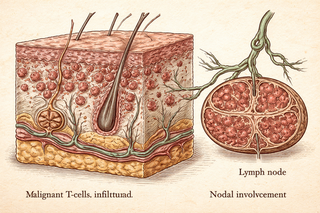
Location, Location, Lymph Node Location
The headline finding is blunt: node involvement at diagnosis was bad news.
In the overall cohort, 5-year and 10-year overall survival were 83.4% and 74.7%. If disease stayed limited to the skin, survival looked better: 86.1% and 78.0%. But when lymph nodes were involved at diagnosis, survival dropped to 74.5% and 63.6%, with an adjusted hazard ratio of 1.60 [1].
That alone would be clinically useful. But the paper goes a step further and asks a much more interesting question: are all involved lymph nodes equally ominous? Apparently not.
Among patients with single-site lymphadenopathy, people with inguinal or lower-limb nodes did best, with 5-year survival of 80.2%, while those with visceral lymphadenopathy did worst, at 62.9% [1]. In other words, MF may not just spread - it may spread with a kind of anatomical hierarchy. Evolution loves geography. A clone that can survive in one neighborhood may still get mugged in another.
That is the kind of detail clinicians actually care about. “Node-positive” is useful. “Which node?” is better.
Cancer, the Tiny Bureaucrat
MF is a disease of malignant T cells, which is darkly funny if you think about it too long. Your immune system is supposed to be security. In MF, part of the security team starts freelancing for chaos.
Recent reviews suggest MF and related Sézary syndrome are not just skin-deep conditions but dynamic systems involving skin, blood, and lymphatic traffic, with malignant cells potentially reseeding sites over time [2,3]. That makes this new study’s focus on nodal anatomy feel less like trivia and more like a map of the battlefield.
The study also reinforces older clinical wisdom with fresher numbers: elevated LDH, lymphocytosis, and eosinophilia predicted worse survival, with LDH standing out especially hard at an adjusted hazard ratio of 3.06 [1]. Translation: routine lab work may be quietly telling you who is dealing with a more dangerous version of the disease.
That is not sexy science. No one is making a prestige TV drama called Mildly Abnormal Serum Markers. But risk stratification wins games.
Why This Matters Outside Oncology Conference Coffee Lines
For patients, MF is often not a cinematic, one-scan, one-biopsy cancer story. It is more like a long administrative nightmare starring rash cream, uncertainty, and the phrase “let’s keep an eye on it.” Diagnostic delays in cutaneous T-cell lymphoma remain a real issue, and patient advocacy groups are full of stories from people who bounced between explanations before landing on the right one [5,8].
So this paper helps in a very grounded way. It gives doctors better benchmarks for counseling patients. It suggests that site-specific nodal involvement should probably factor more clearly into routine prognostic thinking. And it supports a more serious look at simple markers like LDH and eosinophils when estimating risk [1,4].
If these findings hold up across other datasets, they could sharpen follow-up strategies, imaging decisions, and conversations about who may need closer surveillance or earlier escalation. Not a miracle. Not a movie montage. Just better sorting of danger from less danger, which in medicine is often how progress actually shows up.
Nature, as usual, remains horribly inventive. The useful response is not to admire the villain too much - just to get better at reading its moves.
References
-
Filippatos C, Briasoulis A, Terpos E, Fotiou D, Gavriatopoulou M. Real-World Outcomes of Mycosis Fungoides and Site-Specific Nodal Involvement: A Registry-Based Study of 25,467 Patients. Am J Hematol. 2025. DOI: https://doi.org/10.1002/ajh.70334
-
Scarisbrick J, Sokol L. Haematogenous seeding in mycosis fungoides and Sézary syndrome: current evidence and clinical implications. Br J Dermatol. 2025;192(3):381-389. DOI: https://doi.org/10.1093/bjd/ljae441
-
Stuver R, Geller S. Advances in the treatment of mycoses fungoides and Sézary syndrome: a narrative update in skin-directed therapies and immune-based treatments. Front Immunol. 2023;14:1284045. DOI: https://doi.org/10.3389/fimmu.2023.1284045. PMCID: https://pmc.ncbi.nlm.nih.gov/articles/PMC10585160/
-
Allen PB, Khot A, Kim YH, et al. Staging lymph nodes and blood at diagnosis in mycosis fungoides identifies patients at increased risk of progression to advanced stage: A retrospective cohort study. Cancer. 2023;129(4):610-620. DOI: https://doi.org/10.1002/cncr.34579. PMCID: https://pmc.ncbi.nlm.nih.gov/articles/PMC9852075/
-
Brumbaugh B, Thompson B, Holt A, et al. Delays in diagnosis in cutaneous T-cell lymphoma: A retrospective study on clinical course and time to death. J Am Acad Dermatol. 2024;91(5):968-970. DOI: https://doi.org/10.1016/j.jaad.2024.05.099
-
National Cancer Institute PDQ. Mycosis Fungoides and Other Cutaneous T-Cell Lymphomas Treatment (PDQ®) - Health Professional Version. Updated August 16, 2024. https://www.ncbi.nlm.nih.gov/books/NBK65849.16/
-
Wikipedia contributors. Mycosis fungoides. Wikipedia. https://en.wikipedia.org/wiki/Mycosis_fungoides
-
Cutaneous Lymphoma Foundation. Stories of Help and Hope. https://www.clfoundation.org/stories
Disclaimer: The image accompanying this article is for illustrative purposes only and does not depict actual experimental results, data, or biological mechanisms.