The 1962 Alcatraz escape remains one of America's most stubborn unsolved mysteries - three inmates vanished from a prison everyone swore was inescapable, and six decades later, nobody can say for certain how they pulled it off. A research team led by scientists at MD Anderson Cancer Center just pried open a similarly maddening puzzle: how do cancer cells break free from a drug that, by all rights, should have them cornered?
Two Handymen and One Very Clever Trap
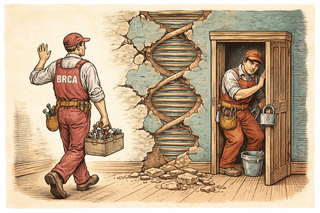
Your cells have a little repair crew inside them. Think of it like two handymen sharing shifts to fix cracks in your house's walls. One goes by BRCA, the other by PARP. Between the two of them, your DNA stays patched up just fine.
In some breast cancers - specifically triple-negative breast cancer, the ornery, hard-to-treat variety - one handyman (BRCA) has already quit. Walked right off the job. So the cancer cell leans entirely on PARP to keep things from falling apart.
Enter talazoparib, a PARP inhibitor. This drug is like locking that second handyman in a closet. With both repair workers out of commission, the cancer cell's DNA crumbles and the cell dies. It's called synthetic lethality, and in clinical trials, talazoparib delivered some jaw-dropping results - over half the women in one neoadjuvant study had zero detectable cancer left by surgery time (Litton et al., 2017). The EMBRACA trial confirmed talazoparib could slow disease progression compared to standard chemotherapy in advanced breast cancer (Litton et al., 2018).
But some tumors didn't cooperate. They survived anyway, and nobody could quite figure out how.
The Great Escape: Two Tunnels, One Prison
In a study just published in Proceedings of the National Academy of Sciences, Abdulkareem and colleagues grew bits of real human tumors in mice - patient-derived xenograft models, if you want the fancy name - and watched what happened as talazoparib resistance developed. What they found was a bit like discovering that Alcatraz inmates had been digging two separate tunnels at the same time.
Tunnel #1: Hiring a surprise contractor. Some tumors cranked up production of a protein called BRN2 - a transcription factor that normally handles brain-related business. (Yes, a brain protein moonlighting in breast cancer. Biology is weird like that.) BRN2 switches on a signaling chain involving ATR and STAT3, two proteins that help the cancer cell jerry-rig an alternative DNA repair system. It's like the tumor posted a job listing on some underground bulletin board and found a third handyman nobody knew about.
Tunnel #2: Letting the weeds take over. Other tumors played a longer game. Lurking within them were small clusters of cells - subclones - that had already lost a protein called SHLD2. SHLD2 belongs to the shieldin complex, a molecular bodyguard crew that normally prevents BRCA1-deficient cells from using a backup repair pathway called homologous recombination (Noordermeer et al., 2018). Lose SHLD2, and suddenly the cell can fix its own DNA again - the very thing talazoparib was counting on being broken. Under drug pressure, these sneaky subclones multiplied until they'd taken over the whole neighborhood. If you've ever pulled weeds from a garden bed only to watch the herbicide-resistant ones fill every inch by August, you already understand this principle perfectly.
Why Should You Care?
Triple-negative breast cancer makes up about 10-15% of all breast cancers and hits younger women and women of African descent disproportionately hard. It's the subtype with the fewest targeted treatments, so when PARP inhibitors showed real promise, the hope was enormous - and earned.
But resistance kept creeping back, like that one stubborn dandelion in the driveway crack. This study matters because knowing how the cancer escapes tells doctors where to set the next trap. If BRN2 is driving resistance through ATR/STAT3, combining talazoparib with ATR inhibitors could keep those cells penned in - and early evidence already suggests dual ATR/PARP blockade can reverse acquired resistance in TNBC models (Wang et al., 2025). If SHLD2-deficient subclones are the culprit, catching them before they take over could change outcomes entirely. Recent reviews have mapped out a whole toolkit of combination strategies aimed at outsmarting these escape routes (Luo et al., 2024).
The Bottom Line
Cancer is a shapeshifter. Every time we build a better mousetrap, some cells chew through the spring. But this research hands us something genuinely useful: a map of the tunnels. And once you know where the digging is happening, you can start pouring concrete.
References
-
Abdulkareem NM, Jiang Y, Qi Y, et al. Resistance to neoadjuvant talazoparib in triple-negative breast cancer by BRN2-induced ATR/STAT3 pathways or SHLD2 subclone expansion. Proc Natl Acad Sci USA. 2026. DOI: 10.1073/pnas.2513742123. PMID: 41961819
-
Litton JK, Scoggins ME, Hess KR, et al. A feasibility study of neoadjuvant talazoparib for operable breast cancer patients with a germline BRCA mutation demonstrates marked activity. npj Breast Cancer. 2017;3:49. DOI: 10.1038/s41523-017-0052-4
-
Litton JK, Rugo HS, Ettl J, et al. Talazoparib in patients with advanced breast cancer and a germline BRCA mutation. N Engl J Med. 2018;379(8):753-763. DOI: 10.1056/NEJMoa1802905
-
Noordermeer SM, Adam S, Setiaputra D, et al. The shieldin complex mediates 53BP1-dependent DNA repair. Nature. 2018;560(7716):117-121. DOI: 10.1038/s41586-018-0340-7
-
Luo J, et al. Combination strategies with PARP inhibitors in BRCA-mutated triple-negative breast cancer: overcoming resistance mechanisms. Oncogene. 2024. DOI: 10.1038/s41388-024-03227-6
-
Wang X, et al. Dual inhibition of ATR and PARP reverses acquired PARP inhibitor resistance in triple negative breast cancer. Discover Oncology. 2025. DOI: 10.1007/s12672-025-03844-x
Disclaimer: The image accompanying this article is for illustrative purposes only and does not depict actual experimental results, data, or biological mechanisms.