For years, the standard story in adult Ph+ ALL went something like this: get the leukemia into remission, then hustle the patient toward an allogeneic stem cell transplant. That transplant brings in donor immune cells that can attack leftover leukemia - a useful trick called the graft-versus-leukemia effect. Very cool in theory. Also, not exactly a spa day in practice.
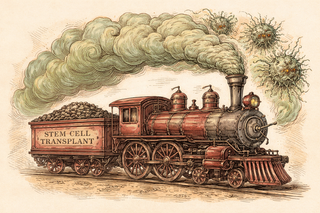
Transplant can save lives, but it comes with serious baggage: infections, organ toxicity, and graft-versus-host disease, which is what happens when your new immune system shows up like an overconfident houseguest and starts rearranging the furniture with a flamethrower.
The review by Pasic and Lipton asks a very 2025 question: do all patients with Ph+ ALL still need that transplant in first remission, now that targeted drugs work so much better? (doi)
The leukemia’s subway line just got blocked
Picture this disease as a subway map with one wildly overactive line: BCR::ABL1. Tyrosine kinase inhibitors, or TKIs, are the people standing on the platform yelling, "Nope, this train is out of service." First came imatinib, then newer drugs like dasatinib and ponatinib, which have generally pushed responses deeper and faster.
That already changed the game. Then researchers added blinatumomab, an immunotherapy that acts like a matchmaker with zero respect for personal space - it physically brings T cells up against leukemia cells so the immune system can do its job. Suddenly, treatment for some patients started looking less like carpet-bombing and more like precision air traffic control.
A 2024 Journal of Clinical Oncology study of ponatinib plus blinatumomab in newly diagnosed Ph+ ALL reported high rates of complete molecular response and strong survival signals, which is exactly the sort of result that makes transplant doctors stare into the middle distance and rethink traditions (Kantarjian et al.). Earlier chemo-light and chemo-free approaches have also looked impressive (Jabbour et al.).
The real plot twist is microscopic
The key character in this whole debate is measurable residual disease, or MRD. That means looking for tiny traces of leukemia that regular microscopy misses. If remission is what the room looks like with the lights on, MRD is what shows up when you bring a forensic flashlight and suddenly regret owning furniture.
Why does MRD matter so much? Because not all remissions are equally safe. A patient who becomes deeply MRD-negative early after modern TKI-based treatment may have a very different risk profile from someone whose leukemia lingers in molecular hiding spots.
That is the heart of the review: transplant is no longer a one-size-fits-all reflex. It is becoming a risk-adapted decision based on MRD, the TKI used, the durability of response, age, fitness, donor options, and the messier realities of actual human bodies, which rarely read treatment algorithms before behaving unpredictably.
So, can some patients skip transplant?
Maybe yes. Not definitely yes for everyone. And that "maybe" is doing some heavy lifting.
Emerging data suggest that a subset of patients with deep molecular responses on potent TKIs and immunotherapy may do well without allogeneic transplant. There is even early interest in treatment-free remission after prolonged TKI use in carefully selected non-transplant patients (Dragani et al.).
But this is where adult supervision returns. Long-term follow-up is still limited, relapse can still happen, and the stakes are high enough that nobody should be making decisions because one curve on a conference slide looked handsome. Reviews in Leukemia make the same point: modern therapy has complicated the transplant question, not erased it (Abou Dalle et al.).
If transplant still happens, details matter a lot
When patients do go to transplant, the conversation shifts from "whether" to "how." Donor selection matters. Conditioning intensity matters. Graft-versus-host disease prevention matters. Post-transplant TKI maintenance matters. This is less like flipping a switch and more like tuning an absurdly expensive race car while it is already on the track.
And the future keeps getting weirder in a good way. CAR T-cell therapy is lurking in the wings as bridge therapy, salvage therapy, or maybe part of consolidation for selected patients. The neighborhood around Ph+ ALL is changing fast. What used to be a straightforward road now looks like a cloverleaf interchange designed by a caffeinated octopus.
That is why this paper is worth your attention. It captures a moment when medicine is moving from blunt rules to sharper judgment. The old question was, "Who gets transplant?" The new question is, "Who genuinely benefits from transplant after we throw our best modern tools at the leukemia first?" That is a smarter question. Also a harder one. Cancer, as usual, refused to keep things simple.
References
-
Pasic I, Lipton JH. The role of allogeneic hematopoietic cell transplantation in the management of Philadelphia chromosome-positive acute lymphoblastic leukemia in the era of tyrosine kinase inhibitors. Am J Hematol. 2025. DOI: https://doi.org/10.1002/ajh.70330
-
Kantarjian H, Short NJ, Jabbour E, et al. Ponatinib and blinatumomab for Philadelphia chromosome-positive acute lymphoblastic leukaemia: a US, single-centre, single-arm, phase 2 trial. J Clin Oncol. 2024. DOI: https://doi.org/10.1200/JCO.23.01455
-
Jabbour E, Short NJ, Ravandi F, et al. Chemotherapy-free regimen of dasatinib plus blinatumomab for patients with Philadelphia chromosome-positive acute lymphoblastic leukemia. JAMA Oncol. 2022. DOI: https://doi.org/10.1001/jamaoncol.2022.0410
-
Abou Dalle I, Kantarjian H, Jabbour E, Short NJ. Adult Philadelphia chromosome-positive acute lymphoblastic leukemia in 2024: ten frequently asked questions. Leukemia. 2024. DOI: https://doi.org/10.1038/s41375-024-02350-z
-
Dragani M, Longhitano C, Candoni A, et al. Discontinuation of tyrosine kinase inhibitors in non-allografted patients with Philadelphia-positive acute lymphoblastic leukemia: a Campus ALL real-life study. Haematologica. 2025. DOI: https://doi.org/10.3324/haematol.2025.287020
Disclaimer: The image accompanying this article is for illustrative purposes only and does not depict actual experimental results, data, or biological mechanisms.