Cancer treatment sometimes feels like logistics with better microscopes. You fix a supply-chain failure, reroute the trucks, and for a while everything runs on schedule - then the warehouse starts quietly swapping labels, opening side doors, and inventing a whole new inventory system just to spite you.
That is basically the drama with pirtobrutinib in mantle cell lymphoma, or MCL. MCL is a B-cell cancer, and B cells rely heavily on a signaling protein called BTK, which works a bit like a relay switch in the cell’s survival circuitry. Drugs that block BTK have helped many patients, but tumors are not famous for respecting maintenance manuals. Pirtobrutinib was designed as a newer, non-covalent BTK inhibitor that can still work after earlier BTK drugs fail, and it showed meaningful activity in pretreated MCL in the BRUIN trial (Wang et al., 2023).
Now comes the annoying systems-engineering question: why does resistance still happen?
Three Scanners, One Very Suspicious Warehouse
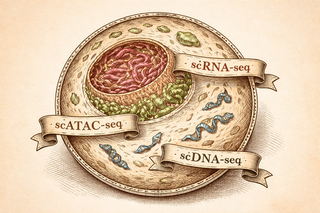
The new paper by Yan and colleagues tackled that problem with single-cell multi-omics - which is a gloriously nerdy phrase meaning they looked at several layers of tumor biology, one cell at a time, instead of blending everything into a molecular smoothie (Yan et al., 2025).
They used:
- scRNA-seq to see which genes cells were actively using
- scATAC-seq to see which stretches of DNA were open for business
- scDNA-seq to see underlying genetic copy-number changes
If that sounds like checking a warehouse’s shipping logs, door-access records, and hardware inventory all at once, that’s because it kind of is.
And the result was not one neat answer. It was several.
The Tumor Was Not Failing the Same Way Twice
Some resistant tumors had clear genetic changes, including copy-number gains in regions like 1q, 2p, and 8q. In plain English, parts of the genome got duplicated, which can boost the output of genes that help cancer survive. But that was only half the story.
Other tumors resisted pirtobrutinib without obvious new DNA-level changes. Instead, they appeared to reprogram themselves through changes in gene activity and chromatin state. Same hardware, different firmware. Because of course cancer had to become a software problem too.
That matters. If resistance were always caused by one mutation, you could build one next drug around it. This paper says MCL is more improvisational than that. Some tumors brute-force the problem genetically. Others redecorate the control room and keep moving.
Meet the Stem-Like Troublemakers
The study also found a stem-like malignant B-cell population enriched in resistant samples. These cells showed signs of metabolic reprogramming and epithelial-mesenchymal transition-like features. EMT is cancer’s classic move where cells adopt a more mobile, adaptable, hard-to-kill persona. In solid tumors it is a familiar villain; seeing that flavor of plasticity echoed here is a reminder that cancer cells love stealing each other’s tricks.
Translation: some of the resistant cells look less like ordinary lymphoma passengers and more like a hardened continuity-of-operations team. If the main route is blocked, they already have generators, backup keys, and a deeply unsettling amount of confidence.
That fits with other recent work suggesting pirtobrutinib-tolerant MCL cells can enter reversible persister states and lean on altered metabolism to survive treatment pressure (Wang et al., 2025; PMCID: PMC12824699).
The Interesting Bit Is Not Just "What Broke" but "What Might Be Fixed"
One of the paper’s more actionable clues involves RAD21 and SMC3, both part of the cohesin complex, a set of proteins that helps organize DNA in 3D space and regulate which genes can be turned on. The authors’ integrative analysis suggests that downregulating these chromatin regulators might re-sensitize cells to pirtobrutinib.
That does not mean doctors should start unplugging cohesin with a screwdriver and hope for the best. It does mean resistance may be vulnerable at the level of chromatin control, not just classic mutation hunting. For a disease as heterogeneous as MCL, that is a big deal.
Why This Matters Outside the Lab
MCL already has a reputation for being biologically messy and clinically stubborn (Jain and Wang, 2022; Armitage and Longo, 2022). Pirtobrutinib has expanded options, especially after prior BTK inhibitor therapy, and small real-world reports support that it can still help heavily pretreated patients (Aydilek et al., 2024; PMCID: PMC11106640). But the field still has a sequencing problem: what to use, when, and how to stop the tumor from treating every therapy line like a temporary road closure.
This paper does not hand us a clean fix. It does something more useful first. It shows that pirtobrutinib resistance in MCL is not one bug. It is a stack of interacting failure modes across DNA, chromatin, transcription, and cell state.
In engineering terms, that is bad news for anyone hoping for a single reset button. In patient-care terms, it is exactly the kind of map researchers need if they want to design smarter combinations, catch resistance earlier, and maybe keep the next backup supplier from going rogue too.
References
Yan F, Liu Y, Lee HH, et al. Dissecting Pirtobrutinib Resistance in Mantle Cell Lymphoma Through Single-Cell Multi-Omics. Am J Hematol. 2025. DOI: 10.1002/ajh.70304
Wang ML, Jurczak W, Zinzani PL, et al. Pirtobrutinib in Covalent Bruton Tyrosine Kinase Inhibitor Pretreated Mantle-Cell Lymphoma. J Clin Oncol. 2023;41(24):3988-3997. DOI: 10.1200/JCO.23.00562
Jain P, Wang M. Mantle cell lymphoma in 2022-A comprehensive update on molecular pathogenesis, risk stratification, clinical approach, and current and novel treatments. Am J Hematol. 2022;97(5):638-656. DOI: 10.1002/ajh.26523
Armitage JO, Longo DL. Mantle-Cell Lymphoma. N Engl J Med. 2022;386(26):2495-2506. DOI: 10.1056/NEJMra2202672
Wang W, Cai Q, Liu Y, et al. TCA cycle mode switch determines the fate of pirtobrutinib-tolerant persister cells in mantle cell lymphoma. Blood. 2025;146(21):2544-2560. DOI: 10.1182/blood.2024026919. PMCID: PMC12824699
Aydilek E, Wulf G, Schwarz F, et al. Outcomes of pirtobrutinib for relapsed/refractory mantle cell lymphoma in compassionate use program in Europe. Cancer Med. 2024;13(10):e7289. DOI: 10.1002/cam4.7289. PMCID: PMC11106640
Disclaimer: The image accompanying this article is for illustrative purposes only and does not depict actual experimental results, data, or biological mechanisms.