Somewhere inside nasopharyngeal carcinoma, the enemy appears to be running a counterintelligence operation - the kind where your supposed bodyguards start acting like confused mall cops, one squad still ready to tackle intruders while another seems weirdly content to wave the bad guys through. That, in plain English, is the drama in this new study on natural killer cells, or NK cells, from patients with nasopharyngeal carcinoma, the cancer that grows in the upper throat behind the nose and is often tied to Epstein-Barr virus infection.
NK cells are your immune system's quick-response unit. They do not wait around for a full committee meeting. They patrol, they inspect, and if a cell looks suspicious enough, they try to eliminate it. Efficient. Brutal. No PowerPoint deck required. But tumors are slippery little operators. They do not just hide from immune cells. They reshape the neighborhood until the immune cells start making bad decisions.
Meet the Night Shift
The new paper by Zhuo and colleagues looked at different NK cell subsets in the blood and tumor environment of people with nasopharyngeal carcinoma. Instead of treating NK cells as one big blob labeled "good guys," the researchers separated them into subgroups, then checked who was where, what they were doing, and whether they seemed to help or hurt patients' odds.
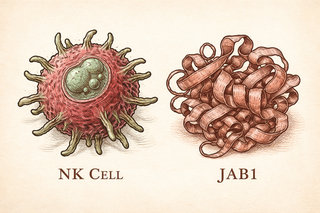
The standout finding was that CD16+CD57+ NK cells in blood tracked with better outcomes, while higher levels of CD16-negative NK cells tracked with worse prognosis. That matters because it suggests the immune system is not merely present or absent. It is organized - or disorganized - in specific ways that could tell doctors something useful about how the cancer is behaving.
The team also found a split in geography. Some NK subsets, especially CD16hiCD57- and CD16hiCD57+ cells, mostly stayed in the blood. Meanwhile, CD16loCD57- cells piled up in tumors. And here is where the plot gets delightfully annoying, because cancer biology never misses a chance to be extra: not all NK cells in the tumor acted like anti-cancer heroes. Functional tests suggested some subsets could suppress tumor growth, while others might actually support it. Yes, even the immune system has double agents.
JAB1 Walks Into the Briefing Room
The other major player here is JAB1, also known as COPS5/CSN5, a regulatory protein involved in cell signaling and protein control. If that sounds abstract, fair. Molecular biology often feels like reading office politics written by caffeinated octopuses. In this study, though, JAB1 did something tangible: it appeared to enhance NK-cell cytotoxicity, meaning it helped certain NK cells do their actual job better.
That raises two interesting possibilities. First, JAB1 may help explain why some NK cells stay effective while others get blunted inside the tumor microenvironment. Second, it may be part of a future biomarker strategy. The authors report that JAB1 expression and the degranulation marker CD107a in NK cells showed better diagnostic and prognostic performance than traditional markers such as SCC and CEA. In strategist terms, that is like swapping a blurry satellite photo for a live drone feed.
Why This Matters Outside the Lab
Nasopharyngeal carcinoma already sits at the crossroads of cancer and immunity. It is heavily shaped by Epstein-Barr virus, and modern treatment has started leaning harder on immunotherapy. In the United States, toripalimab became the first immunotherapy approved for nasopharyngeal carcinoma in late 2023, with the National Cancer Institute describing it on January 3, 2024 as a treatment-changing moment for recurrent or metastatic disease. That means the field is actively looking for better ways to predict who will respond, who will not, and which immune levers are worth pulling.
This paper fits that mission neatly. If NK-cell subsets in blood reflect prognosis, doctors might one day get useful information from a blood draw instead of waiting for the tumor to make its next move. If JAB1 helps preserve or restore NK-cell firepower, it could become part of a future therapeutic playbook. Not tomorrow. Not next Tuesday. Biology is rude and clinical translation is slow. But the direction is real.
The broader literature backs up the logic here. Recent reviews show NK cells are rising stars in cancer immunotherapy, especially as researchers refine cell engineering, checkpoint combinations, and NK-cell engagers [1,2]. Work in nasopharyngeal carcinoma has also shown that the tumor microenvironment is highly structured and deeply immunologic, not just a pile of chaotic cancer cells [3,4]. And newer NPC-focused immunotherapy reviews make the same point clinicians care about most: the future is probably not one magic bullet, but smarter combinations plus better biomarkers [5].
In other words, this study does not claim the war is won. It maps the battlefield better. And in oncology, that is often how real victories start.
References
-
Gong X, Zhang L, He X, et al. Novel natural killer cell-based therapies for hematologic and solid malignancies: latest updates from ASCO 2024. J Hematol Oncol. 2024;17(1):57. doi:10.1186/s13045-024-01575-0. PMCID:PMC11287938
-
Chen S, Zhu H, Jounaidi Y. Comprehensive snapshots of natural killer cells functions, signaling, molecular mechanisms and clinical utilization. Signal Transduct Target Ther. 2024;9:302. doi:10.1038/s41392-024-02005-w
-
Gong L, Kwong DLW, Dai W, et al. Comprehensive single-cell sequencing reveals the stromal dynamics and tumor-specific characteristics in the microenvironment of nasopharyngeal carcinoma. Nat Commun. 2021;12:1540. doi:10.1038/s41467-021-21795-z. PubMed:33750785
-
Jiang Y, Bei W, Li W, et al. Single-cell transcriptome analysis reveals evolving tumour microenvironment induced by immunochemotherapy in nasopharyngeal carcinoma. Clin Transl Med. 2024;14:e70061. doi:10.1002/ctm2.70061. PMCID:PMC11483602
-
Lee VHF, Chan JYW, Chua MLK, et al. Immunotherapy for recurrent or metastatic nasopharyngeal carcinoma. npj Precis Oncol. 2024;8:101. doi:10.1038/s41698-024-00601-1. PMCID:PMC11099100
-
Zhuo G, Li S, Yang G, et al. Alterations in NK cell subsets and the regulatory role of JAB1 in nasopharyngeal carcinoma with implications for tumor immunity and biomarker development. Br J Cancer. 2026. doi:10.1038/s41416-026-03397-y. PubMed:41992060
Disclaimer: The image accompanying this article is for illustrative purposes only and does not depict actual experimental results, data, or biological mechanisms.