Triple-negative breast cancer, or TNBC, is the breast cancer subtype that lacks estrogen receptor, progesterone receptor, and HER2. Translation: a lot of the usual therapeutic handles are missing, which is rude and deeply inconvenient [5].
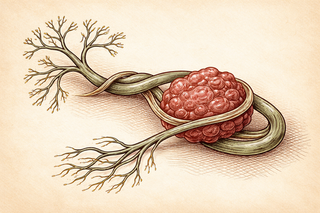
This new study looks at TLR7, a receptor best known for sensing single-stranded RNA, usually in the context of viruses. Very normal immune-system behavior. Except cancer biology loves a plot twist. In this case, the authors argue that a TLR7-related gene signature can act like a fingerprint of tumor innervation - basically, how much the tumor is mixed up with nerve-driven signaling [1].
And yes, tumors having a relationship with nerves is a real thing, not a late-night conspiracy board covered in red string. Recent work in cancer neuroscience has pushed the idea that nerves are not innocent bystanders. They can feed tumor growth, help metastasis, and shape the tumor microenvironment like the worst interior designer alive [2-4].
Not one bad lane - two
Here is the part that makes this paper interesting.
The authors found that TNBC tends to have a higher TLR7 score than estrogen receptor-positive breast cancer. Inside TNBC, the higher scores clustered more with basal-like and mesenchymal-like tumors, which are the subtypes that usually make oncologists sigh and order more coffee [1,5].
But the score did not behave like a simple good-versus-bad marker. That would be too easy. Instead, both very high and very low TLR7 scores were linked to worse outcomes, while the middle range looked less terrible. Goldilocks biology, except nobody gets porridge and everybody gets Kaplan-Meier curves.
Why might that matter? Because the paper suggests those two ends represent different kinds of dangerous.
- TLR7-high tumors looked more innervated and more wired for proliferation. They were enriched for neuronal pathways, mast cell-related signals, and oncogenic programs involving RB1, TP53, E2F, PI3K, MET, and MYC [1].
- TLR7-low tumors looked less nerve-linked and more ER-signaling and T-cell-associated, despite still being triple-negative as a clinical category [1].
That means TNBC may not be one disease wearing different hats. It may be several diseases sharing one awful name tag.
Why the nerve angle is a big deal
A 2024 Nature paper helped set the stage by showing that sensory neurons can drive metastasis through an extracellular RNA-TLR7 axis. In plain English: nerves can release signals that help create RNA-based cues, and tumor cells can read those cues through TLR7 to become more metastatic [2].
That is the kind of sentence that makes cancer biology sound like it was written by a screenwriter who never met an editor.
The broader field is moving in the same direction. Reviews in Nature and Nature Reviews Drug Discovery now describe tumor-nerve crosstalk as a real therapeutic frontier, not a side quest [3,4]. If this paper is right, a TLR7-style signature could help identify which TNBCs are more "nerve-driven" and which are running on a different playbook.
That matters because treatment decisions in TNBC are often blunt instruments. Chemo, immunotherapy, maybe an antibody-drug conjugate if the setting fits. Useful tools, yes. Precision jewelry, not exactly.
The part clinicians will care about
The paper also ties the TLR7 score to pathological complete response, or pCR, in a treatment-dependent way [1]. pCR is the oncology version of hearing "we cannot find remaining invasive cancer after pre-surgery treatment," which is about as welcome as words get in this business.
The catch is that this was not a universal predictor. The score may help with stratification, not fortune-telling. That is still useful. A marker does not need to predict everything to earn a seat at the table. It just has to sort patients into biologically meaningful groups better than shrugging.
If future studies validate this, the practical implication is obvious: some TNBC patients may benefit more from therapies aimed at immune and neural crosstalk, while others may need strategies matched to a more non-innervated, T-cell-rich state. Same diagnosis. Different battlefield.
Bottom line
This paper says TNBC progression may follow at least two distinct routes: one that looks TLR7-dependent and nerve-associated, and another that looks TLR7-low but still dangerous [1]. That is not just a molecular trivia card. It is a reminder that cancer loves categories right up until the moment it breaks them.
Which, honestly, is very on-brand.
References
-
Wang DY, Jiang Z, Ben-David Y, Done SJ, Zacksenhaus E. TLR7 signature of tumour innervation reveals two distinct pathways of triple-negative breast cancer progression. British Journal of Cancer. 2026. DOI: https://doi.org/10.1038/s41416-026-03419-9
-
Padmanaban V, Keller I, Seltzer ES, Ostendorf BN, Kerner Z, Tavazoie SF. Neuronal substance P drives metastasis through an extracellular RNA-TLR7 axis. Nature. 2024;633:207-215. DOI: https://doi.org/10.1038/s41586-024-07767-5
-
Bianchi-Smiraglia A, Ruivenkamp CAL, Monje M, Magnon C, Zahalka AH. Targeting the peripheral neural-tumour microenvironment for cancer therapy. Nature Reviews Drug Discovery. 2024;23:780-796. DOI: https://doi.org/10.1038/s41573-024-01017-z PMCID: https://pmc.ncbi.nlm.nih.gov/articles/PMC12123372/
-
Monje M, Borniger JC, D'Silva NJ, Deneen B, Dirks PB, et al. The neuroscience of cancer. Nature. 2023;618:467-479. DOI: https://doi.org/10.1038/s41586-023-05968-y
-
Hu H, Tong K, Tsang JY, Ko CW, Tam F, Loong TC, Tse GM. Subtyping of triple-negative breast cancers: its prognostication and implications in diagnosis of breast origin. ESMO Open. 2024;9(4):102993. DOI: https://doi.org/10.1016/j.esmoop.2024.102993 PMCID: https://pmc.ncbi.nlm.nih.gov/articles/PMC11024544/
Disclaimer: The image accompanying this article is for illustrative purposes only and does not depict actual experimental results, data, or biological mechanisms.