DMG is a rare, aggressive brain tumor that usually strikes children and young adults. It tends to grow in the brainstem, thalamus, or spinal cord, which is a rotten place to have a tumor because those areas run the basics like movement, swallowing, and breathing. Surgery is often not realistic. Radiation can help for a while, but DMG has a long track record of behaving like a squatter who ignores eviction notices [2,3].
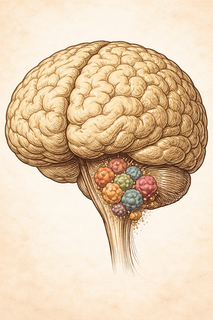
The deeper issue is tumor heterogeneity. That means one tumor contains different groups of cancer cells with different habits, weaknesses, and survival tricks. In DMG, earlier single-cell work showed these cells can sit in several states, often looking like immature glial cells at different stages of development, with different spatial neighborhoods inside the tumor [4]. Same tumor. Different bad ideas.
This new study pushed that concept harder. The researchers mapped seven coexisting DMG cell states and identified the "master regulators" that keep each one running. Think of master regulators as the managers of the chaos. Not the visible mascot. The actual guy with the keys.
Then they screened transcriptional responses to 372 clinically relevant drugs and asked which drugs might flip off the right regulators in each state. That is a smarter game than blindly hurling drugs at the wall and admiring the splatter [1].
Why this one is interesting
The headline result is simple: different drugs hit different cell states, and combining drugs aimed at complementary states worked better than monotherapy in mouse models. Eight of nine predicted drugs showed the expected state-selective activity in vivo. The combo of avapritinib plus ruxolitinib pushed median survival to 83 days versus 53.5 days with avapritinib alone and 25 days with vehicle. That is nearly a threefold jump over control and about 1.5-fold over the better single agent [1].
That matters because DMG has been the poster child for "nice idea, shame about the survival curve." The field has made real progress recently, but it is still a knife fight. In August 2025, the FDA granted accelerated approval to dordaviprone for recurrent H3 K27M-mutant DMG, the first approved systemic therapy for this disease [5]. That was a genuine milestone. Immunotherapy has also shown signs of life: GD2 CAR-T therapy produced tumor shrinkage in some patients, including one complete response in an early trial [6]. So the mood is no longer pure despair. It is cautious aggression.
This paper fits that new mood. It says maybe the problem is not that DMG has no druggable biology. Maybe the problem is that the tumor is running several programs at once, and monotherapy keeps punching only one of them in the face while the others keep paying rent.
The fine print, because biology loves fine print
Before anyone starts printing "cure" on a T-shirt, no. This is preclinical work. Strong preclinical work, but still preclinical. Mouse survival is not human survival. Brain tumors also come with the usual headaches: blood-brain barrier issues, drug dosing limits, toxicity, and the annoying fact that cancer cells can change identities like a con artist changing jackets [1-4].
Still, the logic is solid. Recent studies have shown DMG biology is shaped not only by cell state but also by metabolism, immune suppression, and even weird neuron-tumor communication, including synaptic signaling from nearby brain cells [4,7-9]. Translation: the tumor is not just growing. It is networking.
That is why this study is worth your attention. It does not rely on one magic mutation or one cinematic hero drug. It treats DMG like what it is: a messy ecosystem of coexisting cancer states. And ecosystems usually do not collapse because you glare at one species really hard.
If these results hold up in clinical testing, the real-world impact could be big. Not only for DMG, but for any cancer that survives by splitting into multiple cell camps with different drug sensitivities. The idea is refreshingly blunt: stop treating a riot like it is one loud guy.
References
-
Calvo Fernández E, Tomassoni L, Zhang X, et al. Systematic design of combination therapy by targeting master regulators of coexisting diffuse midline glioma cell states. Nature Genetics. 2026. DOI: https://doi.org/10.1038/s41588-026-02550-w
-
Weller M, Wen PY, Chang SM, et al. Glioma. Nature Reviews Disease Primers. 2024;10:33. DOI: https://doi.org/10.1038/s41572-024-00516-y
-
Koschmann C, Al-Holou WN, Alonso MM, et al. A road map for the treatment of pediatric diffuse midline glioma. Cancer Cell. 2024;42(1):1-5. DOI: https://doi.org/10.1016/j.ccell.2023.11.002
-
Liu I, Jiang L, Samuelsson ER, et al. The landscape of tumor cell states and spatial organization in H3-K27M mutant diffuse midline glioma across age and location. Nature Genetics. 2022;54:1881-1894. DOI: https://doi.org/10.1038/s41588-022-01236-3
-
U.S. Food and Drug Administration. FDA grants accelerated approval to dordaviprone for diffuse midline glioma. August 6, 2025. https://www.fda.gov/drugs/resources-information-approved-drugs/fda-grants-accelerated-approval-dordaviprone-diffuse-midline-glioma
-
Monje M, Mahdi J, Majzner R, et al. Intravenous and intracranial GD2-CAR T cells for H3K27M+ diffuse midline gliomas. Nature. 2025;637:708-715. DOI: https://doi.org/10.1038/s41586-024-08171-9
-
Jovanovich N, Habib A, Head J, et al. Pediatric diffuse midline glioma: Understanding the mechanisms and assessing the next generation of personalized therapeutics. Neuro-Oncology Advances. 2023;5(1):vdad040. DOI: https://doi.org/10.1093/noajnl/vdad040. PMCID: https://pmc.ncbi.nlm.nih.gov/articles/PMC10162114/
-
Mbah NE, Myers AL, Sajjakulnukit P, et al. Therapeutic targeting of differentiation-state dependent metabolic vulnerabilities in diffuse midline glioma. Nature Communications. 2024;15:8983. DOI: https://doi.org/10.1038/s41467-024-52973-4
-
Andrade AF, Annett A, Karimi E, et al. Immune landscape of oncohistone-mutant gliomas reveals diverse myeloid populations and tumor-promoting function. Nature Communications. 2024;15:7769. DOI: https://doi.org/10.1038/s41467-024-52096-w
Disclaimer: The image accompanying this article is for illustrative purposes only and does not depict actual experimental results, data, or biological mechanisms.