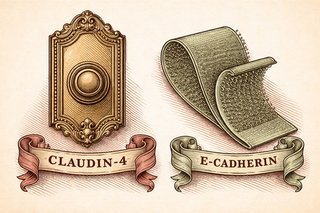
If E-cadherin is part of the Velcro that keeps neighboring epithelial cells attached, claudin-4 is part of the seal that helps keep the gut lining from turning into a leaky apartment building. The new paper shows that BFT does not just wander up and hack randomly at the wall like a raccoon with bolt cutters. It binds claudin-4 first. That binding seems to position the toxin so it can snip E-cadherin at a membrane-proximal site that would otherwise be hard to reach [1].
The team used a genome-wide CRISPR knockout screen in colon cancer cells, which is science-speak for "we systematically broke genes until the trick stopped working." Claudin-4 popped out as the receptor. When the researchers expressed claudin-4 in otherwise unhelpful cells, BFT could suddenly cleave E-cadherin. When they interfered with claudin-4 binding, the toxin lost much of its bite. They even tested a soluble claudin-4 based blocker in mice and saw reduced epithelial injury and preserved E-cadherin staining [1]. That is not a treatment yet, but it is more than hand-waving. It is a plausible starting point.
Why This Matters Outside a Very Nerdy Bar Stool
ETBF has been linked to colorectal neoplasia in people and drives colon tumor formation in mouse models, but the story has always carried an awkward caveat: lots of humans carry B. fragilis without immediately spiraling into doom. A 2022 systematic review found broad support for an ETBF-CRC link, but also plenty of heterogeneity and bias across studies, which is scientist for "the signal is real-looking, but biology refuses to sit still for the camera" [2]. More recent reviews place ETBF among the best-supported microbial suspects in colorectal cancer, alongside names like Fusobacterium nucleatum and pks-positive E. coli [3,4].
This paper matters because mechanisms are what separate spooky correlation from a case that can survive cross-examination. If a bacterial toxin promotes cancer by physically docking on claudin-4 and then clipping E-cadherin, that gives us a chain of events you can test, block, model, and maybe one day exploit for prevention. It also helps explain why ETBF is so good at turning a healthy epithelial border into what can only be described as a sketchy neighborhood for chronic inflammation.
And inflammation, as every colon seems doomed to learn eventually, is rarely content to remain a local inconvenience. Once E-cadherin is disrupted, beta-catenin signaling can go wandering, proliferative programs wake up, and immune pathways like TH17 signaling join the party wearing steel-toe boots [1,3,5].
The Bigger Cosmic Joke
The gut microbiome is full of organisms that are not villains in every context. ETBF is not a cartoon bad guy twirling a mustache under a microscope. It is more like a neighbor who is usually fine, until one day he starts running an illegal fireworks warehouse out of the garage. Context matters. Host genetics matter. Diet matters. Other microbes matter. Cancer, in this sense, looks less like a single betrayal and more like a coalition government of bad decisions.
That is also why the challenges are real. ETBF can be present in healthy people. Claudin-4 itself is a normal human protein with jobs to do. Blocking toxin binding without disrupting normal tissue function will take careful engineering. And mouse protection after direct toxin exposure is not the same as preventing human colorectal cancer in the wild, where microbes, immunity, mucus, diet, and time all conspire to make simple stories embarrass themselves.
Still, this is one of those papers that changes the conversation. It turns "some bacterial toxin messes with the barrier somehow" into "here is the receptor, here is the cut, here is a blocker, now go make this useful." In oncology, that counts as real progress. Not flashy magic. Better. A map.
References
-
White MT, Wang K, Zhang H, et al. A pro-carcinogenic bacterial toxin binds claudin-4 to cleave E-cadherin. Nature. 2026. doi:10.1038/s41586-026-10375-0
-
Scott N, Whittle E, Jeraldo P, Chia N. A systemic review of the role of enterotoxic Bacteroides fragilis in colorectal cancer. Neoplasia. 2022;29:100797. doi:10.1016/j.neo.2022.100797 PMCID:PMC9046963
-
White MT, Sears CL. The microbial landscape of colorectal cancer. Nat Rev Microbiol. 2024;22:240-254. doi:10.1038/s41579-023-00973-4
-
Dougherty MW, Jobin C. Intestinal bacteria and colorectal cancer: etiology and treatment. Gut Microbes. 2023;15(1):2185028. doi:10.1080/19490976.2023.2185028 PMCID:PMC10026918
-
Cao Y, Wang Z, Yan Y, et al. Enterotoxigenic Bacteroides fragilis promotes intestinal inflammation and malignancy by inhibiting exosome-packaged miR-149-3p. Gastroenterology. 2021;161(5):1552-1566.e12. doi:10.1053/j.gastro.2021.08.003
Disclaimer: The image accompanying this article is for illustrative purposes only and does not depict actual experimental results, data, or biological mechanisms.