The review by Ofori-Amanfo, Dustin, and Lim looks at a fast-growing field where air pollution meets data science and lung health [1]. The basic idea is simple enough to explain over fries: pollution does not just irritate the lungs in a vague, hand-wavy way. It appears to nudge multiple biological systems at once.
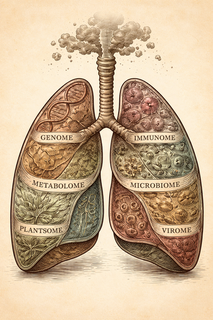
Researchers have been studying how pollution affects the methylome, transcriptome, metabolome, proteome, genome, and microbiome. Yes, the paper basically invited every "-ome" to the party. Cancer biology loves doing this. Just when you think you understand one layer, another one shows up wearing a fake mustache.
What matters is that these layers can reveal how pollution may push the body toward inflammation, DNA damage, cell death, and long-term lung trouble. That includes asthma, COPD, and lung cancer. Instead of treating pollution as one giant invisible villain, scientists are trying to map exactly which exposures hit which people hardest, and through which pathways.
That is the “precision health” part. Not fortune-telling. More like better targeting.
Tiny particles, big drama
A lot of this story revolves around fine particulate matter, especially PM2.5, which is small enough to slip deep into the lungs. “Tiny but chaotic” is a depressingly common theme in biology.
Recent work backs up the review’s main point that pollution leaves measurable biological traces. A 2022 review in European Respiratory Review found that metabolomics may help identify biomarkers linking air pollution exposure to respiratory outcomes across the life course, though the field still struggles with small studies and uneven methods [2]. Another study in nearly 300,000 people from UK Biobank found that some genetic variants may make certain people more vulnerable to pollution-related reductions in lung function [3]. In other words, two people can breathe the same air and not get the same biological bill.
There is also evidence that pollution can mess with DNA methylation, one of the cell’s favorite ways to regulate gene activity without changing the DNA sequence itself. A 2023 study in non-smokers linked personal PM2.5 exposure to epigenome-wide methylation changes that were associated with lung function [4]. If your genome is the script, methylation is one of the stage managers changing the lighting and whispering, “Try sounding more inflamed.”
And then there is the microbiome. Because apparently pollution was not content to annoy human cells and decided to bother our microbial tenants too. A 2023 narrative review found that air pollution is associated with changes in the respiratory microbiome, including shifts toward organisms that may worsen infection risk and respiratory disease [5].
Why this matters outside a journal club
This is not abstract doom. It has real stakes.
The American Lung Association’s 2025 State of the Air report found that 156 million people in the United States were living in places with unhealthy ozone or particle pollution. Meanwhile, WHO has continued to stress that air pollution remains a major public-health threat, especially because fine particles can travel deep into the lungs and beyond.
So when this review argues for better exposure estimates and multi-omic integration, that is not nerdy ornamentation. It is the difference between saying “pollution is generally bad” and saying “this person in this neighborhood with this biology may be at higher risk, and here is how we catch it earlier.”
That could eventually mean smarter screening, sharper risk prediction, better public-health warnings, and maybe even interventions tailored to the people getting hit hardest. It could also help explain why some non-smokers develop serious lung disease while others, frustratingly, seem to dodge it.
The catch, because there is always a catch
This field still has some very fixable messes.
Exposure measurement is hard. Air pollution is not one thing, and your real-life exposure is not captured perfectly by a monitor several blocks away. Omics studies also tend to be expensive, technically messy, and not always easy to compare across cohorts. The review is refreshingly honest about that.
So no, we are not at the stage where your doctor orders a “pollution omics panel” between cholesterol and vitamin D. But the direction makes sense. Precision environmental health is gaining momentum because it treats the environment as something biologically specific, not just background scenery [6].
That is the big charm of this paper. It takes something maddeningly ordinary - breathing city air - and shows that the biology underneath is anything but ordinary. Your lungs are not passive balloons. They are more like an overworked customs desk, checking every suspicious package that floats in.
And pollution, in classic villain fashion, keeps trying new disguises.
References
-
Ofori-Amanfo K, Dustin M, Lim EL. Data Science at the Interface of Air Pollution and Lung Health: Toward Precision Health. Annu Rev Biomed Data Sci. 2026. doi: 10.1146/annurev-biodatasci-092724-061536
-
Gruzieva O, Jeong A, He S, et al. Air pollution, metabolites and respiratory health across the life-course. Eur Respir Rev. 2022. doi: 10.1183/16000617.0055-2022
-
Melbourne CA, Erzurumluoglu AM, Shrine N, et al. Genome-wide gene-air pollution interaction analysis of lung function in 300,000 individuals. Environ Int. 2022;159:107041. doi: 10.1016/j.envint.2021.107041
-
Mu G, Nie X, Yang S, et al. PM2.5-related DNA methylation and the association with lung function in non-smokers. Environ Pollut. 2023;316(Pt 1):120700. doi: 10.1016/j.envpol.2022.120700
-
Vieceli T, Tejada S, Martinez-Reviejo R, et al. Impact of air pollution on respiratory microbiome: A narrative review. Intensive Crit Care Nurs. 2023;74:103336. doi: 10.1016/j.iccn.2022.103336
-
Baccarelli A, Dolinoy DC, Walker CL. A precision environmental health approach to prevention of human disease. Nat Commun. 2023;14(1):2449. doi: 10.1038/s41467-023-37626-2, PMCID: PMC10147599
Disclaimer: The image accompanying this article is for illustrative purposes only and does not depict actual experimental results, data, or biological mechanisms.