Every great spy thriller has a mole - someone on the inside, passing secrets to the enemy, sabotaging missions from within. Your CAR T-cells, those genetically engineered assassins we send to hunt cancer, have been dealing with exactly this kind of double-agent problem. And a team of researchers just figured out how to unmask the traitor.
The Heist Nobody Saw Coming
Here's the setup: CAR T-cell therapy has been one of immunotherapy's greatest hits - a real showstopper that's changed the key for blood cancers. But the encore keeps falling flat. Most patients who receive CAR T-cells relapse within five years, and for a while, nobody could quite pin down why the band kept losing its groove.
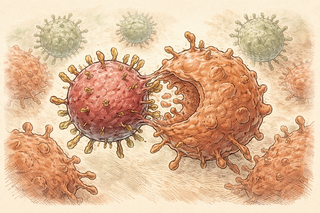
Enter trogocytosis - a process so sneaky it sounds like it belongs in a le Carre novel. During trogocytosis, tumor cells literally hand off pieces of their surface proteins to the very CAR T-cells trying to kill them. It's like a pickpocket slipping their own wallet into a cop's pocket, then shouting "thief!" The tumor cell walks away wearing fewer target antigens (making it invisible to future CAR T-cells), while the CAR T-cell gets stuck wearing the tumor's stolen merchandise on its surface. Now other CAR T-cells see their own teammate looking suspiciously like the enemy and - you guessed it - they take each other out. Fratricide. Friendly fire. The worst kind of dissonant chord in the immunotherapy jazz ensemble.
Cathepsin B: The Inside Man
A team led by Kenneth Dietze, Tim Luetkens, and colleagues at the University of Maryland decided to stop guessing whether trogocytosis actually causes CAR T-cell dysfunction and prove it (Dietze et al., 2026). Using a clever selective degrader that chews up trogocytosed antigen on CAR T-cell surfaces, they showed definitively that those stolen tumor proteins are directly responsible for both fratricide and exhaustion. Not just correlated. Not just suspicious. The smoking gun.
Then came the real solo: a custom high-throughput screening assay that tested thousands of small molecules to find what makes trogocytosis tick. The culprit? Cathepsin B, a cysteine protease that apparently moonlights as the molecular lockpick enabling the whole heist. Block cathepsin B, and the membrane-swapping stops cold - but here's the beautiful part - your CAR T-cells keep killing tumor cells just fine. It's like changing the locks on your building without firing the security team.
Cystatin A Steps Up to the Mic
The researchers didn't just identify the problem; they jammed their way to a solution. By overexpressing cystatin A (CSTA), a natural human inhibitor of cathepsin B, they engineered CAR T-cells that resist trogocytosis without losing any of their tumor-killing mojo. These upgraded cells showed improved persistence both in the lab dish and in animal models - they stuck around longer and kept swinging at tumors when standard CAR T-cells had already tapped out.
This is where the melody really resolves. One of the biggest predictors of whether CAR T-cell therapy works in patients is persistence - how long those engineered cells survive and stay functional (Li et al., 2024). If your T-cells exhaust themselves through friendly fire before finishing the job, the tumor gets a comeback tour nobody wanted.
Why This Changes the Tune
Trogocytosis has been increasingly recognized as a significant tumor escape mechanism alongside antigen loss through mutations and lineage switching (Kim et al., 2025; Wang et al., 2024). But until now, it's been the mechanism everyone talked about at conferences without a clear way to stop it. The elegance here is the selectivity: cathepsin B inhibition decouples trogocytosis from cytotoxicity. You're not dampening the immune response - you're just cutting the enemy's intelligence pipeline.
A recent commentary in The Oncologist noted that while trogocytosis research has been largely preclinical, the clinical need is undeniable - CAR construct design, antigen density, and the chaotic tumor microenvironment all modulate trogocytosis rates (Atanackovic & Luetkens, 2025). This cathepsin B strategy could be one of the first pharmacologically targetable solutions to a problem that's plagued the field.
Think of it this way: CAR T-cell therapy was already a killer band. Trogocytosis was the feedback loop ruining every performance. And cathepsin B inhibition? That's the sound engineer who finally figured out which cable to unplug - without cutting the music.
References:
-
Dietze, K. A., Nguyen, K., Pathni, A., et al. (2026). Preventing trogocytosis by cathepsin B inhibition augments CAR T-cell function. Signal Transduction and Targeted Therapy. DOI: 10.1038/s41392-026-02654-z. PMID: 42020353
-
Li, Y., Zhong, W., et al. (2024). Trogocytosis of CAR molecule regulates CAR-T cell dysfunction and tumor antigen escape. Signal Transduction and Targeted Therapy, 9, 1-12. DOI: 10.1038/s41392-023-01708-w. PMID: 38143263
-
Kim, H. R., et al. (2025). Trogocytosis-mediated immune evasion in the tumor microenvironment. Experimental & Molecular Medicine, 57, 103-109. DOI: 10.1038/s12276-024-01364-2
-
Wang, Z., et al. (2024). Trogocytosis in CAR immune cell therapy: a key mechanism of tumor immune escape. Cell Communication and Signaling, 22, 521. DOI: 10.1186/s12964-024-01894-2
-
Atanackovic, D. & Luetkens, T. (2025). Commentary: is trogocytosis relevant for chimeric antigen receptor-T cells? The Oncologist, 30(6), oyaf150. DOI: 10.1093/oncolo/oyaf150
Disclaimer: The image accompanying this article is for illustrative purposes only and does not depict actual experimental results, data, or biological mechanisms.