Your CD8 T cells are supposed to be the closer, the pass rush, the late-game assassin - pick your sport. They find infected or malignant cells, hit them hard, and keep the scoreboard moving in your favor. But when a fight drags on, those same cells can slide into T cell exhaustion, a state where they still show up but start looking like a team trapped in a three-hour rain delay. They express markers like PD-1, lose punchy functions such as TNF and IL-2 production, and gradually trade menace for burnout [Vignali et al., 2024; Verma et al., 2022].
That matters in cancer because tumors love a tired defense. If immune cells are the security staff, exhausted T cells are the guards who still have the badge but forgot where the exits are.
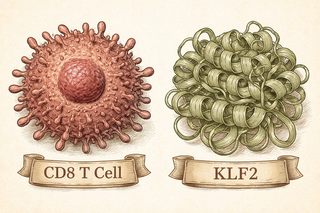
KLF2 calls a surprising play
In this new Immunity paper, Geng and colleagues used multi-round in vivo CRISPR screening in the classic chronic infection model LCMV Clone 13 to ask a sharp question: what pushes T cells toward a more functional route versus an exhausted one? Their standout answer was Krüppel-like factor 2, or KLF2 [Geng et al., 2026].
KLF2 is a transcription factor, meaning it helps decide which genetic plays a cell runs. The authors found that KLF2 programs an early exhausted state and strongly supports a CX3CR1-positive effector-like exhausted CD8 T-cell population during chronic infection. That is already interesting, because CX3CR1-positive cells can look like the immune system’s blue-collar grinders - still active, still moving, still involved. But this paper says KLF2 is not just keeping them on the field. It is helping define a restrained program that ultimately holds back antiviral immunity.
The kicker is the game film result: when researchers disrupted the KLF2-dependent program, viral control improved without obvious runaway immunopathology [Geng et al., 2026]. Translation: the immune system played more offense without setting the stadium on fire. In immunology terms, that is a pretty nice final score.
Why this is more than a virus story
This is where the oncology crowd leans forward in their seats.
T cell exhaustion is one of the main reasons checkpoint blockade and CAR T-cell therapy do not always deliver the Hollywood ending. Cancer does not merely hide from T cells. It drags them into a weird bureaucratic maze of chronic stimulation, inhibitory receptors, and epigenetic lock-in. Several recent reviews argue that exhaustion is not one single dead-end state but a whole messy bracket of related cell states, some salvageable, some much less so [Kang et al., 2026; Chen et al., 2026].
KLF2 sits right in that bracket.
Recent work in Nature Immunology showed that lymph nodes help generate KLF2-dependent CX3CR1-positive effector CD8 T cells during chronic infection and checkpoint blockade, linking KLF2 to T-cell migration, differentiation, and response niches [Tsui et al., 2025]. Another Nature Immunology study in CAR T cells found that KLF2 supports effector differentiation and helps suppress a more exhausted program, including higher TOX when KLF2 is lost [Zhu et al., 2024].
So yes, KLF2 is already giving researchers mixed signals like a referee explaining pass interference. Villain? Hero? Annoying middle manager? The answer seems to be: context matters. In one setting, KLF2 can preserve useful effector traits. In another, like this chronic antiviral model, it appears to help lock cells into an early exhausted lane that limits viral clearance.
That tension is not bad news. It is the point. Biology rarely hands you a cartoon bad guy in a cape.
The real-world playoff implications
If these findings hold up and extend into human disease, they could matter for both chronic infections and cancer immunotherapy. Researchers may be able to tune KLF2-related pathways to keep T cells effective longer, improve responses to PD-1-based therapies, or design smarter cell therapies that avoid an exhaustion-prone trajectory.
The challenge is obvious: you do not want to remove every immune brake and create a full-contact cytokine demolition derby. The sweet spot is stronger killing with controlled collateral damage. This paper is intriguing because it hints that tweaking the KLF2 program might improve control without obvious immune overreaction, at least in the mouse model studied [Geng et al., 2026].
That is why this result stands out. It is not just "we found a gene." Immunologists find genes the way sports analysts find hot takes. The interesting part is that KLF2 may be helping write the opening script of exhaustion, when the game is still close enough to flip.
And if you can rewrite the opening script, sometimes you change the ending.
References
-
Geng S, Li Z, Li W, et al. Krüppel-like factor 2 programs early exhausted T cell states and restrains antiviral immunity. Immunity. 2026. DOI: https://doi.org/10.1016/j.immuni.2026.03.029
-
Tsui C, Heyden L, Wen L, et al. Lymph nodes fuel KLF2-dependent effector CD8+ T cell differentiation during chronic infection and checkpoint blockade. Nature Immunology. 2025;26:1752-1765. DOI: https://doi.org/10.1038/s41590-025-02276-7
-
Zhu H, et al. FOXP1 and KLF2 reciprocally regulate checkpoints of stem-like to effector transition in CAR T cells. Nature Immunology. 2024. DOI: https://doi.org/10.1038/s41590-023-01685-w. PMCID: https://pmc.ncbi.nlm.nih.gov/articles/PMC10841689/
-
Vignali PDA, et al. T Cell Exhaustion. Annual Review of Immunology. 2024;42:179-206. DOI: https://doi.org/10.1146/annurev-immunol-090222-110914
-
Verma V, et al. Clinical implications of T cell exhaustion for cancer immunotherapy. Nature Reviews Clinical Oncology. 2022;19:775-790. DOI: https://doi.org/10.1038/s41571-022-00689-z. PMCID: https://pmc.ncbi.nlm.nih.gov/articles/PMC10984554/
-
Kang TG, Johnson JT, Zebley CC, Youngblood B, et al. Epigenetic regulation of T cell exhaustion in cancer. Nature Reviews Cancer. 2026;26:46-61. DOI: https://doi.org/10.1038/s41568-025-00883-y
Disclaimer: The image accompanying this article is for illustrative purposes only and does not depict actual experimental results, data, or biological mechanisms.