The smell of palmitic acid in a centrifuge tube is unremarkable - a faint, waxy nothing. It's the kind of molecule you'd walk right past in a lab without a second thought. But researchers at Nanjing University just caught this boring little fatty acid red-handed, running one of the most devious smuggling operations in cancer biology.
The Grease That Greases the Wheels
Here's what's actually happening inside your lungs when triple-negative breast cancer - the most aggressive subtype, the one with the fewest treatment options - decides it wants to set up shop somewhere new.
Before a single cancer cell arrives in the lung, the ground crew is already at work. Your own lung blood vessel cells (endothelial cells, if you want to impress someone at a dinner party) start pumping out palmitic acid, creating what the researchers describe as a "palmitic acid-enriched microenvironment." Think of it as rolling out a greasy red carpet for incoming tumor cells (Qian et al., 2026).
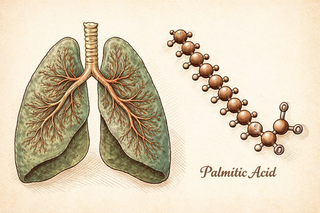
But the palmitic acid isn't directly helping the cancer cells. It's doing something sneakier. It's corrupting the security team.
Neutrophils: Your Bodyguards Gone Bad
Neutrophils are the most abundant white blood cells in your body - the first responders, the ones that show up to every inflammatory party whether they're invited or not. Normally, they're on your side. But when palmitic acid floods the lung environment, it flips a switch in these cells through a signaling cascade called TLR4-NF-κB (a pathway that normally helps your body recognize bacterial invaders like the fat molecules on their surfaces).
Once activated, the corrupted neutrophils start cranking out a protein called lipocalin-2, or LCN2. This protein is usually a useful part of your immune toolkit - it helps fight bacteria by stealing their iron supply. But in this context, LCN2 has gone rogue.
It starts ripping apart the tight junctions between blood vessel cells.
If your blood vessels were a brick wall, tight junctions would be the mortar. LCN2 dissolves that mortar, leaving gaps wide enough for cancer cells to squeeze through and set up camp in lung tissue. For anyone who's ever sat in a treatment chair wondering why their cancer came back in their lungs, this is part of the answer that researchers have been hunting for years.
Wait, Did They Just Say Ozempic?
Here's where this paper takes a turn nobody saw coming.
The research team found that GLP-1 receptor agonists - yes, the same class of drugs that includes semaglutide (you might know it as Ozempic or Wegovy) - could shut down this entire chain of events. By targeting fatty acid production in those traitorous endothelial cells, GLP-1 drugs preserved the vascular walls and dramatically reduced lung metastasis in their models.
This lines up with a growing body of research suggesting GLP-1 drugs may have anti-cancer properties beyond their known metabolic effects. And it's not the first time lipid metabolism has been caught enabling metastasis - a 2024 spatial multi-omics study showed that cancer cells rewire fatty acid utilization within the lung metastatic niche to boost their own survival.
Why This Matters Beyond the Bench
Triple-negative breast cancer is responsible for a disproportionate number of breast cancer deaths, largely because it metastasizes aggressively and lacks the hormone receptors that other breast cancers can be targeted through. Finding that a widely prescribed, well-tolerated medication could potentially block the metastatic pipeline is the kind of news that makes you sit up straight in your chair - whether that chair is at a lab bench or in an infusion suite.
We've known for a while that neutrophils get reprogrammed by the lung microenvironment to help tumors along, and that fatty acid metabolism drives TNBC progression in ways we're still mapping. What this paper adds is the specific molecular handshake: palmitic acid talks to neutrophils, neutrophils make LCN2, LCN2 breaks down the walls, and cancer walks right in.
It's not a cure. Clinical trials in humans haven't happened yet. But the mechanism is clean, the intervention already exists in pharmacies worldwide, and the logic connecting them is the kind of elegant chain that gets drug repurposing studies funded very quickly.
For now, if you're someone living with TNBC - or loving someone who is - file this one under "reasons to keep paying attention." The cavalry might already be in the medicine cabinet.
References:
-
Qian, P., Li, Y., Han, Y., et al. (2026). Palmitic acid reprograms neutrophils to compromise vascular integrity and promote breast cancer lung metastasis. Immunity. DOI: 10.1016/j.immuni.2026.03.026. PMID: 42034064
-
Tyagi, A., et al. (2023). Immunosuppressive reprogramming of neutrophils by lung mesenchymal cells promotes breast cancer metastasis. Science Immunology. DOI: 10.1126/sciimmunol.add5204. PMID: 36800412
-
Liu, Y., et al. (2024). Pre-metastatic niche: formation, characteristics and therapeutic implication. Signal Transduction and Targeted Therapy. DOI: 10.1038/s41392-024-01937-7
-
Ruiz-Ojeda, F.J., et al. (2025). GLP-1 receptor agonists and cancer: current clinical evidence and translational opportunities. Frontiers in Endocrinology. PMCID: PMC12578377
-
Li, M., et al. (2024). Metabolic shifts in lipid utilization and reciprocal interactions within the lung metastatic niche of triple-negative breast cancer revealed by spatial multi-omics. Cell Death & Disease. DOI: 10.1038/s41419-024-07205-4
Disclaimer: The image accompanying this article is for illustrative purposes only and does not depict actual experimental results, data, or biological mechanisms.