If you learned about lysosomes in school, you probably got the discount version: they're the cell's garbage disposals. Which is true in the same way calling a hospital "a building with chairs" is technically true but emotionally unsatisfying.
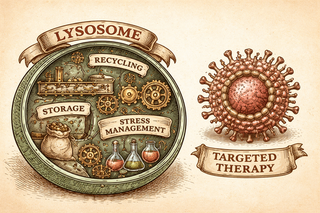
Lysosomes are acidic little compartments packed with enzymes that chop up proteins, fats, and other cellular leftovers. They also help cells recycle raw materials, sense nutrient status, process cargo brought in from outside, and coordinate autophagy - the whole "eat your own broken parts so you can survive a bad day" system (Cao et al., 2021). In other words, the lysosome is not just a trash can. It is the recycling center, panic room, supply closet, and occasionally the bouncer.
Cancer cells, being the overengineered goblins they are, love that setup. Tumors often grow in low-oxygen, low-nutrient, generally terrible conditions. A beefed-up lysosome helps them keep going by recycling molecules, supporting metabolism, and helping them survive treatment stress. That same system can also contribute to invasion, metastasis, and drug resistance (Cao et al., 2021).
When A Survival Tool Becomes A Weak Spot
Here is the plot twist the review leans on: cancer cells may depend on lysosomes more than healthy cells do, and that dependency can become a liability.
Researchers have been building "lysosome-specific chemical platforms" - molecules, nanoparticles, biomimetic carriers, and chimeric systems designed to get into or act on lysosomes on purpose (Wang et al., 2026). Some platforms use the lysosome's acidic interior like a chemical zip code. Others aim to damage the lysosomal membrane, trap drugs there, trigger light-activated killing, or reroute harmful proteins toward lysosomal destruction.
That matters because once you control where a therapy goes inside a cell, you stop playing molecular pin-the-tail-on-the-donkey. You can start hitting cancer where it stores supplies, handles stress, and hides some of its resistance tricks.
One recent example came from a 2023 Chemical Science study: researchers built a self-assembled photosensitizer nanoparticle that homes to lysosomes, then uses light to generate reactive oxygen species and disrupt lysosomal membranes, boosting photodynamic therapy in mouse tumor models (Li et al., 2023; PMCID: PMC10189857). Basically, the tumor's recycling center got turned into a smoke machine with consequences.
Not Just Killing Tumor Cells - Messing With Their Social Life
The really interesting part is that lysosomes are tied to the tumor microenvironment and immune response too. Translation: this is not only about punching cancer cells directly. It is also about changing the sketchy neighborhood they live in.
A 2024 Nature Communications paper showed that boosting Hsc70-driven lysosomal degradation of PD-L1 reduced tumor growth and improved anti-tumor immunity in mice, while also making checkpoint therapy work better (Nature Communications, 2024). That is a big deal because PD-L1 is one of cancer's favorite fake mustaches. It helps tumors tell immune cells, "nothing to see here, officer."
Another 2024 study in Advanced Materials reported lysosome-targeted nanoparticle aggregation that reshaped an immunosuppressive tumor microenvironment for cancer immunotherapy (Xing et al., 2024). In other words, scientists are not just trying to blow up the bunker. They are also trying to cut the phone lines, lock the snack cabinet, and stop the guards from getting paid.
This fits with a broader 2023 review in Trends in Pharmacological Sciences on lysosome-directed degradation strategies such as LYTACs, which aim membrane or extracellular targets toward lysosomal disposal (Chen et al., 2023; PMCID: PMC10591793). For oncology, that opens the door to going after targets that old-school small molecules often struggle to touch.
The Buzzkill Section, Because Biology Never Lets You Leave Early
Before anybody starts ordering a "Lysosome Strike Force" T-shirt, there are real problems.
First, tumors are messy. Not every cancer uses lysosomes the same way. Second, healthy cells also need lysosomes very badly, which means precision matters a lot. "Smash all lysosomes" is less a treatment plan and more a hostage situation. Third, many of the flashiest results are still preclinical. Good mouse data is nice. Cancer has been extremely rude about not always caring what worked in mice.
That is why this review is interesting. It is not selling one magic bullet. It is mapping a toolkit: smarter delivery systems, light-activated compounds, biomimetic carriers, self-assembling peptides, chimeras, and imaging probes, all designed to exploit a real biological pressure point in cancer (Wang et al., 2026).
Basically, lysosomes used to look like the cell's cleanup crew. Now they look more like a control room with terrible security. And cancer, for once, may have been relying on the weirdest room in the house a little too much.
References
Wang X, Tang Y, Li Q. Lysosome-specific chemical platforms for precision oncology: from structural design to biological applications. Chemical Society Reviews. 2026. DOI: 10.1039/D5CS01352F
Cao M, Luo X, Wu K, He X. Targeting lysosomes in human disease: from basic research to clinical applications. Signal Transduction and Targeted Therapy. 2021;6:379. DOI: 10.1038/s41392-021-00778-y
Chen X, Zhou Y, Zhao Y, Tang W. Targeted degradation of extracellular secreted and membrane proteins. Trends in Pharmacological Sciences. 2023;44(11):762-775. DOI: 10.1016/j.tips.2023.08.013. PMCID: PMC10591793
Li Y, Han W, Gong D, Luo T, Fan Y, Mao J, Qin W, Lin W. A self-assembled nanophotosensitizer targets lysosomes and induces lysosomal membrane permeabilization to enhance photodynamic therapy. Chemical Science. 2023;14(19):5106-5115. DOI: 10.1039/d3sc00455d. PMCID: PMC10189857
Xing Y, Yang J, Peng A, Qian Y, Liu Y, Pan P, Liu Q. Lysosome Targeted Nanoparticle Aggregation Reverses Immunosuppressive Tumor Microenvironment for Cancer Immunotherapy. Advanced Materials. 2024;36(47):e2412730. DOI: 10.1002/adma.202412730
Wang C, et al. Hsc70 promotes anti-tumor immunity by targeting PD-L1 for lysosomal degradation. Nature Communications. 2024;15:4237. DOI/article: s41467-024-48597-3
Disclaimer: The image accompanying this article is for illustrative purposes only and does not depict actual experimental results, data, or biological mechanisms.