Help wanted: Star-shaped brain cell seeks flexible role in neighborhood management. Duties include feeding neurons, keeping the blood-brain barrier tidy, and, under unfortunate management, helping a tumor tell the immune system to take a very long coffee break.
That, in one slightly rude nutshell, is the problem this review tackles. The paper by Camilo Faust Akl and Francisco J. Quintana argues that astrocytes, the brain’s resident support crew, are not just innocent bystanders hanging around the tumor like potted plants at a bad office party. In brain tumors, they can get reprogrammed into local enforcers of immunosuppression, which is a fancy way of saying they help make the neighborhood safe for cancer and awkward for immune cells trying to do their jobs [1].
The Brain’s Nice Neighbors, Now in a Crime Drama
Under normal conditions, astrocytes are useful, busy, and frankly underappreciated. They help feed neurons, manage chemical balance, support blood vessels, and keep the central nervous system from turning into electrical soup. But tumors are talented manipulators. Give them a little time and they can turn helpful cells into accomplices.
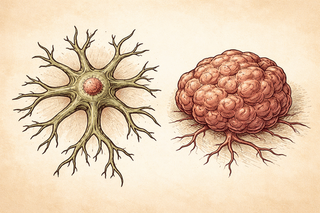
This review focuses on glioblastoma and brain metastases, two situations where the immune system often shows up like security guards who got the wrong building map. The tumor microenvironment - meaning the mess of cancer cells, immune cells, support cells, blood vessels, and chemical signals around a tumor - becomes deeply hostile to anti-tumor immunity [1,2].
Astrocytes sit right in the middle of that mess. According to the review, tumor-derived signals can push astrocytes into reactive states that dampen T-cell activity, promote immune evasion, and help tumors keep growing. Plot twist: the brain’s housekeeping staff may also be quietly locking the front door against the cleanup crew.
Why Immunotherapy Has Had Such a Hard Time Up There
If immunotherapy were a movie hero, glioblastoma would be the villain who somehow keeps surviving the explosion, the sequel, and the reboot. Treatments that work in melanoma or lung cancer have often stumbled in brain tumors. Part of that is the blood-brain barrier. Part of it is the weird and highly specialized immune environment of the brain. And part of it, this review argues, is astrocyte behavior.
Recent work backs that up. A 2021 Nature Reviews Cancer article from many of the same research circles described the brain tumor microenvironment as a moving target full of glial and myeloid cell diversity, rather than one tidy villain monologue [2]. A 2022 Cancer Discovery review on brain metastases also highlighted glial cells, including astrocytes, as active players in shaping whether antitumor immunity gets any traction at all [3].
In plain English: brain tumors are not just hiding from immune cells. They are messing with the whole neighborhood watch.
That matters because many current immunotherapies, from checkpoint inhibitors to CAR-T cells to vaccines, rely on immune cells being able to enter the scene, stay functional, and avoid being talked into a nap. A 2024 review in Cellular & Molecular Immunology laid out just how many ways glioblastoma blocks that process, from poor immune-cell infiltration to a microenvironment that actively favors suppression over attack [4].
The Sneaky Part: Astrocytes May Be Druggable
This is where things get interesting in the good way, not the “your car made that sound again” way.
The review does not merely say, “Wow, astrocytes sure are involved.” It points toward a therapeutic idea: if astrocytes are helping build the immunosuppressive bubble, maybe you can reprogram them, block the signals that corrupt them, or combine astrocyte-targeting strategies with immunotherapy.
That is not pure speculation. In a 2025 Cancer Discovery paper, Priego and colleagues showed that astrocyte-derived TIMP1 can contribute to local immunosuppression in brain metastasis by acting on infiltrating CD8-positive T cells, and that disrupting this axis may improve responses to checkpoint blockade [5]. In other words, the tumor may have hired a local bouncer, and researchers are finally checking the guest list.
If that line of work holds up, future treatment might look less like “throw immune cells at the tumor and wish them luck” and more like “clear the fog, cut the sabotage, then let the immune system work.”
Why This Review Is Worth Your Time
Some papers hand you a single shiny molecule and say, “Behold.” This review is more useful than that. It says the problem is not one magic button. It is a whole little ecosystem of bad incentives.
That is both annoying and helpful. Annoying, because cancer biology apparently refuses to behave like a tidy appliance manual. Helpful, because it points researchers toward combination strategies that make biological sense. If astrocytes help keep brain tumors immunologically cold, then warming up that environment may be just as important as improving the immune therapy itself.
The big takeaway is simple: in brain cancer, the supporting cast may be helping run the show. And if we want better immunotherapy, we may need to stop treating astrocytes like wallpaper and start treating them like negotiators, saboteurs, or, with luck, future allies.
References
-
Akl CF, Quintana FJ. Astrocyte-driven immunosuppression in the brain tumor microenvironment. Nature Immunology. 2026. DOI: 10.1038/s41590-026-02488-5
-
Andersen BM, Akl CF, Wheeler MA, et al. Glial and myeloid heterogeneity in the brain tumour microenvironment. Nature Reviews Cancer. 2021;21:786-802. DOI: 10.1038/s41568-021-00397-3 PMCID: PMC8616823
-
Strickland MR, Alvarez-Breckenridge C, Gainor JF, Brastianos PK. Tumor Immune Microenvironment of Brain Metastases: Toward Unlocking Antitumor Immunity. Cancer Discovery. 2022;12(5):1199-1216. DOI: 10.1158/2159-8290.CD-21-0976 PMCID: PMC11440428
-
Ghosh A, Ghosh P, Devi L, et al. Immunotherapy for glioblastoma: current state, challenges, and future perspectives. Cellular & Molecular Immunology. 2024;21(12):1354-1375. DOI: 10.1038/s41423-024-01226-x PMCID: PMC11607068
-
Priego N, de Pablos-Aragoneses A, Perea-García M, et al. TIMP1 Mediates Astrocyte-Dependent Local Immunosuppression in Brain Metastasis Acting on Infiltrating CD8+ T Cells. Cancer Discovery. 2025;15:179-201. PMCID: PMC11726018
Disclaimer: The image accompanying this article is for illustrative purposes only and does not depict actual experimental results, data, or biological mechanisms.