Dispatch from inside the liver: the streets are slick with fat, oxidative stress is drifting through the air like tear gas, and the dendritic cells - the immune system's field reporters - are going down before they can get the message to the CD8 T-cell cavalry.
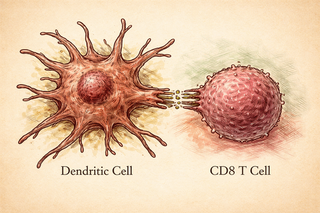
That, in slightly less dramatic language, is the setup for a new Journal of Hepatology paper on steatohepatitis-related liver cancer, or HCC, by Li and colleagues [1]. The study tackles a problem that has been annoying liver cancer researchers with the persistence of a spam call. Patients with MASLD-associated HCC often respond poorly to immunotherapy. We knew the neighborhood was hostile. We did not fully know who was cutting the phone lines.
This paper points a finger at TIM-3.
The Immune System’s Group Project Is Failing
Dendritic cells are the immune system's briefing officers. They grab suspicious material, show it to T cells, and basically say, "This. This is the problem. Please go ruin its day." If dendritic cells disappear, CD8 T cells do not become effective tumor-killers. They become under-informed interns with weapons.
The authors found that in steatohepatitic HCC, dendritic cells are depleted and their interactions with CD8 T cells are reduced [1]. In human tumor samples, higher TIM-3 expression on dendritic cells tracked with worse prognosis [1]. That is not proof by itself, but it is the kind of clue that makes immunologists start circling things in red pen.
And here is where it gets interesting: this was not just a "we saw a correlation and everybody went home early" kind of paper. The team used high-fat-diet mouse models, human tissue staining, genetic and pharmacologic TIM-3 inhibition, dendritic-cell depletion, and adoptive transfer experiments to test mechanism, not just vibes [1].
TIM-3 Is Not Just a T-Cell Drama Queen
TIM-3 is usually discussed as an immune checkpoint molecule, often in exhausted T cells. But immune biology loves side plots. Here, TIM-3 seems to help drive ferroptosis in dendritic cells.
Ferroptosis is a form of cell death caused by iron-dependent lipid peroxidation - basically, fatty cell membranes get chemically trashed until the cell cannot carry on [4]. In a lipid-rich, inflamed liver, that is a pretty ugly setup. Lots of fat. Lots of oxidative stress. Bad time to be a membrane.
Li et al. argue that this metabolic environment pushes dendritic cells toward TIM-3-dependent ferroptosis, shrinking the very cell population needed to activate anti-tumor immunity [1]. Block TIM-3, and dendritic cells survive better. If dendritic cells survive better, CD8 T cells wake up. If CD8 T cells wake up, the tumor has a worse day. Cancer biology occasionally does give us a sentence with a satisfying plot arc.
Why This Matters Beyond One Weird Receptor
This paper fits into a bigger and increasingly awkward story about MASLD and liver cancer. NASH-related HCC has already been linked to impaired response to anti-PD-1 therapy, with prior work suggesting that the immune system in fatty liver disease can become activated in all the wrong ways and still fail at tumor surveillance [2]. Which is, frankly, rude. You pay for an immune system and then it starts free-styling.
Reviews over the past few years have made the same broader point from different angles: MASLD-HCC is not just regular liver cancer wearing a slightly different hat. Its inflammatory, metabolic, and immune wiring is distinct [3]. Dendritic cells are central organizers of anti-cancer immunity in general, so taking them offline is a bit like firing air traffic control and then acting surprised when things hit each other [5].
That makes this study especially interesting because it links three things people often discuss separately:
1. Metabolic liver disease
2. Immune checkpoint biology
3. Ferroptosis
Turns out they may all be gossiping in the same group chat.
The Real-World Angle
The paper also reports that TIM-3 blockade worked even better when paired with anti-PD-1 or lenvatinib in preclinical models [1]. That is the translational hook. Not "TIM-3 cures liver cancer tomorrow," because no, let us all remain adults. But "TIM-3 might help explain why some fatty-liver-associated tumors resist current therapy, and might become a useful combo target."
If these findings hold up, the future clinical move is obvious: identify the subset of HCC patients whose tumors sit in this lipid-heavy, dendritic-cell-killing ecosystem and test whether TIM-3-directed strategies can reopen the immune lane. That would be a lot better than throwing checkpoint inhibitors at everyone and hoping statistics develop a personality.
For now, this is still preclinical work, so the usual caution applies. Mouse models are helpful, not magical. Human tumors are messier. And every exciting immune mechanism eventually runs into the final boss known as "clinical trial reality."
Still, this is a strong mechanistic paper. It gives a clean explanation for how a fatty liver can sabotage anti-tumor immunity without the tumor doing all the sabotage itself. Sometimes the microenvironment is not background scenery. Sometimes it is the bouncer.
Disclaimer: The image accompanying this article is for illustrative purposes only and does not depict actual experimental results, data, or biological mechanisms.
References
-
Li N, Song X, Peng X, et al. Tim-3 facilitates dendritic cell ferroptosis and impairs anti-tumor immunity in steatohepatitis-related HCC. Journal of Hepatology. Published online April 24, 2026. DOI: https://doi.org/10.1016/j.jhep.2026.04.010
-
Pfister D, Núñez NG, Pinyol R, et al. NASH limits anti-tumour surveillance in immunotherapy-treated HCC. Nature. 2021;592(7854):450-456. DOI: https://doi.org/10.1038/s41586-021-03362-0 PMCID: https://pmc.ncbi.nlm.nih.gov/articles/PMC8046670/
-
Llovet JM, Willoughby CE, Singal AG, et al. Nonalcoholic steatohepatitis-related hepatocellular carcinoma: pathogenesis and treatment. Nature Reviews Gastroenterology & Hepatology. 2023;20:487-503. DOI: https://doi.org/10.1038/s41575-023-00754-7
-
Tang D, Kroemer G, Kang R. Ferroptosis in hepatocellular carcinoma: from bench to bedside. Hepatology. 2024;80(3):721-739. DOI: https://doi.org/10.1097/HEP.0000000000000390 PMCID: https://pmc.ncbi.nlm.nih.gov/articles/PMC10551055/
-
Heras-Murillo I, Adán-Barrientos I, Galán M, et al. Dendritic cells as orchestrators of anticancer immunity and immunotherapy. Nature Reviews Clinical Oncology. 2024;21:257-277. DOI: https://doi.org/10.1038/s41571-024-00859-1