If this study were a prestige TV drama, the surgeons would spend an entire season pulling off a heroic finale, only for the villain to sneak back into the same apartment building through the side door. That, in plain English, is the problem with colorectal cancer that has spread to the liver: even after doctors remove or ablate every visible spot, the liver has a nasty habit of hosting an unwelcome encore.
This new randomized phase II trial looked at a very high-risk group - people who had surgery or ablation for four or more colorectal liver metastases after preoperative chemotherapy. That is not a casual little cancer subplot. That is the sort of situation where everyone in the room knows recurrence is lurking nearby, adjusting its cufflinks.
Why the liver keeps becoming the main character
Colorectal cancer loves the liver for boring but powerful anatomical reasons. Blood from the intestines drains straight there, which makes the liver a bit like Grand Central Station for wandering tumor cells. Researchers have spent years trying to understand not just how cancer gets there, but why it is so good at settling in and redecorating the place in its own horrible taste.[1][2]
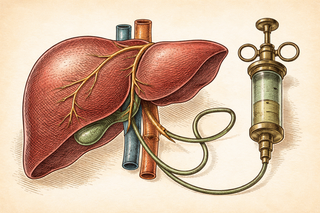
That matters because surgery can absolutely help some patients a lot. But after liver surgery, recurrence is common, especially in people with lots of metastases. So the obvious question becomes: can you hit the liver harder after surgery, before microscopic leftover trouble starts throwing a house party?
The chemotherapy shortcut
That is where hepatic arterial infusion, or HAI, comes in. Instead of sending chemotherapy through the whole bloodstream and hoping enough of it reaches the liver, HAI delivers the drug directly into the artery feeding liver tumors. It is less "spray and pray," more "take the side street and park in front of the building."
The logic is elegant. Liver metastases draw much of their blood supply from the hepatic artery, while normal liver tissue relies more on the portal vein. So if you infuse chemotherapy into the hepatic artery, you can concentrate treatment where the tumors live. Cancer biology is often an incomprehensible swamp, but every now and then it hands researchers a setup this neat and you almost want to applaud.[1][3]
What this trial actually found
In this study, 99 patients were randomly assigned after curative-intent treatment of at least four liver metastases. One group got oxaliplatin through HAI plus IV fluorouracil/leucovorin. The other got oxaliplatin by standard IV infusion plus the same IV fluorouracil/leucovorin.[4]
The headline result is strong and very practical: median hepatic recurrence-free survival was 25 months with HAI versus 12 months with IV treatment. That means the liver stayed free of returning cancer for about twice as long in the HAI group. Overall recurrence-free survival also improved: 14 months versus 9 months. Overall survival favored HAI too - 74 months versus 57 months - though that difference did not reach statistical significance in this phase II study.[4]
So no, this is not "we cured everything, cue confetti cannons." It is more like: we bought meaningful time in the exact organ most likely to betray us. In oncology, that is not a footnote. That is the plot.
The catch, because there is always a catch
HAI was not gentler. Grade 3-4 adverse events occurred in 58% of patients in the HAI arm versus 32% in the IV arm. That is real toxicity, and it matters. The good news is there were no treatment-related deaths, and patients in both groups were similarly able to complete at least four adjuvant cycles.[4]
So the tradeoff here is pretty adult: more liver-focused control, more side effects, and a technique that requires expertise, equipment, and a center that actually knows what it is doing. This is not microwave popcorn oncology. You do not just shove the bag in and hit "start."
Why people in the field are paying attention
This paper did not appear out of nowhere. Recent reviews and meta-analyses have been pointing toward a bigger role for liver-directed therapy in selected patients with colorectal liver metastases.[1][3][5] Major centers such as Mayo Clinic, Penn Medicine, and UCLA have been expanding hepatic artery infusion programs, largely because standard IV chemotherapy often cannot deliver enough punch to the liver without roughing up the rest of the body too much.[6][7][8]
And that may be the most interesting part of this story. The study is not saying systemic therapy is obsolete. Far from it. It is saying that, for the right high-risk patients, where you deliver chemotherapy may matter almost as much as which chemotherapy you choose.
That feels like a smart shift. Cancer treatment has spent decades getting better at choosing drugs. Now it is also getting savvier about traffic patterns.
The bottom line over dessert
If these results hold up in a larger phase III trial, postoperative HAI with oxaliplatin could become an important option for patients whose liver metastases have already shown they do not do subtle. For people facing a high chance of cancer returning in the liver, stretching that liver-free interval from 12 months to 25 months is not a statistical parlor trick. It is more time with the disease not actively reclaiming territory.
Which, honestly, is the kind of plot twist we will take.
References
-
Patel RK, Rahman S, Schwantes IR, et al. Updated Management of Colorectal Cancer Liver Metastases: Scientific Advances Driving Modern Therapeutic Innovations. Cell Mol Gastroenterol Hepatol. 2023;16(6):881-894. DOI: 10.1016/j.jcmgh.2023.08.012. PMCID: PMC10598050
-
Jafari MD, Lianos GD, Economopoulos KP, et al. Molecular Mechanisms of Colorectal Liver Metastases. CA Cancer J Clin. 2023;73:233-254. DOI: 10.3322/caac.21772
-
Sugumar K, Stitzel H, Wu V, et al. Outcomes of Hepatic Artery-Based Therapies and Systemic Multiagent Chemotherapy in Unresectable Colorectal Liver Metastases: A Systematic Review and Meta-analysis. Ann Surg Oncol. 2024;31:4413-4426. DOI: 10.1245/s10434-024-15187-y. PMCID: PMC11164761
-
Gelli M, Ewald J, Tanguy ML, et al. Postoperative Hepatic Arterial Infusion With Oxaliplatin After Surgery of Four or More Colorectal Liver Metastases: A Randomized Phase II Trial. J Clin Oncol. Published April 22, 2026. DOI: 10.1200/JCO-25-01737. PubMed: 42018958
-
Guiu B, Deshayes E, Boige V, et al. Hepatic arterial oxaliplatin plus intravenous 5-fluorouracil and cetuximab for first-line treatment of colorectal liver metastases: A multicenter phase II trial. Eur J Cancer. 2023. DOI: 10.1016/j.ejca.2023.113400. PubMed: 37922632
-
Mayo Clinic News Network. Hepatic artery infusion pump therapy for colorectal liver metastases. November 1, 2024. https://newsnetwork.mayoclinic.org/discussion/hepatic-artery-infusion-pump-therapy-for-colorectal-liver-metastases/
-
Penn Medicine. Hepatic arterial infusion for colorectal liver metastases. February 14, 2022. https://www.pennmedicine.org/physicians-hub/clinical-briefing/hepatic-arterial-infusion-for-colorectal-liver-metastases
-
UCLA Health. UCLA team initiates hepatic artery pump program for targeted chemotherapy. June 3, 2024. https://www.uclahealth.org/news/article/hepatic-artery-pump-chemotherapy-colorectal-liver-cancer
Disclaimer: The image accompanying this article is for illustrative purposes only and does not depict actual experimental results, data, or biological mechanisms.