The ending first: tumors can sometimes be shoved from "immune dead zone" to "active crime scene" with engineered viruses and cytokine gene therapy. The rewind is where it gets weird, because yes, this means doctors are using carefully modified viruses to make cancer more visible to your immune system, which sounds like a plot written at 2 a.m. and then funded anyway.
That is the core of a new Nature Cancer review by Bernstock, Spanehl, and Chiocca [1]. Not a single flashy miracle experiment. A field report. A "here's what seems to work, here's what keeps breaking, and here's why tumors remain annoying" kind of paper.
The Tumor's Favorite Trick: Looking Boring
Your immune system is good at dealing with loud problems. Infected cells. Broken cells. Cells acting like they just drank six espressos and joined a coup. Tumors survive by doing the opposite. They build a tumor microenvironment - the whole neighborhood around the cancer - that suppresses immune cells, blocks T-cell entry, and floods the area with "nothing to see here" chemistry.
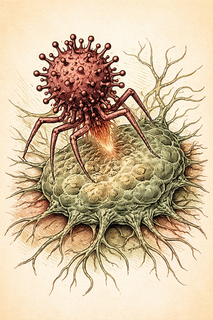
So when people say a tumor is "cold," they do not mean stylish. They mean the immune system is barely showing up.
That is where oncolytic viruses enter, wearing the biological equivalent of steel-toe boots. These viruses are designed to infect tumor cells more readily than normal cells. They kill some cancer cells directly, but the bigger trick is the mess they create. Infected tumor cells burst. Antigens spill out. Danger signals go up. Cytokines start talking. Suddenly the tumor is less speakeasy, more fire alarm.
Tiny Viral Chaos Goblins, but Make It Clinical
The review focuses on two linked ideas.
First, oncolytic viruses can reshape the tumor microenvironment. They can increase immune-cell infiltration, change cytokine signaling, and help T cells actually get into the building [1,2].
Second, cytokine-based gene therapies can deliver powerful immune stimulators locally instead of dumping them through the whole body like a waiter dropping soup onto every table. Cytokines such as IL-12 can be potent anti-cancer tools, but when given systemically they can also be brutally toxic. Local delivery is the difference between using a flashlight and setting the block on fire [1,3].
This is not theoretical hand-waving. Clinical studies already show evidence that these treatments can change immune-cell patterns inside tumors. In melanoma, talimogene laherparepvec, better known as T-VEC, increased immune-cell populations even in non-injected lesions, which is exactly the kind of "oh, now the immune system gets the memo" effect researchers want [4]. In recurrent glioblastoma, a 2023 Nature study linked oncolytic immunoactivation with longer survival, which is not nothing in a disease that treats optimism like a personal insult [5].
Why People in Oncology Keep Coming Back to This
Because solid tumors are stubborn. Checkpoint inhibitors changed cancer care, but many tumors still act like a nightclub with a fake guest list. T cells arrive. Bouncer says no. Everyone goes home.
Oncolytic viruses may help crack that problem in a few ways:
- They make tumors inflamed enough for immune cells to notice.
- They can carry extra payloads, including cytokines or checkpoint-blocking tools.
- They may help turn local tumor destruction into a broader systemic immune response.
Recent reviews and clinical reflections show the field maturing fast. The conversation is no longer just "can a virus kill cancer cells?" It is "can we deliver it reliably, avoid immune clearance, pick the right patients, and combine it intelligently with checkpoint blockade or cell therapy?" [2,6]
That is a much better question. Less sci-fi. More medicine.
The Part Where Reality Walks In With a Clipboard
There are still real problems.
A virus injected into a tumor is easier than a virus sent through the bloodstream, where antibodies and other defenses may neutralize it before it reaches the target [2,6]. Tumors differ wildly. One lesion may be loaded with suppressive macrophages, another with fibrosis, another with hardly any immune cells at all. Same disease name, completely different battlefield.
Then there is durability. The review makes this point clearly: you can see biologic activity, even lasting changes in infiltration and signaling, and still not get consistent long-term clinical responses [1]. Cancer biology loves partial wins. It collects them like trophies.
That is why newer strategies are getting more elaborate. Retargeted viruses, multi-gene payloads, combinations with PD-1 inhibitors, and approaches designed to remodel myeloid cells as well as T cells are all moving forward [6,7]. The field is basically building a Swiss Army knife and then asking it to survive a hurricane.
Reasonable. Totally normal.
What This Could Mean for Actual Humans
If these approaches keep improving, the payoff is big. Tumors that currently ignore immunotherapy might become treatable. "Cold" cancers could become "hot" enough for existing drugs to work better. And local treatment might trigger whole-body immune effects, which is the dream when metastatic disease is involved.
That is the intrigue here. Not that viruses are magical. They are not. It is that they might help convert a locked, immunosuppressive tumor into a place where the immune system can finally do its job.
Which, in cancer medicine, counts as a very serious plot twist.
References
-
Bernstock JD, Spanehl L, Chiocca EA. Oncolytic viruses and cytokine-based gene therapies reprogram the tumor microenvironment. Nature Cancer. 2026. DOI: https://doi.org/10.1038/s43018-026-01153-y
-
Lin D, Shen Y, Liang T. Oncolytic virotherapy: basic principles, recent advances and future directions. Signal Transduction and Targeted Therapy. 2023;8:156. DOI: https://doi.org/10.1038/s41392-023-01407-6 PMCID: https://pmc.ncbi.nlm.nih.gov/articles/PMC10090134/
-
Chiocca EA, et al. Regulatable interleukin-12 gene therapy in patients with recurrent high-grade glioma: results of a phase 1 trial. Science Translational Medicine. 2019. DOI: https://doi.org/10.1126/scitranslmed.aaw5680
-
Malvehy J, et al. Talimogene laherparepvec upregulates immune-cell populations in non-injected lesions: findings from a phase II, multicenter, open-label study in patients with stage IIIB-IVM1c melanoma. Journal for ImmunoTherapy of Cancer. 2021;9:e001621. DOI: https://doi.org/10.1136/jitc-2020-001621
-
Ling AL, et al. Clinical trial links oncolytic immunoactivation to survival in glioblastoma. Nature. 2023;623:157-166. DOI: https://doi.org/10.1038/s41586-023-06623-2
-
Appleton E, Chiocca EA, Ungerechts G, Melcher A, Vile R. Oncolytic viruses as anticancer agents: clinical progress and remaining challenges. The Lancet. 2025;406(10509):1295-1312. DOI: https://doi.org/10.1016/S0140-6736(25)01206-1
-
Giovannoni F, Strathdee CA, Faust Akl C, et al. Retargeted oncolytic viruses engineered to remodel the tumor microenvironment for glioblastoma immunotherapy. Nature Cancer. 2025;6:1994-2010. DOI: https://doi.org/10.1038/s43018-025-01070-6
Disclaimer: The image accompanying this article is for illustrative purposes only and does not depict actual experimental results, data, or biological mechanisms.