What makes a cell itself - its DNA, its habits, or the tiny chemical Post-it notes slapped onto the messages it sends all day? That question sits underneath a new April 22, 2026 review in Molecular Cancer, and the answer is delightfully unsettling: in pancreatic cancer, some of the most important decisions may happen after the gene is written, when RNA gets chemically edited like a draft that refuses to stay put.
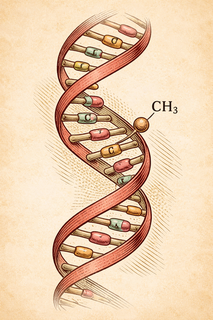
That edit is called RNA methylation. The celebrity version is m6A, short for N6-methyladenosine, which is a very fancy way of saying, "the cell added a small methyl tag to an RNA message and now the whole plan might change." In normal biology, this helps cells decide which messages to keep, translate, ship out, or shred. In pancreatic cancer, those same tags can help run a brutally efficient startup nobody asked to fund.
The Tumor Is Not Just Growing - It’s Scaling
Pancreatic ductal adenocarcinoma, the main form of pancreatic cancer, is infamous for being hard to catch early and hard to treat once found. The American Cancer Society’s current U.S. estimate still puts the overall 5-year relative survival at about 13%, which is the sort of statistic that makes oncologists stare into the middle distance for a second (ACS).
Part of the problem is the neighborhood. Pancreatic tumors live inside a dense, fibrotic, low-oxygen, immune-hostile microenvironment - basically a luxury bunker for bad actors. Immune cells struggle to get in, drugs struggle to spread through, and the cancer cells themselves keep rewiring how they use fuel so they can thrive in lousy conditions. This is where the new review plants its flag: RNA methylation may be one of the control panels linking immune evasion and metabolic reprogramming in the same disease process (Zhu et al., 2026).
Meet the Message Editors
RNA methylation works through three broad crews: writers, which add the tag; erasers, which remove it; and readers, which interpret it. If that sounds like a software stack, congratulations, you now speak cancer biology.
The review walks through how these regulators can influence whether pancreatic cancer cells grow faster, spread further, dodge immune attack, or resist treatment. Some of the names keep coming up: METTL3 as a writer, ALKBH5 and FTO as erasers, and YTHDF or IGF2BP proteins as readers. These are not just random molecular extras wandering through frame. They can reshape which RNAs survive long enough to matter.
That matters because pancreatic cancer is not only trying to grow. It is also trying to manage inventory, energy, and security. RNA methylation can affect glycolysis, lipid use, amino acid handling, inflammatory signaling, and the behavior of immune cells in the tumor microenvironment. In plain English: the cancer is not just building more cells, it is tuning the thermostat, locking the doors, and messing with the catering.
Why This Review Is Actually Interesting
The clever part of this paper is not just "m6A exists." We knew that. The interesting bit is the idea that RNA methylation acts like an immunometabolic hub. Instead of treating immune escape and altered metabolism as two separate headaches, this framework suggests they are entangled at the level of RNA message control.
That helps explain why pancreatic cancer can be such a stubborn platform. One tweak to RNA handling might ripple outward into drug resistance, immune suppression, and metastatic behavior all at once. For example, studies cited in the review show METTL3 can promote pancreatic cancer progression and gemcitabine resistance, while other work suggests ALKBH5 can restrain tumor progression in certain contexts (Lin et al., 2023; Guo et al., 2020). Another study found that m6A modification of FZR1 helps drive gemcitabine resistance, which is about as rude as it sounds (Su et al., 2023).
So yes, the tumor is doing molecular product optimization. Of course it is. Cancer never misses a chance to be aggressively overengineered.
What Could This Mean for Real Patients?
If these findings hold up, RNA methylation could matter in three practical ways.
First, it could help identify biomarkers that predict prognosis or treatment response. Second, it opens the door to drug targets such as METTL3 and related regulators, several of which are already being explored in cancer research more broadly (Chen et al., 2023). Third, it supports the growing logic of combination therapy: do not just hit the tumor cell, also hit the message-editing machinery that helps the tumor hide, adapt, and resist.
That broader strategy fits where pancreatic cancer research is heading. Recent clinical work, including a phase 2 Nature Medicine trial published on April 14, 2026, reflects the field’s push toward combination approaches that crack the tumor’s protective ecosystem rather than pretending one silver bullet will stroll in wearing sunglasses and fix everything (Nalluru et al., 2026).
None of this means RNA methylation drugs are ready to moonwalk into routine pancreatic cancer care tomorrow. The biology is messy, context matters, and some of these regulators can act differently depending on cell type and setting. But this review makes a strong case that the field should stop treating RNA methylation like a side quest. In pancreatic cancer, it may be closer to the operating system.
References
- Zhu Y, Ma K, Hao Q, et al. The RNA methylation modification as an immunometabolic regulatory hub in pancreatic cancer: from mechanistic insights to clinical translation perspectives. Molecular Cancer. 2026. DOI: 10.1186/s12943-026-02667-w
- Chen M, Wong C-M. The roles and implications of RNA m6A modification in cancer. Nature Reviews Clinical Oncology. 2023;20:507-526. DOI: 10.1038/s41571-023-00774-x
- Hu X, Lei X, Guo J, et al. The Emerging Role of RNA N6-Methyladenosine Modification in Pancreatic Cancer. Frontiers in Oncology. 2022;12:927640. DOI: 10.3389/fonc.2022.927640. PubMed: 35936737
- Lin C, Li T, Zhang Y, et al. METTL3 enhances pancreatic ductal adenocarcinoma progression and gemcitabine resistance through modifying DDX23 mRNA N6 adenosine methylation. Cell Death & Disease. 2023;14:221. DOI: 10.1038/s41419-023-05715-1
- Su J, Li R, Chen Z, et al. N6-methyladenosine Modification of FZR1 mRNA Promotes Gemcitabine Resistance in Pancreatic Cancer. Cancer Research. 2023. DOI: 10.1158/0008-5472.CAN-22-3346
- He J, Liu F, Zhang Z. Functions of N6-methyladenosine in cancer metabolism: from mechanism to targeted therapy. Biomarker Research. 2023;11:40. DOI: 10.1186/s40364-023-00483-8. PubMed: 37055798
- Hartupee C, Nagalo BM, Chabu CY, et al. Pancreatic cancer tumor microenvironment is a major therapeutic barrier and target. Frontiers in Immunology. 2024. DOI: 10.3389/fimmu.2024.1287459
- Nalluru SS, Mahalingam D, et al. Elraglusib and chemotherapy in metastatic pancreatic ductal adenocarcinoma: a randomized controlled phase 2 trial. Nature Medicine. Published April 14, 2026. DOI: 10.1038/s41591-026-04327-4
Disclaimer: The image accompanying this article is for illustrative purposes only and does not depict actual experimental results, data, or biological mechanisms.