Take one extremely stubborn lymphoma, add several prior treatments that already failed, fold in a patient’s own T cells after some high-tech genetic meddling, and then pray the whole thing does not boil over into cytokine chaos. That is more or less the recipe behind CAR-T therapy for relapsed or refractory mantle cell lymphoma, and in the new five-year follow-up from ZUMA-2, the dish did not just survive the oven - it kept feeding people years later.[1]
Mantle cell lymphoma, or MCL, is a relatively uncommon B-cell lymphoma that tends to behave like the overconfident villain in a sequel: even when treatment works at first, it often comes back, and it can come back meaner.[2] Patients in this study had already been through a lot, including Bruton tyrosine kinase inhibitors, which are important drugs in MCL but not a forever shield. Once MCL stops responding there, the road gets rough fast, and recent reviews still describe a big unmet need in that post-BTK inhibitor setting.[3,4]
Your Immune System, Now With Aftermarket Parts
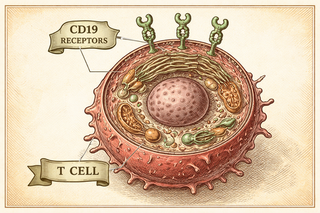
CAR-T therapy is basically immune-system custom work. Doctors collect a patient’s T cells, re-engineer them to recognize CD19 on lymphoma cells, grow them up in the lab, and infuse them back in like a tiny, highly motivated security team that finally got the right address.[5] In ZUMA-2, that product was brexucabtagene autoleucel, or brexu-cel.
This mattered because early ZUMA-2 results already looked unusually strong for such a hard-to-treat group. The original report showed a 93 percent objective response rate and a 67 percent complete response rate.[6] Those are the sort of numbers that make hematologists sit up straighter and reach for a second coffee.
The new paper asks the question everyone actually cares about after the conference applause dies down: okay, but did it last?
The Five-Year Plot Twist
Apparently, often enough to matter.
With a median follow-up of 67.8 months in the pivotal cohort, the median duration of response was 36.5 months, and median overall survival was 46.5 months.[1] For patients who achieved a complete response, median overall survival reached 60.2 months.[1] In plain English: a meaningful chunk of heavily pretreated patients were not just getting a dramatic short-term win, they were buying real time. Not fake biotech-brochure time. Actual calendar time.
That is the headline here. CAR-T in MCL has always had the energy of a very powerful but slightly alarming power tool. You know it can do the job, but you would also like to keep all your fingers. The reassuring part of this follow-up is that no new safety signal popped out over the long haul, and the study reported no grade 5 cytokine release syndrome or neurologic events, no subsequent T-cell malignancies, and no fresh late-surprise horror show.[1]
That does not mean CAR-T is easy. It absolutely is not. Cytokine release syndrome and neurologic toxicity are still part of the deal, because giving immune cells permission to go full action-movie mode can get messy.[5] But long-term follow-up matters because it tells us whether the bargain still looks reasonable years later. Here, it mostly does.
Why This Hits Harder Than a Usual Survival Curve
The real intrigue is not just that brexu-cel worked. It is that it kept working in a disease where remissions after multiple relapses can feel annoyingly temporary, like trying to keep a beach umbrella open in a thunderstorm.
Recent reviews and meta-analyses support the same broader picture: CAR-T therapy in relapsed or refractory MCL produces high response rates, but access, timing, and relapse after treatment remain major issues.[4,7] Real-world UK data from 2024 looked broadly consistent with trial efficacy among infused patients, while also showing something trials can blur a bit: some patients never make it to infusion because the disease moves too fast or manufacturing falls apart.[7] That is one of the least glamorous and most important facts in cell therapy. You can have a brilliant living drug, but if the cancer outruns the factory schedule, biology wins the argument.
So the challenge this paper addresses is not only, “Can CAR-T knock down MCL?” We already knew it could. The harder question is, “Can it produce durable remissions without a hidden long-term bill arriving five years later?” This follow-up says yes, for some patients, and that is a big deal.
What This Could Mean in Real Life
If these results keep holding up in broader practice, brexu-cel looks less like a flashy rescue move and more like a treatment that can carve out long remissions for a subset of people with very few good options. That changes conversations. It affects referral timing. It raises the stakes for getting patients to CAR-T centers before the lymphoma turns into a sprinting maniac. It also strengthens the case for figuring out who benefits most, how to reduce infections and dropout before infusion, and what to do for patients who relapse after CAR-T.[3,7,8]
Cancer biology still insists on being weird. But every now and then, the weirdness works for patients. In this case, the immune cells were not locked out of the building. They got in, found the troublemakers, and in some people, kept patrol going for years.
Disclaimer: The image accompanying this article is for illustrative purposes only and does not depict actual experimental results, data, or biological mechanisms.
References
-
Muñoz J, Locke FL, Reagan PM, et al. Five-year follow-up of patients with relapsed/refractory mantle cell lymphoma treated with anti-CD19 CAR T-cell therapy in ZUMA-2, Cohorts 1 and 2. J Hematol Oncol. 2026. DOI: https://doi.org/10.1186/s13045-026-01797-4
-
Rule S. Mantle cell lymphoma. Blood Rev. 2020;44:100691. DOI: https://doi.org/10.1016/j.blre.2020.100691
-
Wu JJ, Wade SW, Itani T, et al. Unmet needs in relapsed/refractory mantle cell lymphoma post-covalent BTK inhibitor: a systematic literature review and meta-analysis. Leuk Lymphoma. 2024;65(11):1609-1622. DOI: https://doi.org/10.1080/10428194.2024.2369653
-
Wan H, Weng S, Sheng S, et al. Chimeric antigen receptor T-cell therapy in relapsed or refractory mantle cell lymphoma: a systematic review and meta-analysis. Front Immunol. 2024;15:1435127. DOI: https://doi.org/10.3389/fimmu.2024.1435127. PMCID: https://pmc.ncbi.nlm.nih.gov/articles/PMC11412868/
-
CAR T cell. Wikipedia. https://en.wikipedia.org/wiki/CAR_T_cell
-
Wang M, Munoz J, Goy A, et al. KTE-X19 CAR T-cell therapy in relapsed or refractory mantle-cell lymphoma. N Engl J Med. 2020;382(14):1331-1342. DOI: https://doi.org/10.1056/NEJMoa1914347
-
O'Reilly MA, Wilson W, Burns D, et al. Brexucabtagene autoleucel for relapsed or refractory mantle cell lymphoma in the United Kingdom: a real-world intention-to-treat analysis. HemaSphere. 2024;8(6):e87. DOI: https://doi.org/10.1002/hem3.87. PMCID: https://pmc.ncbi.nlm.nih.gov/articles/PMC11170269/
-
Liebers N, Boumendil A, Finel H, et al. Brexucabtagene autoleucel versus allogeneic hematopoietic cell transplantation in relapsed and refractory mantle cell lymphoma. J Clin Oncol. 2025. DOI: https://doi.org/10.1200/JCO-24-01308. PMCID: https://pmc.ncbi.nlm.nih.gov/articles/PMC12050943/