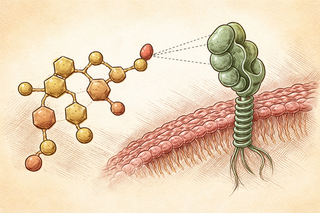
Here is the core puzzle piece. The authors found that MMRN1 is highly expressed in leukemia stem cells and can switch on EGFR, a signaling receptor better known from solid tumors than blood cancers. Once that pathway lights up, it helps leukemia cells accumulate sialylglycans - sugar structures rich in sialic acid, the same family of molecules your cells normally use as part of their surface ID badges.
Immune cells carry receptors called Siglecs that read those sugar badges. Under ordinary circumstances, that helps the immune system avoid wrecking healthy tissue. In cancer, though, this can turn into bureaucratic nonsense: the malignant cell flashes enough “looks normal to me” sugar, and the immune patrol waves it through. Reviews over the past few years have increasingly framed the sialylglycan-Siglec axis as a real immune checkpoint system, not just biochemical garnish on the side (Stanczak and Läubli, 2023; Jame-Chenarboo et al., 2024).
In this paper, MMRN1 seems to help build exactly that kind of checkpoint in AML. Translation: the leukemia stem cells are not merely hiding behind the couch. They are forging visitor badges, changing the locks, and somehow convincing the bouncer that the T cells are the problem.
Two Problems, One Molecule
The clever part is that MMRN1 does not only help immune escape. The same paper links it to self-renewal, through a related EGFR-STAT5-CD9 route. That makes MMRN1 look like a two-for-one headache: it helps leukemia stem cells survive as stem cells and helps them dodge immune destruction.
That “dual function” idea is why this study feels bigger than a single pathway diagram. AML has been frustratingly good at immune evasion through many routes - exhausted T cells, suppressive marrow neighborhoods, altered antigen presentation, and checkpoint signaling that turns the whole place into a cellular customer-service maze (Gurska and Gritsman, 2023; Sauerer et al., 2023). A target that hits both stemness and immune escape is the sort of answer researchers keep hoping will exist and then usually find out does not, because biology enjoys practical jokes.
There is also a broader pattern showing up. On April 9, 2026, a separate Science study reported that AML cells can use sialylated CD43 as a glyco-immune barrier against macrophages, NK cells, and T cells, reinforcing the idea that sugar-based immune evasion in AML is not some niche side quest - it may be part of the main storyline (Chung et al., 2026).
Why This Could Actually Matter
The most immediately intriguing part is therapeutic. The authors report that erlotinib, an EGFR inhibitor, combined with azacitidine plus HAG produced a 75% remission rate in relapsed or refractory AML in the trial they cite. That is encouraging, but this is where everyone should keep both eyebrows raised. Early clinical signals are not victory laps. They are invitations to do the harder, bigger, less glamorous follow-up work.
Still, if the result holds up, the real-world impact could be substantial. Instead of treating AML relapse as only a genetics problem or only an immune problem, this work suggests some leukemias may be exploiting a glyco-immune checkpoint wired directly into stem-cell survival machinery. Break that circuit, and you might make the most dangerous cells both more visible and less durable. That is a much better bargain than simply punching the disease harder and hoping the right cells fall over.
Cancer biology loves red herrings, and this field has enough of them to stock a suspiciously upscale fish market. But this paper fits a growing picture: in AML, the sugar coating is not decoration. It may be part of the lock on the door.
References
- Peng M, Huang Y, Zhang M, et al. MMRN1-EGFR drives sialylglycan-Siglec immune evasion in AML leukemia stem cells. Cell Stem Cell. 2026. DOI: https://doi.org/10.1016/j.stem.2026.03.012
- Long NA, Golla U, Sharma A, et al. Acute Myeloid Leukemia Stem Cells: Origin, Characteristics, and Clinical Implications. Stem Cell Reviews and Reports. 2022;18(4):1211-1226. DOI: https://doi.org/10.1007/s12015-021-10308-6 PMCID: https://pmc.ncbi.nlm.nih.gov/articles/PMC10942736/
- Stanczak MA, Läubli H. Siglec receptors as new immune checkpoints in cancer. Molecular Aspects of Medicine. 2023;90:101112. DOI: https://doi.org/10.1016/j.mam.2022.101112
- Jame-Chenarboo Z, Gray TE, Macauley MS. Advances in understanding and exploiting Siglec-glycan interactions. Current Opinion in Chemical Biology. 2024;83:102454. DOI: https://doi.org/10.1016/j.cbpa.2024.102454
- Serroukh Y, Hébert J, Busque L, et al. Blasts in context: the impact of the immune environment on acute myeloid leukemia prognosis and treatment. Blood Reviews. 2023;57:100991. DOI: https://doi.org/10.1016/j.blre.2022.100991
- Gurska L, Gritsman K. Unveiling T cell evasion mechanisms to immune checkpoint inhibitors in acute myeloid leukemia. Cancer Drug Resistance. 2023;6(3):674-687. DOI: https://doi.org/10.20517/cdr.2023.39 PMCID: https://pmc.ncbi.nlm.nih.gov/articles/PMC10571054/
- Sauerer T, Filippini Velázquez G, Schmid C. Relapse of acute myeloid leukemia after allogeneic stem cell transplantation: immune escape mechanisms and current implications for therapy. Molecular Cancer. 2023;22:180. DOI: https://doi.org/10.1186/s12943-023-01889-6 PMCID: https://pmc.ncbi.nlm.nih.gov/articles/PMC10640763/
- Chung J, Vallurupalli M, Noel S, et al. Sialylated CD43 forms a glyco-immune barrier that restrains antileukemic immunity. Science. 2026;392(6794):eady5196. DOI: https://doi.org/10.1126/science.ady5196
Disclaimer: The image accompanying this article is for illustrative purposes only and does not depict actual experimental results, data, or biological mechanisms.