Here lies the old pancreatic cancer strategy: throw DNA-damaging chemotherapy at the tumor, cross your fingers, and act surprised when the tumor comes back wearing sunglasses and a fake mustache. It had a long run. Not a great run, but a long one.
A new paper in Nature Cell Biology suggests part of the problem is not just the cancer cells themselves, but the neighborhood they live in. In pancreatic ductal adenocarcinoma, or PDAC, that neighborhood is packed with cancer-associated fibroblasts, the stromal support crew that should sound boring but absolutely refuses to be boring. These fibroblasts build the extracellular matrix, a kind of molecular scaffolding around the tumor. Scientists have long suspected this scaffolding helps tumors dodge treatment. What this study adds is the sneaky mechanism: the matrix seems to help cancer cells repair DNA damage and survive chemotherapy by activating a protein called NDRG1, which helps process dangerous RNA-DNA tangles called R-loops and protects stressed replication forks [1].
The Tumor’s Repair Shop Was Open the Whole Time
Pancreatic cancer is notoriously difficult to treat, and the numbers are still grim. The American Association for Cancer Research reports a 13.3% five-year relative survival rate in the United States for 2025, which is the sort of statistic that makes everyone in oncology stare into the middle distance for a minute [2].
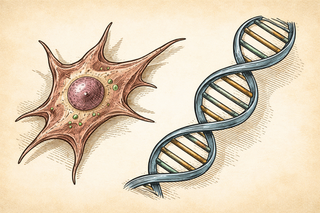
So why is PDAC such a menace? Part of it is the stroma, the dense mix of fibroblasts, immune cells, and extracellular matrix around the tumor. Think of the tumor as a crook, and the stroma as the heavily lawyered-up, alarm-system-equipped mansion that crook somehow lives in rent-free. Reviews over the past few years have emphasized that fibroblasts and the matrix do far more than provide structural support. They shape immunity, drug delivery, metabolism, and treatment resistance [3-5].
This new study pushes that story further. The authors found that extracellular matrix proteins secreted by fibroblasts can signal through adhesion receptors and SGK1 to increase NDRG1 activity in pancreatic cancer cells. NDRG1 then helps those cells keep copying their DNA even under stress, resolve stalled replication forks, and reduce R-loops, those awkward RNA-DNA hybrid structures that are useful in some contexts but, when unmanaged, can gum up the genome like chewing gum in a printer [1,6,7].
R-Loops: Tiny Molecular Traffic Jams
If you have never heard of an R-loop, congratulations on having a healthier social life than many cell biologists. An R-loop forms when newly made RNA sticks back onto DNA, creating an RNA-DNA hybrid and leaving one DNA strand hanging loose. Cells can handle some of these structures. Too many, though, and replication and transcription start arguing in the parking lot.
That matters because many chemotherapies work by stressing DNA replication. If a tumor cell gets better at managing that stress, chemo loses some of its bite. This paper argues that fibroblasts are not just bystanders in that process. They may be actively coaching tumor cells through the damage, like a very unethical SAT tutor for malignant genomes [1].
Recent reviews back up why that is a big deal. R-loops are now viewed as major players in genome instability, DNA repair, and therapy response across cancers [6-8]. So if PDAC cells are getting stromal help to clean up R-loops and restart damaged replication forks, that could explain why DNA-damaging treatments often underperform.
Why This Matters Outside the Lab
The practical implication is not "NDRG1 is evil, roll credits." Biology hates simple villains. Fibroblasts are heterogeneous, and some stromal signals can restrain tumors while others help them [4]. Still, this work opens a sharper therapeutic idea: maybe the best way to weaken pancreatic cancer is not only to hit the cancer cell, but also to cut the phone line between the tumor and its fibroblast-built repair network.
That fits with other recent PDAC research. A 2024 Science Translational Medicine study showed that reprogramming fibroblast-related stromal signaling could overcome treatment resistance and improve responses to therapy in pancreatic cancer models [5]. Another 2024 Cancer Cell paper showed that tumor-intrinsic changes can reshape fibroblast behavior to metabolically support PDAC, which is rude, impressive, and very on-brand for cancer [9].
If these findings hold up, future treatment strategies might combine standard chemotherapy with drugs that block stromal signaling, ECM sensing, SGK1-NDRG1 activity, or R-loop handling. The dream is not just "more drugs." It is smarter timing and smarter combinations, so the tumor does not get to repair the damage before the bill comes due.
The Bigger Joke Is That the "Scaffolding" Runs the Show
This is the part that keeps happening in cancer biology: the thing we thought was background scenery turns out to be part of management. Fibroblasts are not folding chairs at the tumor conference. They are helping choose the playlist, lock the exits, and apparently patch the DNA.
That makes this paper interesting beyond pancreatic cancer. It adds to a growing view that the tumor microenvironment can directly influence the cell’s most intimate survival machinery, including replication stress and DNA repair. For patients, that does not mean an immediate new treatment tomorrow morning. It does mean researchers are getting less fooled by the obvious suspect and more interested in the accomplices.
And in pancreatic cancer, where "good enough" has not been good enough for a very long time, that shift matters.
References
- Kozlova N, Cruz KA, Ruzette AA, et al. Cancer-associated fibroblasts regulate DNA repair in pancreatic cancer through NDRG1-mediated R-loop processing. Nat Cell Biol. 2026. DOI: https://doi.org/10.1038/s41556-026-01938-4
- AACR. Pancreatic Cancer. 2025 statistics page. https://www.aacr.org/patients-caregivers/cancer/pancreatic-cancer/
- Arpinati L, Carradori G, Scherz-Shouval R. CAF-induced physical constraints controlling T cell state and localization in solid tumours. Nat Rev Cancer. 2024;24(10):676-693. DOI: https://doi.org/10.1038/s41568-024-00740-4
- Vera R, Lamberti MJ, Gonzalez AL, Fernandez-Zapico ME. Epigenetic regulation of the tumor microenvironment: A leading force driving pancreatic cancer. Pancreatology. 2024;24(6):878-886. DOI: https://doi.org/10.1016/j.pan.2024.07.005. PMCID: https://pmc.ncbi.nlm.nih.gov/articles/PMC11994899/
- Liu X, Baer JM, Stone ML, et al. Stromal reprogramming overcomes resistance to RAS-MAPK inhibition to improve pancreas cancer responses to cytotoxic and immune therapy. Sci Transl Med. 2024;16(770):eado2402. DOI: https://doi.org/10.1126/scitranslmed.ado2402. PMCID: https://pmc.ncbi.nlm.nih.gov/articles/PMC12376167/
- Crossley MP, Bocek M, Cimprich KA. Intertwining roles of R-loops and G-quadruplexes in DNA repair, transcription and genome organization. Nat Cell Biol. 2024;26(7):1025-1036. DOI: https://doi.org/10.1038/s41556-024-01437-4
- Lee SY, Kwak MJ, Kim JJ. R-loops: a key driver of inflammatory responses in cancer. Exp Mol Med. 2025;57(7):1455-1466. DOI: https://doi.org/10.1038/s12276-025-01495-0. PMCID: https://pmc.ncbi.nlm.nih.gov/articles/PMC12322051/
- Li D, Shao F, Li X, et al. Advancements and challenges of R-loops in cancers: Biological insights and future directions. Cancer Lett. 2025;610:217359. DOI: https://doi.org/10.1016/j.canlet.2024.217359
- Niu N, Shen X, Wang Z, et al. Tumor cell-intrinsic epigenetic dysregulation shapes cancer-associated fibroblasts heterogeneity to metabolically support pancreatic cancer. Cancer Cell. 2024;42(5):869-884.e9. DOI: https://doi.org/10.1016/j.ccell.2024.03.005
Disclaimer: The image accompanying this article is for illustrative purposes only and does not depict actual experimental results, data, or biological mechanisms.