Cells can enter senescence, which is biology’s version of “you are done dividing, please stop touching the machinery.” That can be helpful. It keeps damaged cells from turning into tumors. But senescent cells also have a bad habit of hanging around like ex-employees who still have the office Slack password and keep sending inflammatory messages to everyone. They release a stew of signals called the SASP, which can push tissues toward aging, chronic inflammation, and cancer-friendly chaos (McHugh et al., 2025).
That makes senescent cells tempting drug targets. The dream is a senolytic: a drug that removes these lingering troublemakers while sparing normal cells. Easy to say. Much harder to do when cells have spent millions of years becoming slippery little survival artists.
A grease-fire problem hiding in plain sight
The new paper by D’Ambrosio and colleagues took a brute-force approach. They screened 10,480 electrophilic compounds looking for ones that selectively kill senescent cells. They found 38 hits, then zoomed in on a family of chloroacetamides that seemed especially good at the job. The key target turned out to be GPX4, an enzyme that protects cell membranes from oxidized lipids (D’Ambrosio et al., 2026).
Why does that matter? Because senescent cells already look like they are living on the edge. They carry high oxidative stress and extra intracellular iron, which means they are partly set up for ferroptosis. Ferroptosis is a form of cell death driven by iron-dependent lipid damage. Think less “clean self-destruct button,” more “the ship hull slowly turns into a frying pan.” GPX4 is one of the main systems stopping that disaster from fully kicking off (Wahida and Conrad, 2025).
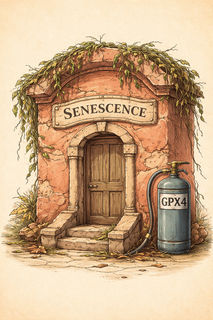
So the paper’s big idea is almost comically elegant: senescent cells are already standing in a room that smells like smoke, and GPX4 is the overworked fire extinguisher. Knock out GPX4, and those cells tip into ferroptosis.
Why oncologists should care, besides the obvious “fire is bad” thing
This gets especially interesting in cancer because many therapies do not fully kill tumor cells. Some push them into a senescent state instead. That sounds fine until you remember those cells can linger, stir up the tumor neighborhood, and possibly help relapse later. Cancer biology loves a plot twist and rarely chooses the fun kind.
D’Ambrosio’s team showed that combining anticancer treatment with GPX4 inhibition cleared senescent tumor cells in melanoma, prostate, and ovarian cancer models, and GPX4 inhibition also reduced premalignant senescent hepatocytes in mice (D’Ambrosio et al., 2026). That fits with other recent work suggesting therapy-driven senescence can create a ferroptosis-sensitive state, including a 2024 Cancer Research study showing that cotargeting CDK4/6 and BRD4 promoted both senescence and ferroptosis vulnerability in cancer cells (Zhu et al., 2024).
In other words, this is part of a broader “one-two punch” strategy: first force cancer cells into a compromised, senescent limbo, then remove them before they can cause trouble. It sounds a bit like science fiction because modern oncology increasingly is science fiction, just with more pipettes and fewer cape billows.
The catch, because there is always a catch
Nobody should read this and assume GPX4 inhibitors are ready to roll into the clinic next Tuesday. Ferroptosis is powerful, but it is also context-dependent. Not every route into ferroptosis works equally well in senescent cells. A 2025 Nature Communications paper found that some senescent cells resist upstream ferroptosis triggers like cystine deprivation because lysosomal changes reroute iron handling, yet they still remain dependent on GPX4 protection (Loo et al., 2025).
That means researchers still need answers on selectivity, biomarkers, dosing, and normal tissue safety. Reviews in Nature Cancer and Nature Reviews Cancer make the same point bluntly: ferroptosis is exciting, but translating it into real cancer drugs has been slower than the hype machine would like (Ubellacker and Dixon, 2025; Wahida and Conrad, 2025).
Still, the core finding lands hard. Senescent cells are not just inert biological furniture. They are metabolically tense, iron-loaded, oxidative little drama factories. And GPX4 may be one of the things keeping them from falling apart.
That is the fun part of this paper: it turns senescence from a vague “zombie cell” concept into something more tactical. If these results hold up, cancer treatment may someday include not just stopping bad cells, but escorting the supposedly retired ones all the way out of the building.
References
-
D’Ambrosio M, White MEH, Gavriil ES, et al. Electrophilic compound screening identifies GPX4-dependent ferroptosis as a senescence vulnerability. Nature Cell Biology. 2026. DOI: 10.1038/s41556-026-01921-z
-
McHugh D, Durán I, Gil J. Senescence as a therapeutic target in cancer and age-related diseases. Nature Reviews Drug Discovery. 2025;24:57-71. DOI: 10.1038/s41573-024-01074-4
-
Wahida A, Conrad M. Decoding ferroptosis for cancer therapy. Nature Reviews Cancer. 2025;25:910-924. DOI: 10.1038/s41568-025-00864-1
-
Ubellacker JM, Dixon SJ. Prospects for ferroptosis therapies in cancer. Nature Cancer. 2025;6:1326-1336. DOI: 10.1038/s43018-025-01037-7
-
Zhu X, Fu Z, Dutchak K, et al. Cotargeting CDK4/6 and BRD4 Promotes Senescence and Ferroptosis Sensitivity in Cancer. Cancer Research. 2024;84(8):1333-1351. DOI: 10.1158/0008-5472.CAN-23-1749
-
Loo TM, Zhou X, Tanaka Y, et al. Senescence-associated lysosomal dysfunction impairs cystine deprivation-induced lipid peroxidation and ferroptosis. Nature Communications. 2025;16:6617. DOI: 10.1038/s41467-025-61894-9
Disclaimer: The image accompanying this article is for illustrative purposes only and does not depict actual experimental results, data, or biological mechanisms.