Cancer drugs fail partly because tumor cells are annoyingly good at cleaning up their own mess. A 2026 paper argues that in BRCA1-deficient tumors, one of the cleanup crews is a protein called RPA, and if you knock it out while using a PARP inhibitor, the whole operation can go from "coping" to "absolute chromosomal disaster" pretty fast ([1]).
If that sounds like a lot of acronyms in a trench coat, fair. Basically, BRCA1-deficient cancers already have trouble handling DNA damage. That is why PARP inhibitors work in some of these tumors in the first place. The older story was fairly simple: block PARP, pile up DNA problems, cancer cells tap out. But over the last few years, scientists have been building a messier and more interesting version of that story. It turns out tiny single-stranded DNA gaps, especially on the lagging strand during replication, may be a big part of what decides whether a tumor lives, dies, or develops the scientific equivalent of a fake mustache and escapes treatment ([2]-[4]).
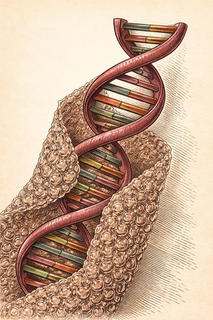
Meet RPA, the panic blanket
RPA stands for replication protein A. It binds single-stranded DNA, which is the exposed, vulnerable version of DNA that shows up during replication and repair. In other words, when the genome has a frayed edge hanging out, RPA throws a blanket over it so things do not get even worse.
That matters because DNA replication is not one smooth zipper. The lagging strand gets built in little chunks called Okazaki fragments, which is a very elegant way for cells to do something that sounds like a contractor repeatedly leaving half-finished patches in your kitchen. Those patches need careful processing. If they are not handled well, gaps remain.
BRCA1-deficient cells already struggle with suppressing these gaps. PARP inhibitors can make that worse. The new paper says RPA is one reason those cells do not instantly fall apart. RPA protects the gaps long enough for the cell to limp forward ([1],[3]).
What this new study actually found
VanderVere-Carozza and colleagues used lung, breast, and ovarian cancer models, including BRCA1-deficient breast and ovarian cancer cells. They found that RPA helps replication forks keep moving under normal conditions and helps restart them after stalling. When they chemically inhibited RPA with a small molecule called NERx-329, cells became much worse at protecting single-stranded DNA. Add a PARP inhibitor on top of that, and the DNA damage escalated into chromosome pulverization and cell death ([1]).
That is the real hook here. The paper is not just saying "RPA does stuff," which, yes, thank you science, very specific. It is saying RPA acts like a protective buffer that limits how lethal PARP inhibitors can become in BRCA1-deficient tumors. Remove that buffer, and the synthetic lethality gets much sharper.
The team also showed this in mice with BRCA1-deficient triple-negative breast cancer xenografts. The combination of PARP inhibition plus RPA inhibition suppressed tumor growth without obvious added toxicity by body-weight readout in that model ([1]). That is still preclinical, not a green light to start rewriting treatment guidelines on a napkin, but it is the kind of result that makes drug developers sit up straighter.
Why this is a big deal beyond one protein
This paper lands in the middle of a broader shift in the field. For years, the headline explanation for PARP inhibitors focused on double-strand breaks. More recent work has pushed a different idea: replication gaps may be one of the earliest and most decisive lesions in BRCA-deficient cells ([2]-[4]). Another 2024 study showed that the DNA polymerase alpha-primase complex helps protect BRCA1-deficient cells from these PARP inhibitor-induced gaps, which nicely fits the theme that tumors survive by patching replication trouble any way they can ([5]).
So the challenge is not just "how do we damage cancer DNA?" It is "how do we stop cancer cells from calmly bringing duct tape to the scene?"
That matters in the clinic because PARP inhibitors can work really well, especially in BRCA-mutant cancers, but resistance remains a stubborn problem. Some patients never respond much, and many who do respond eventually relapse ([3],[4],[6]). If RPA-mediated gap protection is part of that survival strategy, then combining PARP inhibitors with drugs that block gap protection could become a way to push resistant tumors back into a corner.
The catch, because there is always a catch
No, this does not mean an RPA inhibitor combo is ready for routine use tomorrow. RPA is not some optional gadget. Healthy cells need it too. That makes dosing, scheduling, and side effects a serious issue. Cancer biology loves a narrow therapeutic window the way raccoons love unsecured trash cans.
Still, this study gives a much clearer map of where the vulnerability might be. Not just "BRCA tumors hate PARP inhibitors," but "BRCA tumors may depend on RPA to survive the single-stranded DNA gaps that PARP inhibitors create." That is a far more actionable sentence.
And honestly, cancer research often advances like this: not with one dramatic movie-scene breakthrough, but by catching tumor cells relying on one extra support beam and then quietly sawing through it.
References
-
VanderVere-Carozza PS, Jordan MR, Garrett JE, Pollok KE, Pawelczak KS, Turchi JJ. Replication protein A protects lagging strand gaps, restricting PARP inhibitor-induced synthetic lethality in BRCA1-deficient tumors. Nucleic Acids Research. 2026;54:gkag396. DOI: https://doi.org/10.1093/nar/gkag396
-
Cong K, Peng M, Kousholt AN, Lee WTC, Lee S, Nayak S, et al. Replication gaps are a key determinant of PARP inhibitor synthetic lethality with BRCA deficiency. Molecular Cell. 2021;81(15):3128-3144.e7. DOI: https://doi.org/10.1016/j.molcel.2021.06.011
-
Li X, Zou L. BRCAness, DNA gaps, and gain and loss of PARP inhibitor-induced synthetic lethality. Journal of Clinical Investigation. 2024;134(14):e181062. DOI: https://doi.org/10.1172/JCI181062
-
Dibitetto D, Widmer CA, Rottenberg S. PARPi, BRCA, and gaps: controversies and future research. Trends in Cancer. 2024;10(9):857-869. DOI: https://doi.org/10.1016/j.trecan.2024.06.008
-
Machacova Z, Chroma K, Lukac D, Protivankova I, Moudry P. DNA polymerase alpha-primase facilitates PARP inhibitor-induced fork acceleration and protects BRCA1-deficient cells against ssDNA gaps. Nature Communications. 2024;15:7375. DOI: https://doi.org/10.1038/s41467-024-51667-1. PMCID: https://pmc.ncbi.nlm.nih.gov/articles/PMC11350149/
-
Mukherjee UA, Miller RE, Ledermann JA. Controversies and clinical unknowns in the use of PARP inhibitors in ovarian cancer. Therapeutic Advances in Medical Oncology. 2025. DOI: https://doi.org/10.1177/17588359251343973
Disclaimer: The image accompanying this article is for illustrative purposes only and does not depict actual experimental results, data, or biological mechanisms.