Science once blamed combustion on phlogiston, a made-up substance that sounded convincing right up until reality showed up with a folding chair. GlycoRNA has that same "surely not" flavor, except this time the absurd-sounding idea is real: some RNAs can be sugar-coated and displayed on the outside of cells, like they ignored the usual floor plan of biology and let themselves onto the balcony.
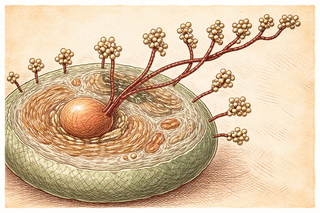
That alone is a lovely little insult to textbook neatness. Now a new paper adds something even juicier: a way to track these glycoRNAs directly on single cells, and a clue for how they get to the membrane in the first place (Gong et al., 2026).
Meet glycoRNA, the molecular rule-breaker
For a long time, cell-surface sugars mostly meant glycoproteins and glycolipids. Then in 2021, researchers reported that small noncoding RNAs could also carry N-glycans and appear on living cell surfaces (Flynn et al., 2021; PMCID: PMC9097497). That was not a minor footnote. It was more like discovering your houseplants have been filing taxes.
Since then, the field has been trying to answer three obvious questions. Which RNAs get glycosylated? How do they get there? And what on earth are they doing once they arrive?
The new study tackles the first two with a method called GLINT, short for GlycoRNA-Lighted In situ Nano-Tracking. Science naming remains undefeated.
Tiny sugar tags, big detective work
Here is the basic trick. GLINT does not just ask, "Is there sugar here?" It asks, "Is there sugar here attached to this specific RNA?" That matters, because the cell surface is already a crowded flea market of molecules, and plenty of them are wearing glycans.
The researchers used two recognition steps. One probe grabs the sialic-acid-labeled glycan part. Another probe grabs the RNA part. Only when both sit close enough together does the system trigger a DNA amplification cascade that lights up the signal. In other words, GLINT behaves like a molecular bouncer with a guest list and terrible trust issues. Good. Biology needs more of that.
Using this setup, the team tracked five glycoRNAs on single cells: U1, U3, U35a, Y5, and U8. They also found evidence that these glycoRNAs are transported to the cell surface through a SNARE-mediated secretory pathway, which is basically the cell’s membrane-fusion delivery service. SNARE proteins help vesicles dock and fuse with membranes, so the picture here is less "RNA wandered outside" and more "RNA got shipped with receipts" (Kageler et al., 2024; PMCID: PMC11193615).
That transport clue matters because glycoRNA has been biologically awkward from day one. RNA is not supposed to be a regular on the secretory pathway. Yet here we are, politely watching the cell break its own seating chart.
Why cancer people should care
The flashiest result is not just that GLINT sees glycoRNAs. It is that different breast cell lines showed different glycoRNA surface patterns, and those patterns could distinguish ten breast cell subtypes in this experimental setting (Gong et al., 2026).
That does not mean your future mammogram comes with a glycoRNA horoscope. These are cell-line data, not a ready-for-clinic diagnostic. Still, the idea is compelling. Cancer classification lives and dies by molecular detail, and tumors are experts at looking similar under one lens while behaving very differently under another. If glycoRNA signatures add a new layer of distinction, they could eventually help with subtyping, prognosis, or tracking treatment response.
This also lands in a broader wave of glycoRNA research. In 2024, another team identified the modified RNA base acp3U as an attachment site for N-glycans in glycoRNA, which starts to answer how the sugar gets physically linked to the RNA in the first place (Xie et al., 2024; PMCID: PMC11571744). And a 2026 review makes the larger point plainly: better tools are finally letting scientists treat glycoRNA as a real frontier instead of a biochemical rumor (Zhang et al., 2026).
The challenge, as always, is that weird biology does not automatically become useful biology. We still need to know how stable these signals are in real patient samples, whether they change with treatment, and whether they are functionally important or just exquisitely decorated bystanders. Cancer has no shortage of molecules that look dramatic and then vanish under clinical lighting.
Still, this paper gives the field something precious: a better flashlight. And when the thing you are studying is an RNA wearing sugar and sneaking onto the cell surface, a better flashlight is not nothing. It is the difference between "that cannot be right" and "well, apparently the rebels have a transit system."
References
Gong M, Tang X, Xie Z, et al. In situ tracking of glycoRNAs on single-cell surface to reveal RNA heterogeneity and transport mechanism. Nucleic Acids Research. 2026;54(8):gkag362. https://doi.org/10.1093/nar/gkag362
Flynn RA, Pedram K, Malaker SA, et al. Small RNAs are modified with N-glycans and displayed on the surface of living cells. Cell. 2021;184(12):3109-3124.e22. https://doi.org/10.1016/j.cell.2021.04.023 PMCID: https://pmc.ncbi.nlm.nih.gov/articles/PMC9097497/
Xie Y, Chai P, Till NA, et al. The modified RNA base acp3U is an attachment site for N-glycans in glycoRNA. Cell. 2024;187(19):5228-5237.e12. https://doi.org/10.1016/j.cell.2024.07.044 PMCID: https://pmc.ncbi.nlm.nih.gov/articles/PMC11571744/
Kageler L, Perr J, Flynn RA. Tools to investigate the cell surface: Proximity as a central concept in glycoRNA biology. Cell Chemical Biology. 2024;31(6):1132-1144. https://doi.org/10.1016/j.chembiol.2024.04.015 PMCID: https://pmc.ncbi.nlm.nih.gov/articles/PMC11193615/
Zhang X, Zhu Y, Shao X, et al. Chemical Biology Tools for Decoding the Cell Surface GlycoRNA. Angewandte Chemie International Edition. 2026;65(11):e26098. https://doi.org/10.1002/anie.202526098
Disclaimer: The image accompanying this article is for illustrative purposes only and does not depict actual experimental results, data, or biological mechanisms.