Last time on the show, we spent decades building better scans, sharper radiation plans, and increasingly expensive cancer drugs, only to be reminded that a boring old human need - stable housing - still has the power to change who lives longer. Not exactly the plot twist Hollywood ordered, but biology and bureaucracy have always made a weird writing team.
A new study in the Journal of the National Cancer Institute looked at older adults, ages 66 to 95, diagnosed with prostate cancer between 2007 and 2019, and asked a deceptively simple question: does federal housing assistance matter once cancer enters the chat? The answer was not flashy, but it was striking. People receiving housing assistance did not get more guideline-concordant workup or more active treatment than a matched comparison group, yet they had better overall survival over the following two years, with a hazard ratio for mortality of 0.88 (Chen et al. 2026).
Your Tumor Is Not the Only Thing Running the Plot
Prostate cancer, especially in older adults, often unfolds less like an action movie and more like a long, annoying negotiation. Some tumors behave quietly. Some do not. Doctors weigh PSA levels, biopsy findings, imaging, age, other illnesses, and whether treatment might help more than it harms. It is already a complicated business before real life barges in wearing muddy boots.
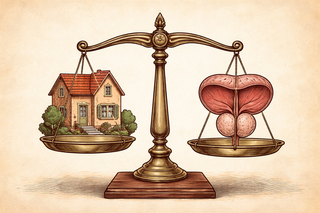
And real life does barge in. Housing is one of those social determinants of health that sounds like public health jargon until you translate it into ordinary language: can you pay rent, keep the lights on, store your medications, get to appointments, sleep without the nervous system doing jazz percussion at 3 a.m.? If the answer is shaky, cancer care gets shaky too. Not because the tumor reads your lease agreement like a villain in a legal thriller, but because the rest of your body and your daily life are trying to fight on twelve fronts at once.
That broader pattern has been building for a while. A 2022 systematic review found that housing-related hardship was usually linked to worse cancer care or outcomes across the cancer continuum (Fan et al. 2022). Another JNCI paper from the same year showed that housing insecurity itself is common among people with cancer, especially among those facing financial strain and other overlapping stressors (Fan et al. 2022).
The Weird Part Is Also the Interesting Part
Here is the bit that makes researchers lean back in their chairs and stare into the middle distance: in this new prostate cancer study, housing assistance was not associated with more workup or more treatment, but it was associated with better survival.
So what gives?
One possibility is that housing assistance helps in ways oncology databases only partly capture. Stable housing may mean fewer missed medications, better nutrition, less chaos around follow-up, fewer emergency spirals, and a little less physiological wear-and-tear from chronic stress. Your immune system is already running a 24/7 security service. It does not need the landlord subplot. Overall survival, after all, includes everything that can kill a person, not just prostate cancer. In older adults especially, the line between "cancer outcome" and "life outcome" is thinner than our medical silos like to admit.
That idea fits with other recent work. A 2023 JAMA Network Open study found that higher state public assistance spending was associated with better overall survival among adults with cancer (Barnes et al. 2023). A 2024 JNCI review of interventions aimed at social needs concluded that the field is growing, but the evidence base is still thinner than anyone would want for a problem this obvious (Graboyes et al. 2024). Translation: everybody can see the fire, but we are still arguing over the hose attachments.
Cancer Care, but With a Map of Actual Human Life
What makes this paper interesting is not that housing somehow replaces oncology. It does not. No one is proposing Section 8 instead of radiation. The point is subtler and, frankly, more unsettling: good cancer care may depend on social policy more than the medical world has been comfortable admitting.
Medicine likes variables it can biopsy, scan, stain, and bill. Housing assistance is messier. It lives in the realm of waiting lists, eligibility rules, rent burdens, and the ordinary dignity of not having your treatment year also become your eviction year. Yet if stable housing nudges survival in the right direction, then it is not some soft side issue. It is part of the treatment landscape, even if it arrives from the Department of Housing and Urban Development instead of the infusion center.
There is something almost rude about that conclusion. We spend so much energy imagining the war on cancer as a battle of clever molecules against rogue cells, and then society walks in and says, yes, but did the patient have somewhere safe to sleep? Thomas Hobbes wrote that life can be "solitary, poor, nasty, brutish, and short." Oncology, on its best days, tries to make it less short. Studies like this suggest social support may help with the other adjectives too.
References
-
Chen KL, Craig TK, Blackford AL, et al. Federal housing assistance, cancer care, and overall survival among older adults with prostate cancer. J Natl Cancer Inst. 2026. DOI: https://doi.org/10.1093/jnci/djag099
-
Fan Q, Nogueira L, Yabroff KR, Hussaini SMQ, Pollack CE. Housing and Cancer Care and Outcomes: A Systematic Review. J Natl Cancer Inst. 2022;114(12):1601-1618. DOI: https://doi.org/10.1093/jnci/djac173 PMCID: https://pmc.ncbi.nlm.nih.gov/articles/PMC9745435/
-
Fan Q, Keene DE, Banegas MP, et al. Housing Insecurity Among Patients With Cancer. J Natl Cancer Inst. 2022;114(12):1584-1592. DOI: https://doi.org/10.1093/jnci/djac136
-
Barnes JM, Johnston KJ, Johnson KJ, Chino F, Osazuwa-Peters N. State Public Assistance Spending and Survival Among Adults With Cancer. JAMA Netw Open. 2023;6(9):e2332353. DOI: https://doi.org/10.1001/jamanetworkopen.2023.32353 PMCID: https://pmc.ncbi.nlm.nih.gov/articles/PMC10481229/
-
Graboyes EM, Lee SC, Lindau ST, et al. Interventions addressing health-related social needs among patients with cancer. J Natl Cancer Inst. 2024;116(4):497-505. DOI: https://doi.org/10.1093/jnci/djad269
Disclaimer: The image accompanying this article is for illustrative purposes only and does not depict actual experimental results, data, or biological mechanisms.