Most cancer stories about RNA splicing focus on the protein-coding parts of a message. Fair enough. That is where the protein recipe lives, and recipes feel important when cells are making terrible life choices. But this new Blood paper goes after the parts scientists used to treat a bit like the packing peanuts of biology: the untranslated regions, or UTRs, sitting at the 5' and 3' ends of mRNA [1].
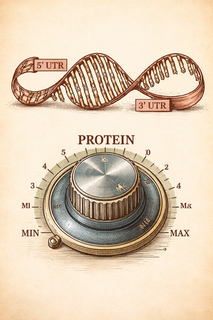
Those regions do not code for protein, but they absolutely boss proteins around. They help decide how much protein gets made, how long an mRNA survives, and where it goes in the cell. In other words, “noncoding” does not mean “doing nothing.” It means biology once gave it a terrible PR team.
Sekrecki and colleagues studied cancers with mutant SF3B1, a splicing factor commonly altered in myeloid cancers, chronic lymphocytic leukemia, and some solid tumors. Instead of only looking for the usual splicing weirdness in coding regions, they systematically checked what mutant SF3B1 does to mRNA noncoding regions. And they found a repeatable pattern across cell lines and patient samples: these mutations rewire splicing in UTRs too [1].
That is the plot twist. The paper says cancer is not just mangling the instructions. It is also editing the fine print.
A mutant that turns the volume up
The standout example was DCAF16. Mutant SF3B1 changed splicing in both the 5' and 3' UTRs of the DCAF16 transcript, and those changes were tied to higher DCAF16 protein levels [1].
That matters because much of the SF3B1 literature has focused on the opposite pattern: bad splicing leading to broken transcripts and loss of function. Here, the mutation acts more like a crooked sound engineer and turns the amplifier knob the wrong way. According to the authors, this is the first reported gain-of-function increase in a target protein driven by oncogenic SF3B1 [1].
If you want the big-picture biology, recent reviews back up why this is notable. SF3B1 is a core spliceosome component, and its mutations have been tied to distinct cancer phenotypes and clinically relevant vulnerabilities, especially in blood cancers [2-4]. Separately, broader cancer work has shown that UTR splicing is not some niche sideshow. It can be widespread and tumor-promoting in its own right [5].
So this paper joins two ideas that were already getting louder: splicing mutations matter, and noncoding RNA regions matter. Put them together, and cancer starts looking less like a smashed engine and more like a hacked control panel.
The therapeutic angle is the fun part, and the serious part
DCAF16 is part of an E3 ubiquitin ligase complex, basically one of the cell’s protein disposal systems. The authors then used DCAF16-co-opting degrader molecules that push cells to destroy BRD4, a protein many cancers lean on. Because SF3B1-mutant cells had more DCAF16, those degrader compounds showed preferential activity in SF3B1-mutant cancers and primary CLL samples [1].
That is a clever move. Instead of trying to fix every strange splice event one by one, the strategy exploits a consequence of the mutation. Cancer built itself a weird dependency, and the drug walks in like it owns the place.
This also fits with a fast-moving drug-development area: targeted protein degradation. Recent studies have shown that DCAF16 can be recruited by molecular glue-like degraders to knock down BRD4, giving this paper’s therapeutic idea a strong chemical-biology backbone [6,7]. In plain English: this is not just a cute lab trick taped together with hope.
Why this could matter outside the lab bubble
The exciting part is obvious. If SF3B1 mutations create a measurable vulnerability, then patients with those mutations might someday get more tailored treatment instead of the usual oncology tradition of “let’s throw a flaming chair at the problem and see what survives.”
But the part worth saying out loud is access. Precision oncology loves to announce a shiny new weakness in cancer. Less often it announces who will actually get sequenced, who will get the drug, who will get enrolled in trials, and who gets left reading the press release like it is a menu for a restaurant they cannot afford. A mutation-specific therapy is only as just as the testing and access system around it.
Still, this paper earns the attention. It expands the map of what SF3B1 mutations do, shows that UTR splicing changes can have real protein-level consequences, and turns that biology into a plausible treatment strategy [1]. That is a solid day’s work for a molecule most people have never heard of.
References
-
Sekrecki M, Sekrecka A, Lattupally RR, et al. Oncogenic SF3B1 mutations alter the splicing of mRNA noncoding regions to induce a novel therapeutic vulnerability. Blood. 2026. DOI: https://doi.org/10.1182/blood.2025029972
-
Yang T, Qian R, Sun X, et al. SF3B1 mutations in spliceosome-driven tumorigenesis: From splicing dysregulation to signaling network rewiring and therapeutic targeting. Biochim Biophys Acta Rev Cancer. 2026;1881(1):189521. DOI: https://doi.org/10.1016/j.bbcan.2025.189521
-
Cilloni D, Itri F, Bonuomo V, Petiti J. SF3B1 Mutations in Hematological Malignancies. Cancers (Basel). 2022;14(19):4927. DOI: https://doi.org/10.3390/cancers14194927 PMCID: https://pmc.ncbi.nlm.nih.gov/articles/PMC9563056/
-
Gajzer DC, Yeung CCS. Significance of SF3B1 Mutations in Myeloid Neoplasms. Clin Lab Med. 2023;43(4):597-606. DOI: https://doi.org/10.1016/j.cll.2023.07.005
-
Chan JJ, Zhang B, Chew XH, et al. Pan-cancer pervasive upregulation of 3' UTR splicing drives tumourigenesis. Nat Cell Biol. 2022;24(6):928-939. DOI: https://doi.org/10.1038/s41556-022-00913-z PMCID: https://pmc.ncbi.nlm.nih.gov/articles/PMC9203280/
-
Kozicka Z, Milbeo P, Osuna Cabello M, et al. Targeted protein degradation via intramolecular bivalent glues. Nature. 2024. DOI: https://doi.org/10.1038/s41586-024-07089-6 PMCID: https://pmc.ncbi.nlm.nih.gov/articles/PMC10917667/
-
Hassan MM, Li YD, Ma MW, et al. Exploration of the tunability of BRD4 degradation by DCAF16 trans-labelling covalent glues. Eur J Med Chem. 2024;279:116904. DOI: https://doi.org/10.1016/j.ejmech.2024.116904 PMCID: https://pmc.ncbi.nlm.nih.gov/articles/PMC11960843/
Disclaimer: The image accompanying this article is for illustrative purposes only and does not depict actual experimental results, data, or biological mechanisms.