That is the punchline from this new colorectal cancer imaging paper: the probe stayed mostly quiet until it hit the exact biochemical weirdness of tumor tissue, then switched on hard enough to help separate cancer from normal tissue during surgery. Rewind a bit, because this is where cancer biology starts acting like a very picky nightclub bouncer with a clipboard.
Not all glowing things are helpful
Surgeons would love a clean visual border between tumor and normal tissue. Real life, naturally, prefers chaos. Colorectal tumors can blend into surrounding tissue, leave tiny satellite spots behind, or make margins look annoyingly respectable right up until pathology says, "actually, no." Fluorescence-guided surgery tries to help by using dyes that glow under near-infrared light, but many currently used probes are basically always on. That means they can glow in the wrong places too, which is not ideal when the whole job is "cut out the bad stuff, keep the useful intestine." [1,2]
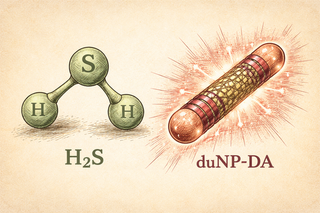
The new paper attacks that problem with a near-infrared nanoprobe called duNP-DA. Instead of glowing all the time like a toddler with a drum set, it uses AND-logic. In plain English, the probe wants multiple tumor-like conditions to be true before it lights up. No conditions, no show. One condition, still no show. Cancer chemistry has to hit the whole combo. [1]
The tumor microenvironment is a sketchy neighborhood
This design leans on a few classic features of the tumor microenvironment. First, many tumors are acidic outside the cell, partly because cancer cells burn fuel in strange, inefficient ways and dump acidic byproducts into the neighborhood. Tumors also rewire sulfur metabolism, and colorectal cancer can produce unusually high hydrogen sulfide, or H2S - yes, the molecule best known for smelling like rotten eggs. Cancer really knows how to commit to a bit. [1,3]
In this study, acidity first flips the nanoprobe's surface charge, which helps it stick to and enter tumor tissue more effectively. Then the probe still refuses to fully fluoresce unless it encounters the next signals: endogenous H2S and lysosomal acidity inside cells. That is the AND gate. The chemistry only cashes the glow check when all the boxes are ticked. [1]
If you think that sounds like molecular overengineering, fair. But cancer is basically a manuscript covered in genomic typos, metabolic edits, and regulatory volume knobs pushed into cursed positions. Sometimes the best response is to make your tool just as picky.
Why this is clever, not just complicated
According to the paper, duNP-DA produced a more than 100-fold fluorescence enhancement at 800 nm after activation. Even more eye-catching, the authors report 100% diagnostic sensitivity and specificity for distinguishing tumor from normal tissue in their study set, and fluorescence intensity tracked strongly with AI-quantified tumor cellularity. That last part matters because it hints the glow may reflect how much tumor is really there, not just whether something vaguely suspicious wandered into frame. [1]
That is the broader promise of activatable probes. Instead of painting every structure with the same fluorescent roller, they aim to read biology in context. Reviews over the last few years have argued that this is exactly where the field needs to go: less indiscriminate brightness, more signal tied to real cancer-associated chemistry. [4,5]
This is also not happening in a vacuum. Other groups have built colorectal imaging systems around H2S-responsive probes, CEA-targeted fluorescent nanoparticles, and CEACAM5-targeted nanobodies for PET plus near-infrared imaging. So the field has been steadily moving from "can we make tumors glow?" to "can we make only the right tumors glow, at the right time, for the right surgical decision?" Which, honestly, is a much more adult question. [6-8]
What this could mean in the operating room
If results like these hold up in larger and more realistic studies, a surgeon might someday get a sharper live map of where colorectal cancer ends and healthy tissue begins. That could help with margin assessment, detection of small residual foci, and maybe those sneaky peritoneal nodules that love playing hide-and-seek with standard vision. Better contrast could mean more complete resections and fewer nasty surprises after surgery. [1,2]
But the usual translation warning label applies. This is not the part where we put on sunglasses and declare victory. Many smart imaging probes look great in preclinical systems and then run into the brick wall of human biology, manufacturing, safety, dosing, timing, regulatory review, and the fact that tumors in patients are rude enough to be heterogeneous. Reviews of fluorescence-guided surgery keep making the same point: the concept is strong, but standardization and real clinical validation still lag behind the hype. [2,4]
Still, this paper has real charm because it exploits colorectal cancer's own biochemical habits against it. The tumor makes the conditions, the probe reads the conditions, and the surgeon gets a cleaner signal. For a disease built from accumulated cellular typos, that is a satisfying plot twist: the very glitches that help the cancer survive may also make it easier to spot.
References
-
Fang L, Ishigaki Y, Huang W, Sakai K, Xu Z, Harimoto T, et al. A Cascade-Responsive AND-Logic-Activatable Nanoprobe for Intraoperative Fluorescence Imaging of Colorectal Cancer. Journal of the American Chemical Society. 2026. DOI: https://doi.org/10.1021/jacs.6c04349
-
Lamme B, Boerma EC, Handgraaf HJM, Vahrmeijer AL, Mieog JSD. Fluorescence-guided surgery in colorectal cancer; A review on clinical results and future perspectives. Eur J Surg Oncol. 2022;48(4):810-821. DOI: https://doi.org/10.1016/j.ejso.2021.10.005
-
Zhang J, Wang X, Ji R, et al. Implications of hydrogen sulfide in colorectal cancer: Mechanistic insights and diagnostic and therapeutic strategies. Front Pharmacol. 2022. PMCID: https://pmc.ncbi.nlm.nih.gov/articles/PMC9841368/
-
Sutton PA, van Dam MA, Cahill RA, Mieog JSD, Polom K, Vahrmeijer AL, van der Vorst JR. Fluorescence-guided surgery: comprehensive review. BJS Open. 2023;7(3):zrad049. DOI: https://doi.org/10.1093/bjsopen/zrad049 ; PMCID: https://pmc.ncbi.nlm.nih.gov/articles/PMC10183714/
-
Wang Y, Hu Y, Ye D. Activatable Multimodal Probes for In Vivo Imaging and Theranostics. Angew Chem Int Ed Engl. 2022;61(50):e202209512. DOI: https://doi.org/10.1002/anie.202209512
-
Chan J, et al. Targeted contrast agents and activatable probes for photoacoustic imaging of cancer. Chem Soc Rev. 2022;51(3):829-868. DOI: https://doi.org/10.1039/D1CS00814B
-
Bi S, Deng Z, Jiang Q, Jiang M, Zeng S. A H2S-Triggered Dual-Modal Second Near-Infrared/Photoacoustic Intelligent Nanoprobe for Highly Specific Imaging of Colorectal Cancer. Anal Chem. 2021;93(39):13212-13218. DOI: https://doi.org/10.1021/acs.analchem.1c02200
-
Xiao Y, Mei C, Xu D, et al. Identification of a CEACAM5 targeted nanobody for positron emission tomography imaging and near-infrared fluorescence imaging of colorectal cancer. Eur J Nucl Med Mol Imaging. 2023;50:2569-2583. DOI: https://doi.org/10.1007/s00259-023-06156-z
Disclaimer: The image accompanying this article is for illustrative purposes only and does not depict actual experimental results, data, or biological mechanisms.