Three little metabolites in urine - glycine, alanine, and citrate - are what make this ovarian cancer study different from the usual biomarker parade, and honestly, that is a pretty wild sentence to get from a paper about prognosis.[1]
In this new Clinical Cancer Research study, researchers looked at pre-operative urine samples from 199 people with newly diagnosed ovarian cancer and measured 149 metabolites using NMR spectroscopy.[1] They did not find one giant neon sign screaming "bad outcome here." Instead, they landed on a compact three-metabolite signature that, when combined with standard clinical information, helped identify which patients were more likely to have shorter progression-free and overall survival.[1] The model predicted 60-month overall survival with an AUC of 0.839, and the highest-risk quartile had substantially worse outcomes than the lowest-risk quartile.[1]
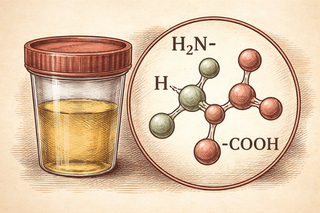
That matters because ovarian cancer is still far too good at showing up late, wearing a fake mustache, and acting innocent. Many patients are diagnosed with advanced disease, when treatment gets harder and the stakes get very real, very fast.[4]
Why a pee test gets people interested
Urine is not glamorous. Nobody writes sonnets about it. But from a clinical perspective, urine has excellent bedside manners. It is non-invasive, easy to collect, repeatable, and a lot less dramatic than biopsies or extra blood draws when someone already feels like a human pincushion.[2]
That is part of why this paper is so appealing. It asks a practical question: can the chemistry your body sheds into urine give your care team a better read on how risky an ovarian cancer is before treatment starts?
Maybe.
And "maybe" is doing honest scientific work there.
Researchers have been chasing better ovarian cancer biomarkers for years because our current tools are useful but blunt. CA125 and HE4 can help, but they do not tell the whole story, and they definitely do not solve prognosis on their own.[4] Reviews over the last few years have kept coming to the same conclusion: liquid biomarkers are promising, metabolomics is especially interesting, and validation is the boss fight nobody gets to skip.[2-4]
What those three metabolites might be whispering
Metabolomics is basically the study of the tiny chemical leftovers and fuel packets cells make while going about their business, or in cancer's case, going about their deeply rude business.[3] Cancer cells rewire metabolism all the time. They burn fuel differently, hoard resources, improvise around stress, and generally behave like tenants who have decided the lease no longer applies.
So when glycine, alanine, and citrate show up as useful signals, that is not random trivia.
Alanine and glycine are amino-acid-related metabolites, and citrate sits right in the citric acid cycle, one of the body's central energy pathways. In plain English, these molecules can reflect how cells are handling fuel, stress, and growth. Ovarian cancer has long been suspected to carry distinct metabolic fingerprints, and newer work in blood-based metabolomics from some of the same research orbit supports that idea: metabolic states can track with surgical outcome and relapse risk, not just diagnosis.[5]
This is where the study gets especially interesting. It is not just trying to say, "Does this person have ovarian cancer?" It is asking, "Which newly diagnosed patients might be headed for a tougher road?" That is a more useful question for real-life care planning.
What could change if this holds up
If this signature proves reproducible in larger, external cohorts, it could become one more piece of pre-treatment risk stratification. Not a crystal ball. Not magic pee. Just a better clinical weather report.
That could mean earlier identification of patients who need closer monitoring, more aggressive treatment discussions, or enrollment in trials aimed at higher-risk disease. It could also help doctors move beyond broad categories like stage alone and toward something more personal. Your tumor's behavior is not always fully captured by what the scan shows or what the surgeon finds in the OR. Biology loves loopholes.
From a patient perspective, that matters more than the stats might suggest. When someone is newly diagnosed, the first phase often feels like being shoved onto a moving walkway you did not agree to board. Any tool that helps the team sort risk more clearly, earlier, and less invasively has real value.
The fine print, because cancer biology never lets us leave early
This study is promising, but it is not practice-changing on day one.[1] It comes from a single clinical cohort and needs external validation. Urine collection, processing, and metabolite measurement all need standardization. And like other biomarker efforts in ovarian cancer, the big question is not whether a signal can be found. It is whether the signal keeps showing up when the lighting is bad, the patient mix is broader, and the real world starts being its usual chaotic self.[2-4]
Still, this is the kind of paper worth watching. Not because it offers a miracle, but because it offers something medicine often needs more of: a simple test, tied to real clinical outcomes, built from biology instead of wishful thinking.
References
-
Funk AM, Brieske M, Schwarz FM, Link T, Jonas S, Wimberger P, Freitag L, Klimova A, Chavakis T, Mirtschink P, Kuhlmann JD. A urinary three-metabolite signature enables non-invasive identification of high-risk ovarian cancer patients. Clinical Cancer Research. 2026. DOI: 10.1158/1078-0432.CCR-25-4260
-
Gentry-Maharaj A, Sharma A, Burnell M, Ryan A, Kalsi J, Karpinskyj C, Manchanda R, Campbell S, Jacobs I, Menon U. Urinary biomarkers for the detection of ovarian cancer: a systematic review. Carcinogenesis. 2022;43(4):311-320. DOI: 10.1093/carcin/bgac016
-
Zhang W, Lai Z, Liang X, Yuan Z, Yuan Y, Wang Z, Peng P, Xia L, Yang X, Li Z. Metabolomic biomarkers for benign conditions and malignant ovarian cancer: Advancing early diagnosis. Clinica Chimica Acta. 2024;560:119734. DOI: 10.1016/j.cca.2024.119734
-
Ghose A, McCann L, Makker S, Mukherjee U, Gullapalli SVN, Erekkath J, Shih S, Mahajan I, Sanchez E, Uccello M, Moschetta M, Adeleke S, Boussios S. Diagnostic biomarkers in ovarian cancer: advances beyond CA125 and HE4. Therapeutic Advances in Medical Oncology. 2024;16:17588359241233225. DOI: 10.1177/17588359241233225 PMCID: PMC10908239
-
Funk AM, Freitag L, Schwarz FM, Link T, Jonas S, Wimberger P, Brieske M, Klimova A, Chavakis T, Mirtschink P, Kuhlmann JD. Exploring translational relevance of baseline and longitudinal metabolic profiling in the blood of ovarian cancer patients. npj Precision Oncology. 2026;10:45. DOI: 10.1038/s41698-025-01193-0
Disclaimer: The image accompanying this article is for illustrative purposes only and does not depict actual experimental results, data, or biological mechanisms.