Molecular imaging has serious dating-app energy: one tracer is obsessed with who is burning sugar right now, the other wants to know who is actually planning a future. In this new phase II trial in triple-negative breast cancer, FDG-PET turned out to be the better matchmaker for early treatment response, while FLT-PET mostly got left on read (Akay et al., 2026).
Triple-negative breast cancer, or TNBC, is the subtype that skips the three big receptors doctors often target in breast cancer. No estrogen receptor, no progesterone receptor, no HER2. From a systems point of view, that means fewer convenient control knobs and more reliance on chemo, immunotherapy, and blunt-force biology. It is effective biology, sure, but not exactly elegant. More emergency patch than polished software release.
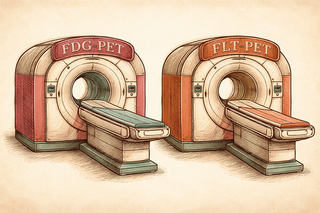
Two Scans Walk Into a Clinic
The study asked a very practical question: after just one cycle of neoadjuvant treatment, can a PET scan tell whether therapy is working?
That matters because neoadjuvant treatment happens before surgery. You are not just trying to shrink a tumor for fun. You are trying to learn, early, whether the current plan is actually knocking cancer off balance or just generating side effects and paperwork.
The researchers compared two PET tracers:
- FDG-PET, which tracks glucose use. Cancer cells often gobble sugar like they are stress-eating during a server outage.
- FLT-PET, which tracks cell proliferation, meaning how actively cells are copying themselves.
In theory, both sound useful. One measures metabolic activity, the other measures growth. In practice, biology loves theory the way printers love working right before a deadline.
FDG Won the Tryout
In the analytical part of the trial, both FDG and FLT cleared the repeatability bar. That is important because if a scan cannot give consistent readings, it is not a biomarker - it is a horoscope with better hardware.
But FDG had better image quality and was more available, so it moved on to the next phase. Then came the key result: after just one treatment cycle, drops in FDG uptake correlated significantly with later MRI findings and, even more importantly, with residual cancer burden at surgery (Akay et al., 2026).
That last part is the big deal. Residual cancer burden is a more nuanced way of asking, "How much trouble is still left after treatment?" And it matters because lower residual burden tends to track with better long-term outcomes across breast cancer subtypes, including TNBC (Yau et al., 2022). Pathologic complete response also matters, but it is not a perfect crystal ball for every trial or every regimen (Conforti et al., 2021).
So this is not just scan nerd trivia. It is an early signal that may help sort responders from non-responders while there is still time to change course.
Why This Is Sneaky Important
MRI is already a major player in treatment monitoring. But this study found FDG-PET after one cycle correlated with residual cancer burden even more strongly than MRI. That suggests PET may be picking up functional change before anatomy has fully caught up.
Which makes sense. A tumor can still sit there looking bulky on imaging while its internal wiring is already failing. Buildings do that too. The lights are still on, but half the circuit breakers have already melted.
This fits with the broader PET literature in TNBC. A 2024 review in European Journal of Nuclear Medicine and Molecular Imaging concluded that FDG-PET is especially promising for predicting response during neoadjuvant treatment in TNBC, though cutoffs and workflows still need standardization (Filippi et al., 2024). Another 2023 study suggested FDG-PET could also help predict outcomes in TNBC treated with neoadjuvant therapy, with or without pembrolizumab, which matters because the immunotherapy era has made the system even more complicated in ways both exciting and mildly rude (Seban et al., 2023).
The Immune Twist
One of the more interesting findings here involved tumor-infiltrating lymphocytes, or TILs. Patients whose TIL levels increased early tended to show a bigger metabolic drop on PET and lower residual cancer burden.
That is catnip for anyone who likes systems biology. It hints that the scan is not just watching the tumor sulk. It may also be capturing the broader neighborhood dynamics - treatment pressure, immune engagement, and whether the local anti-cancer security team has finally been let back into the building.
That matters because TILs already have a growing reputation as meaningful biomarkers in TNBC (Leon-Ferre et al., 2024). The challenge is that TIL measurement still requires tissue, pathology workflows, and human interpretation. A good scan-based early-response marker could complement that picture in a way that is faster and less invasive.
The Catch, Because There Is Always a Catch
This was a small study. Only 22 patients enrolled, and only 14 underwent FDG-PET across both trial parts. That is not enough to rewrite practice on its own. It is enough to justify bigger validation studies, especially in modern treatment settings where chemo and immunotherapy are often combined.
Still, the logic is strong: if you can tell after one cycle that the current plan is failing, you have a chance to adapt instead of waiting months for the biological equivalent of a postmortem.
And that is the real appeal here. Not that PET is flashy. It is not. PET is the engineer in the corner quietly checking system load while everyone else argues about the dashboard theme. But sometimes that is exactly the person you want in the room.
References
-
Akay M, Glendenning J, Tovey H, et al. A Randomized, Phase II Clinical Trial of FLT-PET and FDG-PET for Early Response Assessment of Neoadjuvant Systemic Therapy in Triple Negative Breast Cancer. Clinical Cancer Research. 2026. doi:10.1158/1078-0432.CCR-26-0041
-
Filippi L, Urso L, Ferrari C, et al. The impact of PET imaging on triple negative breast cancer: an updated evidence-based perspective. European Journal of Nuclear Medicine and Molecular Imaging. 2024;52:263-279. doi:10.1007/s00259-024-06866-9
-
Seban RD, Arnaud E, Loirat D, et al. [18F]FDG PET/CT for predicting triple-negative breast cancer outcomes after neoadjuvant chemotherapy with or without pembrolizumab. European Journal of Nuclear Medicine and Molecular Imaging. 2023;50:4024-4035. doi:10.1007/s00259-023-06394-y
-
Leon-Ferre RA, Jonas SF, Salgado R, et al. Tumor-Infiltrating Lymphocytes in Triple-Negative Breast Cancer. JAMA. 2024;331(13):1135-1144. doi:10.1001/jama.2024.3056
-
Conforti F, Pala L, Sala I, et al. Evaluation of pathological complete response as surrogate endpoint in neoadjuvant randomised clinical trials of early stage breast cancer: systematic review and meta-analysis. BMJ. 2021;375:e066381. doi:10.1136/bmj-2021-066381
-
Yau C, van der Noordaa M, Wei J, et al. Residual cancer burden after neoadjuvant chemotherapy and long-term survival outcomes in breast cancer: a multicentre pooled analysis of 5161 patients. Lancet Oncology. 2022;23(1):149-160. doi:10.1016/S1470-2045(21)00589-1
Disclaimer: The image accompanying this article is for illustrative purposes only and does not depict actual experimental results, data, or biological mechanisms.