This study is different because it did not mainly try to blast cancer cells into confetti. It tried to redecorate the tumor microenvironment - the sketchy neighborhood around the tumor where immune cells usually wander in, look uncomfortable, and somehow still fail to shut the place down.
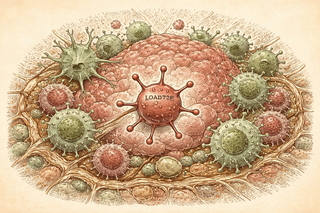
That is the big idea behind LOAd703, an engineered adenovirus injected straight into tumors in the phase I/IIb LOKON002 trial. The virus carries instructions for two immune-activating signals, CD40L and 4-1BBL, which are meant to wake up antigen-presenting cells and T cells inside the tumor’s local ecosystem. In plain English: instead of begging the immune system to care from a distance, the treatment tries to start a loud little riot on site. Cancer, being evolution’s most obnoxiously resourceful side project, often survives by making its surroundings sleepy, suppressive, and hostile to immune attack. LOAd703 is an attempt to change the weather.
Cold tumors, warm excuses
Some tumors are called immune cold because they are terrible at attracting and activating the right immune cells. Pancreatic cancer is one of the grand masters of this trick. It builds dense scar-like stroma, recruits suppressive immune cells, and generally behaves like a nightclub with a fake guest list where T cells are told, "Sorry, not tonight." Reviews over the last few years have argued that if pancreatic cancer immunotherapy is going to work, it probably needs to remodel the neighborhood, not just add another checkpoint inhibitor and hope for cinematic redemption.[2-5]
That is where LOAd703 gets interesting. It is an oncolytic adenovirus, meaning it is designed to infect and damage cancer cells, but its more intriguing move may be the immune engineering. CD40 helps activate antigen-presenting cells like dendritic cells, which are the immune system’s overcaffeinated project managers. 4-1BB gives activated T cells extra survival and functional boost. Put together, the strategy aims to make an invisible tumor less invisible and a passive immune response less passive.[3,5]
What actually happened in patients?
In LOKON002, 41 patients with advanced solid tumors were treated with intratumoral LOAd703 plus gemcitabine-based chemotherapy. Most had pancreatic cancer. The primary goal was safety, and on that front the treatment looked overall tolerable. The most common side effects linked to LOAd703 were fever, chills, and fatigue, mostly grade 1-2, which is not exactly a spa day but is a familiar immunotherapy flavor.[1]
The efficacy signals were modest overall, but not shrug-worthy. Across dose levels, the overall response rate was 0% at the lowest dose, 25% at the middle dose, and 12% at the highest dose. The more eyebrow-raising detail was that all objective responses occurred in pancreatic cancer patients treated in the first-line setting, where the response rate reached 35%.[1] For a disease that usually treats immunotherapy the way a brick treats a motivational speech, that gets attention.
The biopsy data are also doing a lot of the intellectual heavy lifting here. By week 13, the tumor microenvironment showed significant upregulation of Th1 immunity biomarkers, which is exactly the sort of molecular clue you want if your whole sales pitch is "we can turn a cold tumor hot."[1] It does not prove the treatment wins long term. It does suggest the mechanism is not just marketing with a lab coat.
Why this matters, and why nobody should spike the football yet
The appeal of this approach is not only that it may shrink some tumors. It is that it might make stubborn cancers more coachable for other immunotherapies. If you can inflame the tumor microenvironment first, then checkpoint blockade or other immune therapies may have a better shot later. That logic already runs through a lot of pancreatic cancer research, including trials of CD40 agonists and combination immunotherapy strategies.[3-5]
Now for the cold shower. This was a single-arm, early-phase trial with a small sample, mixed tumor types, and no randomized control group.[1] That means we cannot confidently separate the contribution of LOAd703 from chemotherapy, patient selection, or plain old statistical mischief. Evolution loves a false dawn. Cancer researchers have seen many.
Still, this study earns attention because it treats cancer less like a lone villain and more like an ecosystem under bad management. That framing is probably closer to the truth. Tumors do not survive by brute force alone. They survive by shaping incentives, bending local rules, and recruiting helpful neighbors. Very corporate behavior, honestly.
If future studies confirm these signals, LOAd703 or similar therapies could become part of a broader playbook: inject the tumor, inflame the microenvironment, then follow with systemic immunotherapy while the door is finally cracked open. That would not be a magic bullet. Oncology does not hand those out. But it would be a smarter move in the evolutionary chess match.
References
-
Hahn A, Irenaeus S, Sandin LC, et al. Tumor microenvironment gene engineering with LOAd703 in patients with solid malignancies: LOKON002 phase I/IIb clinical trial. Clinical Cancer Research. 2025. DOI: 10.1158/1078-0432.CCR-25-4396
-
Musher BL, Rowinsky EK, Smaglo BG, et al. LOAd703, an oncolytic virus-based immunostimulatory gene therapy, combined with chemotherapy for unresectable or metastatic pancreatic cancer (LOKON001): results from arm 1 of a non-randomised, single-centre, phase 1/2 study. Lancet Oncology. 2024;25(4):488-500. DOI: 10.1016/S1470-2045(24)00079-2
-
Ullman NA, Burchard PR, Dunne RF, Linehan DC. Immunologic Strategies in Pancreatic Cancer: Making Cold Tumors Hot. Journal of Clinical Oncology. 2022;40(24):2789-2805. DOI: 10.1200/JCO.21.02616 | PMCID: PMC9390820
-
Padrón LJ, Maurer DM, O'Hara MH, et al. Sotigalimab and/or nivolumab with chemotherapy in first-line metastatic pancreatic cancer: clinical and immunologic analyses from the randomized phase 2 PRINCE trial. Nature Medicine. 2022;28(6):1167-1177. DOI: 10.1038/s41591-022-01829-9
-
Farhangnia P, Khorramdelazad H, Nickho H, Delbandi AA. Current and future immunotherapeutic approaches in pancreatic cancer treatment. Journal of Hematology & Oncology. 2024;17(1):40. DOI: 10.1186/s13045-024-01561-6 | PMCID: PMC11151541
Disclaimer: The image accompanying this article is for illustrative purposes only and does not depict actual experimental results, data, or biological mechanisms.